essays, faith, Mental health, queer

For those whose bodies are policy issues: A defense of online church

Today, there is much discussion on embodiment, what it means to show up in a space as your full self, and to be present in your body wherever you are. The topic du jour, in particular, is church attendance. Can we experience the “real” church online?

This got me thinking about how if you’re going to talk about embodied presence, you need to be aware of what it means for someone to show up in their marginalized body, whether in a physical or online space. The risks it takes and the emotional cost it demands.

Continue reading “For those whose bodies are policy issues: A defense of online church”
essays, faith

Homesick

Homesickness is a funny kind of illness. It sort of hurts all over. In your throat when someone asks the wrong question at the wrong time. In your lungs when a reminder of what you’ve lost takes your breath away. In your core when there’s the gut-punch of knowing what you long for may never come to pass. There’s a desperation to it, when hope and grief intertwine into an ache.

Someday, we know, someday, as our seasonal songs tell us: “The blind will see, the deaf will hear, the dead will live again.” Another tells us, “Chains shall he break, for the slave is our brother! And in his name all oppression shall cease!”

Luke 21:25-36 tells us to be on guard, for your redemption is drawing near. But we wait, we long for the time when all shall be made right, when there will be no more tears or death, no more oppression, or haves and have-nots, no more pandemics or natural disasters or injustice… when the upside-down Kingdom of God comes on earth as it is in heaven.

We wait. We hope. We long, with the deep groaning of the Spirit within us when words fail. It hurts, God. Life hurts so much.

Continue reading “Homesick”
faith, Poetry

The Remodel

Photo by Kelly L on Pexels.com

Deconstruction not as in Derrida

But baseboards pulled gently,

Carefully, finished by small hands

Decades long past


Cabinet doors stacked on the floor

You never know what you’ll reuse

Standing back, hands on hips

Deep in imagining


Burn the shoebox of him

and loss and the road not taken

Except the teddy bear

You place to the side.


Fill up the bags of clothes and sheets

Cry as you pull in to the shelter

Hand over the memories

Hoping it will help 


a fresh start

To begin

That’s what we need

To tear it all down and click Refresh

Deconstruct every assumption

The sofa’s never been over there

What if we let some light in

Build a shelf for the keepsakes


Some porcelain smashed and an exhale

Some wrapped to store away

No longer on display

But part of you all the same


Grateful for what brought you here

But not caged by it

Hammers to demolish

and to drive the tiny nail


20-odd years and it’s time for change

Ideas and patterns

The fabric that holds you,

Shades in the colors of life


Each brick and paving stone 

Handled one by one

Reconsidered and examined

To determine its place


What if, what could be

What has been here all this time

And you didn’t even know it

Growing resilient new life


Who would have thought

Destruction could be this

This beautiful, this curious, 

This wonder-full

After, when you’re covered in sheetrock

And you’ve cried it out 

And the tarps cover the floor

It begins. Hope.

Stand up from the bathroom floor

And you see it in the reflection

What if… What if that were there

Pieces fall into place


One day, home looks familiar again

Different, so much different

But more you, somehow, 

More who you’ve always been.

You’ve become. 

Now that it’s in motion, unraveled

It keeps going

Evolving


Deconstructing and reconstructing

Not as in podiums and dusty studied texts

But as a heart pumps blood,

As the soul beckons you home. 

faith, queer, resources

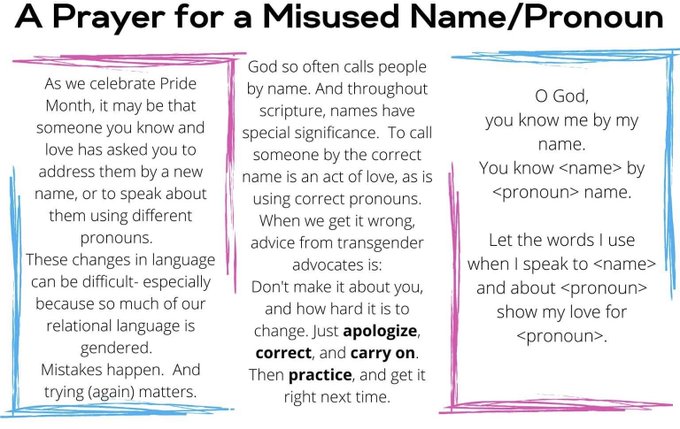
A prayer for a misused name/pronoun

By Rev Naomi Miller, Church of the Apostles, Guelph. Thank you, Rev. Miller, for letting me share this here!

Image description: As we celebrate Pride Month, it may be that someone you know and love has asked you to address them by a new name, or to speak about them using different pronouns. These changes in language can be difficult–especially because so much of our relational language is gendered. Mistakes happen. And trying (again) matters. God so often calls people by name. And throughout scripture, names have special significance. To call someone by the correct name is an act of love, as is using correct pronouns. When we get it wrong, advice from transgender advocates is: Don’t make it about you and how hard it is to change. Just apologize, correct, and carry on. Then practice, and get it right next time.

O God,

You know me by my name.

You know <name> by <pronoun> name.

Let the words I use when I speak to <name> and about <pronoun> show my love for <pronoun>.

asexuality, essays, faith, queer

Side A. Celibate. Asexual. Queer.

Asexuality is not the same as celibacy. Lots of asexual people do have sex. Asexuality is about attraction, not behavior.

I am also celibate. I consider this a calling in the sense that God made me sex-averse intentionally and for a reason.

Not all asexual people are sex-averse.

My understanding of this vocation is different from those who typically get the microphone in regards to celibacy, talking about a traditional understanding of what gay people must do with their sexuality to be “orthodox.”

I’m Side A. How does this work?

Celibacy should be for those who are personally called to it. It should not be in any way related to your orientation. Straight, bi, pan, queer, ace, gay, whatever… you can be called to celibacy.

Important: This also has nothing to do with anyone else. It’s you and only you.

Side A theology doesn’t reserve any specific restrictions on any orientation. We are all one in Christ Jesus and each individual part of Christ’s body has its own calling. This is why I’m all over the podcast land as a celibate ace telling you to create your own sexual ethic.

Can you be Side A and celibate? YES. There is no sexual liberation without the choice not to have it. Side A doesn’t mean you personally feel called to have sex. It means the Bible is fully affirming of queer relationships and identities including the choice to have sex. Or not!

If anyone tells you you have to be Side B if you’re called to celibacy, here is your sign that that’s a lie. It’s about belief and biblical interpretation. Not behavior.

Stuff like this is why the church needs asexual leadership. We have the vocabulary for this. We need more Christian aces affirmed and heard. We need the church to understand the difference between attraction, behavior, desire, and vocation. Aces can lead. We’re worthy and called.

Remember: We aren’t new. Just erased. Just today I ran across a blog on a queer Christian website acknowledging asexuality as a queer orientation. It was written 21 years ago. We’ve been here. You just haven’t been listening or haven’t had the opportunity because of gatekeeping.

We’re in your churches. We may not know the label (though that’s changing as awareness grows), but we’re there. We might be partnered. But some of us are happily single, and we might be celibate and/or sex-averse. And we have words to describe that array of sexuality and desire.

Give aces a voice and you’ll discover so many keys to this beautiful diversity of God’s kingdom. We can help those called to celibacy and unite in our common goals. We can support singles who need help accepting their vocation to singleness.

We also face queerphobia, often recycled arguments used against bi or pan or gay and lesbian people are used against us, right here on this website every damn day and in churches and elsewhere.

Asexuality is so difficult to see because it is not only against traditional understandings of sexuality (heteronormativity) but also against the assumptions that we can sub in different genders into that traditional understanding (all have sexual attraction = allonormativity).

Asexuality is compatible with the Bible (and so is celibacy) but runs counter to “traditional Christian teaching” that emphasizes being created for heterosexual marriage, aka a lifelong sexual relationship, implying that God gives everyone attraction. So while asexuality and celibacy aren’t the same, we do have shared history.

Theology that only says same-sex marriage is ok without seeing vocational singleness and/or celibacy as holy too is missing it just as much as those who demand celibacy is the only “orthodox” answer for queerness. Both are missing the parallel diversity the ace community provides.

(Meaning that for centuries, asexuality has had to work out whether it is only for those not interested in the acts of sex, behavior, or for anyone without attraction, regardless of behavior. We landed on the latter in recent years. More on this elsewhere.)

So do I need Side A theology for my “pet sins”? Am I just capitulating to the culture to sleep with whoever I want? Am I Side A because celibacy is too hard? Am I going along with sexual trends of “the world”? Nope. I’m ace, single, and celibate. But I’m Side A because I’ve seen the good fruit when everyone is allowed to live out their own unique, God-given identities and vocations and behavior. Asexuality is a form of queerness that reveals anything is possible when we discard the narrow roles normativity would place on us.

So don’t devalue my calling by claiming it’s tied to orientation. Don’t perpetuate myths about asexuals by claiming it’s just “not having sex” or the same as celibacy. That’s not it. But aces and celibate people do have a lot of overlap and goals in common. It’s time to work together, fully affirming each other’s callings.

More on asexuality here.

faith, queer, resources

Queer theology and the Bible

Usually, when someone becomes affirming, it is because they have seen the bad fruit of non-affirming theology. They know you can judge a tree by its fruit, and the fruit of the Spirit are useful tools for discernment. They usually know someone who is queer or know of them in some circle of proximity. They want to love their neighbors, and see that God is love, and can no longer support the theology of fear, hate, exclusion, suffering, and death they have previously been told is correct. They have usually had some sort of awareness (whether through gender or abuse or promises that never panned out or science or a thousand other things) that what is “traditional” in the church is not always what is faithful, best, or loving. At some point, they have to ask, “Is this really what the Bible says about LGBTQIA+ people? Is this really what God wants for his people and his church? If this is orthodoxy, what does that say about the gospel? Can I keep my faith and love my neighbor?”

Continue reading “Queer theology and the Bible”
aromanticism, asexuality, faith, queer, resources

Queer podcasts

A few podcasts around queerness, queer faith, and aromanticism and asexuality. For my own podcast appearances, see Podcasts.

Queer – general

Queer Christian

Search for these on your favorite podcast-listening platform!

faith, Poetry

Welcome home

Welcome, welcome to the wandering
I was once welcomed
And here you are too

Take a tea or a coffee.
There is no brochure
You’ve left rulebooks behind

It’s the wilderness, yes,
And it feels so alone
But look around! There’s a caravan

Wagons and timbrels
The young and the wise
We’re all growing

Welcome, you’re welcome
Don’t be ashamed
It’s never too late or too early

You’re not behind
There’s no supply list
No one leader or route.

You’ll wander awhile
Take your time
You’ll settle in, no rush.

One day you will welcome
One day you’ll be the guide
But we’re all just evolving

Take out your tools
Get down to the bones
Clean out and start anew

Remember it’s yours
Not anyone else’s
Only you know what to be

It’s not the destination
Or a linear line
There is no success or perfection

Holiness wanders
Righteousness blooms
Hunger and thirst are rewarded

Belonging comes in
When you least expect it
Exploration through yeses and noes

Find your path
Find yourself
Find freedom out here

The wilderness
welcomes you
home.

faith, interview

Women of Valor – Mary Magdalene

I had the great privilege of joining my friend Kelly Wolfe on her blog, Let It Matter, this week discussing Mary Magdalene. We have a video of our conversation on her blog as well as a transcript for you to read. We discuss the way she’s been treated by church history, biblical interpretation, how fandom culture can help us with theology, and the way women of the Bible provide a unique perspective on the gospel story.

“These women that have been through hell that are the ones recognizing Him, not just as a man, and not just as a teacher, or as a leader, but as God.”

“The better you understand fandom culture, the better you can engage with theology. And Mary has been mythologized for 2,000 years so there’s an awful lot of fandom culture around Mary Magdalene to deal with. She has been a saint, a prostitute, a wife of Jesus, a preacher, to the feminine side of Christ, there’s all sorts of things that have her in very odd positions in France as a hermit.”

“This is why it’s so vital that we are examining our own biases. We’re examining our own agendas coming into the text, we’re engaging in scripture itself, and we have to question what we’re absorbing from, sermons, podcasts, books, cultural references, music, art, even very old art. Read what’s there and notice what’s not.” 

Read more or listen to our conversation here!