
Thank you to all our aromantic and asexual Jesus-loving folks who participated this summer’s interview series! Here is a list of all of the posts in this series:
Category: aromanticism
Get to know a-spectrum Christians: Blue Ice-Tea
As aromantic- and/or asexual-spectrum Christians and Jesus-adjacent people, it can be hard to believe that we are not alone. There are few examples of us in queer Christian spaces speaking about our experiences, not to mention the broader queer or Christian/faith worlds in general. I want to do my part to change that with this website and connect you with more a-spectrum Christian and Christian-ish people across the internet. This summer, I’m hosting a short Q&A series. This is the last interview for this year. I’ll post a round-up list for easy linking soon!
1. Hi! We’re so glad you’re here. Can you introduce yourself to the Invisible Cake Society with your name, pronouns, any identity labels you feel like sharing?
Hi, my name is Blue Ice-Tea (“Ice” for short). As a genderless woman, I’m never sure how to answer “pronouns” questions; most people in real life use “she/her” for me, but online people often use “they/them”. I’m heterosexual, demisexual, and platoniromantic (which is a subtype of quoiromantic). I sometimes use the labels “cis-genderless” or “gender-detached”, or you could just say I don’t have a gender identity. I’m also a white-passing Canadian of mixed European and (West) Indian ancestry.
2. What do you like to spend your time doing, online or in person, creatively and/or professionally?
As you might guess from my blog, I love movies! I also love books and music, and I’ve dabbled in art and creative writing. Unfortunately, I don’t have as much time as I’d like for any of them. At different times in my life, I’ve been into different things: dancing, choir, TTRPGs, and, of course, blogging. Regardless of what I’m doing, though, I try to prioritise spending time with my friends. Watching movies with my friends is probably my favourite thing to do.
3. When did you hear about aromanticism and asexuality, and when did you realize they described you?
I first heard about asexuality when I was in my early 20s–more than 20 years ago, now! I’d actually used the word “asexual” to describe myself once before that, but I wasn’t sure the label was really accurate. When I discovered the asexual community (specifically, AVEN), I started following and participating in it, but I didn’t feel I truly belonged to it until I discovered the word “demisexual” (about 15 years ago). Now I comfortably describe myself as “demisexual” or “ace”.
I’ve always had a conflicted relationship with the “aromantic” label. I don’t experience feelings I consider “romantic”, but I also wouldn’t say I don’t experience romantic feelings. It’s just that the feelings other people label romantic, I consider platonic! This has caused me a lot of confusion over the years, but eventually I discovered the label “platoniromantic”, which means “not distinguishing between romantic and platonic feelings”, and that fits me very well!
4. What’s your faith background and how would you describe your relationship with religion/spirituality/faith today?
I was raised Presbyterian (a kind of Protestant), and growing up I regularly attended church, Sunday school, and youth group. As an adult, I’ve gone to various kinds of churches, including Methodist, Anglican, and Lutheran. My faith was also shaped by popular media: writers like C. S. Lewis, J. R. R. Tolkien, and G. K. Chesterton, and TV shows like Touched by an Angel and Veggie Tales. I went through a period of questioning in my teens, but I’ve never really drifted away from the faith, and I still go to church every Sunday. I believe in God, and my relationship with him is deeply important to who I am.
5. How has your a-spec identity influenced your personal faith?
I think being ace gave me a lot of unfair advantages growing up. The Christian spaces I grew up in were pretty conservative: no sex before marriage, and marriage was only between one man and one woman. These were not very friendly messages for queer people, and they were hard on a lot of straight people, too. But as an ace person, the rules seemed fairly easy. And–especially before I realised I was ace–I didn’t understand why other people had such problems with them. It was easy to be complacent and judgemental. As an adult, I’ve had to work to overcome that and become a better ally to allos, especially queer ones.
The flip side of that is that I didn’t feel the same discomfort in Christian spaces as a lot of people do. For me, Christian spaces were actually more comfortable than a lot of others, because there was less emphasis on sex. As a result, I stayed in the church at an age when a lot of people drift away. I don’t think that was a very good reason, but I am grateful things worked out that way, because the older I get, the more I feel the need for faith in my life. I hope that, as churches become more welcoming and inclusive places, more people will feel comfortable staying in them.
6. How has your a-spec identity affected your relationship with religious or spiritual communities?
Oops, I guess I covered that already!
7. How has your faith affected your relationship with the a-spec or larger LGBTQIA+ community?
I don’t think it’s affected my relationship with the ace community. But coming from a religious background is part of the reason I didn’t engage much with queer spaces when I was younger.
8. Does your a-spec identity impact your gender identity? Or vice versa?
I’ve heard that ace people seem to be less likely to identify with gender, but I can’t say how those things are related in my own case. I also suspect that genderless allosexuals may be more common than we think. I think more research needs to be done in this area.
9. What should all a-spec Christians know?
For ace Christians who grew up in conservative churches, it can be easy to think we must be doing something right because we don’t face the same sexual temptations as those around us. It’s especially easy when we don’t know that asexuality exists. I would like all ace Christians to know that they are ace, that sexual attraction is real, and that if we don’t understand other people’s sexual urges, that’s not because we’re better or because they’re lying; it’s just because we have different sexual orientations and that doesn’t make us better or worse than anyone else.
10. What do you want the larger affirming LGBTQIA and ally Christian community to know about a-spec Christians?
I don’t know if there is anything specific. Obviously, I want everyone to know that ace and aro Christians are real and valid.
11. At Invisible Cake Society, we highlight experiences that have been erased or seem invisible to those outside of them. What’s your favorite way to show your a-spectrum Pride?
I actually don’t show much Pride! I don’t wear an ace ring, and I have hardly any ace merch. I don’t particularly want most people to know about my aceness. I think ace visibility is very important, though, and so I’ve done what I can to educate others about asexuality. I’ve written for AVENues, I focused on asexuality when I was doing my master’s degree, and I obviously write about it on my blog. I like that long-form writing allows me to get into the details and nuances of asexual experience, which can be hard to do in conversation.
Honestly, the time I feel most “proud”–or maybe just comfortable–being ace is when I’m around friends who accept me and value me in my aceness. By which I mean that they accept and value me as a single person who prioritises platonic relationships, and they don’t expect or pressure me to pursue a romantic or sexual relationship.
12. Do you have a favorite example of a-spec representation (whether explicitly stated or not) in media, books, public figures, theater, etc.? What about them resonated with you?
Luke Skywalker’s sexuality is open to interpretation, but his story has been deeply important to me as an ace person. In the original Star Wars trilogy, he never really has a romantic interest, and a lot of his story is instead driven by his relationship with his friends. When I was a child and adolescent, he was one of the only examples I had of a human adult protagonist who was single and happy. In most other stories, the hero’s “happy ending” was equated with finding a partner, and if they ended up single, then the ending was considered unhappy. But Luke’s story ends with him saving his father and reuniting with Han and Leia, and the fact that they are a couple and he’s single doesn’t seem to bother him at all. I could joke that Luke “turned me ace”, but what I really mean is that he gave me permission to be ace–that is, to imagine myself having a life full of love and meaning even if I didn’t have a romantic partner. And, although I have a lot of complaints about the sequel trilogy, I’m really glad they kept Luke single and continued to focus on his platonic relationships.
For a much more recent example, the film Project Hail Mary really resonated with me, not just because one of the characters could be read as ace, but because the film really seems to validate the celibate, friendship-focused lifestyle in a way few movies do.
13. Anything else you want readers to know?
Don’t think so.
14. Where can they follow your work online?
At my main blog, Ace Film Reviews, or my X-Files blog, The Realm of Asexual Possibility.
Get to know a-spectrum Christians: Destiny DiMattei
As aromantic- and/or asexual-spectrum Christians and Jesus-adjacent people, it can be hard to believe that we are not alone. There are few examples of us in queer Christian spaces speaking about our experiences, not to mention the broader queer or Christian/faith worlds in general. I want to do my part to change that with this website and connect you with more a-spectrum Christian and Christian-ish people across the internet. This summer, I’m hosting a short Q&A series.
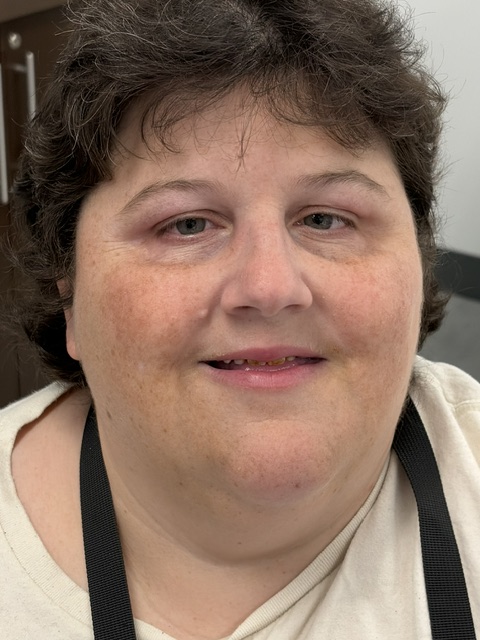
1. Hi! We’re so glad you’re here. Can you introduce yourself to the Invisible Cake Society with your name, pronouns, any identity labels you feel like sharing?
Hi, my name is Destiny DiMattei, my pronouns are she/her and they/them. I’m asexual, genderqueer, fat, disabled, and white. I haven’t decided on my label for my romantic orientation, but for me, the lines between romance and friendship are hard to define. Especially once you take sex out of the picture.
2. What do you like to spend your time doing, online or in person, creatively and/or professionally?
Professionally, I work as a peer recovery specialist at On Our Own Inc. Baltimore, and I’m working on getting my peer recovery specialist certification. I’m also getting certified as a body trust provider, and I’m a certified Body Image Coach. I am also a coleader of Body Liberation Baltimore. I also love doing activism, and when I can, I get involved with my local Baltimore chapter of Democratic Socialists of America. Creatively, I love to swim, watch horror movies, listen to podcasts (especially horror audio dramas), and hang out with friends. I’ve also recently got into ceramics. I’m hoping to get good at making human figures and dolls. I also love to create songs, and I consider myself a bit of a storyteller because I love making up scary stories. I need to start writing them down, but I hate writing. lol
3. When did you hear about aromanticism and asexuality, and when did you realize they described you?
I don’t remember when the exact year was, but it was in my mid 20s. I was thinking about me trying to date and how I was dreading getting closer to people because I didn’t really want to have sex with people and someone asked me if I considered that I might be asexual. I went into the rabbit hole of research and discovered that this is me. Before that, I thought I was just waiting till marriage like some Christians do, even though that wasn’t a whole thing with my faith. My family never pushed that on me anyway. It was only after reflecting that I realized that was just my out.
4. What’s your faith background and how would you describe your relationship with religion/spirituality/faith today?
I grew up Catholic, thanks to my granny. She loved the Catholic Church because of the sacraments, but she didn’t agree with everything, especially their thoughts on divorce because she’s remarried a few times. My granny isn’t the most LGBT inclusive, but she is better than some. Now after researching and realizing problems with the Catholic Church, I still have a connection with the Catholic faith, but I say I’m Catholic-ish. I’ve started attending an independent Catholic Church and I’m exploring other methods of spirituality. Now my only goal is to take my new understanding of what mainstream Christianity got wrong from an intellectual thought exercise to trying to develop a personal relationship with God.
5. How has your a-spec identity influenced your personal faith?
I don’t really know how to answer that. Purity culture was not stressed too hard in my family, but I would hear it in music. It was always also just talks about families and having kids and all that, but I was never expected to live up to that because I’m disabled. As time went on, however, I realized that being ace doesn’t change that I’m a child of God. I think the divine knows me and loves me as I am. I truly believe that. I feel like there needs to be more support for ace Christians, who are living single lives or in the nontraditional relationships.
6. How has your a-spec identity affected your relationship with religious or spiritual communities?
I left Roman Catholic churches because I was afraid if they got to know me and I started talking about being asexual and open to romance from either gender that I might be rejected. I found an LGBT-inclusive Independent Catholic Church called Our Lady, Undoer of Knots, which is part of Dignity USA. It’s the Baltimore chapter. The only thing that kind of sucks is the priest talks about sometimes that the LGBT community was virtually just gays and then bis and trans entered, and now it’s the whole alphabet. This kind of joke makes me a little mad sometimes. I feel like asexuality is still a mostly invisible orientation.
7. How has your faith affected your relationship with the a-spec or larger LGBTQIA+ community?
I’m very careful about who I share my faith with in the general LGBT community because there are some people that I’ve known who have had religious trauma. That’s the main thing I’ve noticed. My faith is pretty important to me, and sometimes I do educate when Christianity comes up about the more progressive and accepting version of things, but sometimes I feel alone in that effort.
8. Does your a-spec identity impact your gender identity? Or vice versa?
I don’t really think so. All I know is I figured out ace first before I started thinking about questioning my gender identity.
9. What should all a-spec Christians know?
They should know that they are all beloved children of God and that your identities are valid.
10. What do you want the larger affirming LGBTQIA+ and ally Christian community to know about a-spec Christians?
The larger community should know that ace Christians share things in common with the wider community, but there are some differences. For ace Christians, it’s harder to find love if they want love, and marriage might not be in the cards. Also for disabled queer Christians, marriage might not be possible, especially if they’re worried about benefits, such as Social Security, Medicare, and Medicaid. Queer marriage cannot be the end all be all when it comes to LGBT inclusion and affirmation in the church. Maybe a commitment ceremony of QPRs or recognition of polyamorous couples would be a beneficial celebration of queer friendships, and more support for single people as well. If an ace person does get married (either because of love or convenience and necessity) support them as well.
11. At Invisible Cake Society, we highlight experiences that have been erased or seem invisible to those outside of them. What’s your favorite way to show your a-spectrum Pride?
I have an ace queer T-shirt that a friend from an ace meetup helped me make. I also try to go to ace meetups and just share things about myself. I also recommend my favorite podcasts, which two of them have ace main characters.
12. Do you have a favorite example of a-spec representation (whether explicitly stated or not) in media, books, public figures, theater, etc.? What about them resonated with you?
I love the Magnus Archives podcast because of the horror and the ace representation.
13. Anything else you want readers to know?
Nothing that I can think of. I’m so happy to hear about other ace Christians out there.
14. Where can they follow your work online?
I’m not very active online, but I do have a few social media things you can follow me on. I used to have TikTok, but I don’t use it anymore. My Facebook is Destiny DiMattei, and my Instagram. If you search my name, I should come up as well. I also am coleader of a Facebook group called Body Liberation Baltimore. I also just recently created my own Instagram for when I start up my coaching practice eventually. It’s a slow work in process, but it’s called ShrinklessCoach.
Get to know a-spectrum Christians: Gena Thomas
As aromantic- and/or asexual-spectrum Christians and Jesus-adjacent people, it can be hard to believe that we are not alone. There are few examples of us in queer Christian spaces speaking about our experiences, not to mention the broader queer or Christian/faith worlds in general. I want to do my part to change that with this website and connect you with more a-spectrum Christian and Christian-ish people across the internet. This summer, I’m hosting a short Q&A series.
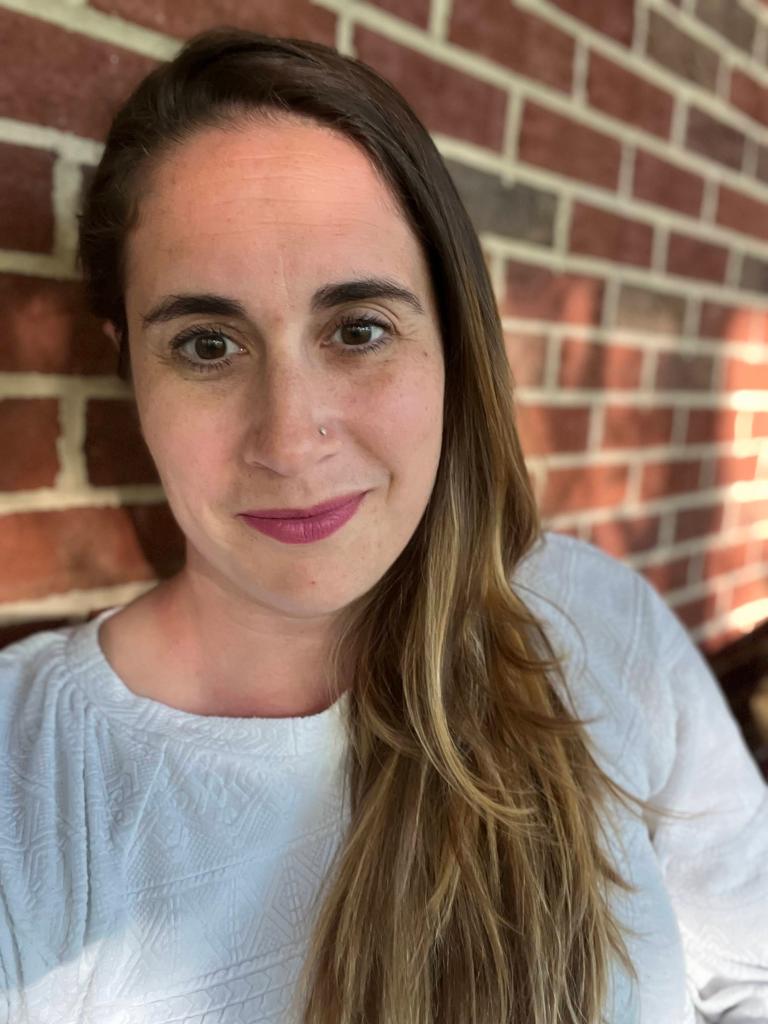
1. Hi! We’re so glad you’re here. Can you introduce yourself to the Invisible Cake Society with your name, pronouns, any identity labels you feel like sharing?
My name is Gena Thomas, she/her, and I am a demiromantic ace.
2. What do you like to spend your time doing, online or in person, creatively and/or professionally?
Writing is my intuition. Watching my kids play sports is my favorite source of entertainment these days. Playing rec sports (volleyball recently and now softball) is probably entertainment for others, and volunteering with Indivisible (the No Kings protest organization) keeps me sane in this political environment.
3. When did you hear about aromanticism and asexuality, and when did you realize they described you?
I had heard about asexuality several years ago, but it wasn’t until I was doing some research for a piece of fiction that I really understood the difference between romantic and sexual attraction—and therefore aromanticism and the spectrum of asexuality. I was in my late 30s when I realized that this was an identity that described me. Because I didn’t understand that attraction is not just attraction, but has types, I had no framework to question my struggles with sex except for purity culture and what doctors told me was a typical low sex drive for women. So for a very long time, I felt abnormal, off, and weird without believing I was and am fearfully and wonderfully made.
4. What’s your faith background and how would you describe your relationship with religion/spirituality/faith today?
Growing up in a Pentecostal church, I never really knew a day without Christ in my life, and while there is religious trauma I’m working through, I’m grateful that I was introduced to Christ at such a young age and have always believed in being like Christ. As an adult, I moved around to different evangelical churches, but never really found a denominational home especially as I deconstructed and began reconstructing my faith. Now, I attend a United Methodist church and it has been such a great fit for me theologically. Faith has always been such a huge part of who I am, and I’ve found a place where I not only feel like I belong in this moment but feel like there’s space to grow without being judged for how that evolving takes shape as I continue to reconstruct.
5. How has your a-spec identity influenced your personal faith?
Love Beyond Sex, a book I’m currently working on, is my attempt to answer this very important question. When you grow up believing that queerness is sin, it’s a long road to loving your queer self. Especially when you identify as the identity that feels like one of the most queer in the queer community because it pushes the boundaries of what sexual liberation actually is. That is, can sexual liberation include not wanting sex or only wanting it under certain circumstances — and I have you, Jenna, to thank for seeing asexuality so clearly through this lens.
I’m often so grateful that I became an affirming Christian before I realized I was ace. It was like the Spirit was guiding me on a journey of truly learning to love others as a way of leading me back toward fully loving myself. I’ve often heard the phrase, “You can’t give what you don’t have” as a way of communicating the need to love oneself first before loving others. But I think it goes both ways. Sometimes you can’t have what you don’t give. For me, making space for queerness in my theology first resulted in me being able to ask myself the courageous questions about love and sex and attraction. I never had to personally ask myself the very unjust question that many queer people are asking: Does God still love me? My expanded faith opened up the path to immediately know the answer to that question the moment I saw my ace identity: Yes, always and forever, God loves me.
6. How has your a-spec identity affected your relationship with religious or spiritual communities?
Even as an affirming person of faith in a church whose values were more conservative than my own, I felt OK staying put for other reasons. But when I started feeling the need to really show up authentically, it felt impossible to stay at an evangelical church. If people began talking about “those queers over there,” they were talking about me whether they knew it or not. For my own spiritual health, it was time to leave. But to be honest, I miss the people there and our shared values. It was a multiethnic church, and it stretched me in ways that a monoethnic church cannot.
On the other hand, in working on the book, I’ve been privileged to meet many Christian aces across the world, and even though many of my interactions with them were specific to a survey or a short video interview, just knowing them feels like its own sense of belonging. From these interactions came this concept of eternal identity that I talk about in my book:
From the moment I began to belong to this word, I also began to belong to the community—past, present, and future—behind that word. The word became flesh, and yet, it had always been flesh—always been right there in my bones, in my blood, in my marrow. And in the world around me. The meaning of the word has existed from the beginning. It was created, just as the stars and the grass were created. It’s much easier looking back to see its eternality. … because of my experience with the weight of the word asexual, I now grasp how something can exist before our understanding of it. I better understand how a personhood, an identity, can bring with it life and light. I better understand how words take on flesh and that a moment or series of moments can change the trajectory of our lives. I understand how one word can bring with it both the heaviest sense of darkness and simultaneously the most piercing, bright light. The word asexual was made flesh for me, and everything came into light because of it.
7. How has your faith affected your relationship with the a-spec or larger LGBTQIA+ community?
I’m not sure it has.
8. Does your a-spec identity impact your gender identity? Or vice versa?
No, it doesn’t.
9. What should all a-spec Christians know?
If you are ace and your Christian community is making you ask of yourself, “Does God love me as I am?” that question is unjust. It’s a reflection of your community that it would cause you to ask the question. It is not a reflection of you. Yes, always and forever, God loves you as you are. And there are churches and/or spiritual communities that can and are ready and willing to affirm that in you.
10. What do you want the larger affirming LGBTQIA+ and ally Christian community to know about a-spec Christians?
We may be the last letter in some of the acronyms and not in others, but we exist. Please take the time to ask us questions and learn from us. True inclusivity requires mutuality and just respecting our presence isn’t the end goal. We need allies too. We need awareness too. And that goes both ways. As aces, we need to constantly ask ourselves: who are we leaving out? Who are we merely respecting but not learning from?
I truly believe the ace community has much to teach the Church, as I wrote about in my article under my pen name at Red Letter Christians, but I hope that more and more, we can see resources, white papers, and theological articles at queer and ally Christian spaces on asexuality. There are too few.
11. At Invisible Cake Society, we highlight experiences that have been erased or seem invisible to those outside of them. What’s your favorite way to be visible?
Writing: it’s actually how I become visible to myself first and then beyond myself to the world around me.
12. Do you have a favorite example of a-spec representation (whether explicitly stated or not) in media, books, public figures, theater, etc.? What about them resonated with you?
I really enjoyed the ace characters in Elatsoe and The Charm Offensive. While both main characters are ace and both have aspects that really resonated with me, it was reading them both near each other that helped me see the ace spectrum come alive.
When I can, which has not been much lately, I jump into a piece of fiction I’ve started that follows the life of a 20-something ace. Her name is Mattie and she’s helped me process a lot myself: a family history of breast cancer, religious trauma, emotionally immature parental figures, and how being asexual intersects with all of these things. I hope one day others will get to meet her.
13. Anything else you want readers to know?
I want to speak to any closeted aces. There are many reasons that queer people do and don’t come out, and it’s no different for the ace community. If you are reading this and thinking, “I wish I felt safe enough to come out,” whether you are referring to folks in your real life or online spaces or both, please know that you aren’t alone. And know that this journey you are on is not one you have to be on alone. You can be fully ace and fully quiet about it at the same time, these are not mutually exclusive.
14. Where can they follow your work online?
Best places for people to find me:
Get to know a-spectrum Christians: Ell Huang
As aromantic- and/or asexual-spectrum Christians and Jesus-adjacent people, it can be hard to believe that we are not alone. There are few examples of us in queer Christian spaces speaking about our experiences, not to mention the broader queer or Christian/faith worlds in general. I want to do my part to change that with this website and connect you with more a-spectrum Christian and Christian-ish people across the internet. This summer, I’m hosting a short Q&A series to introduce us to you.
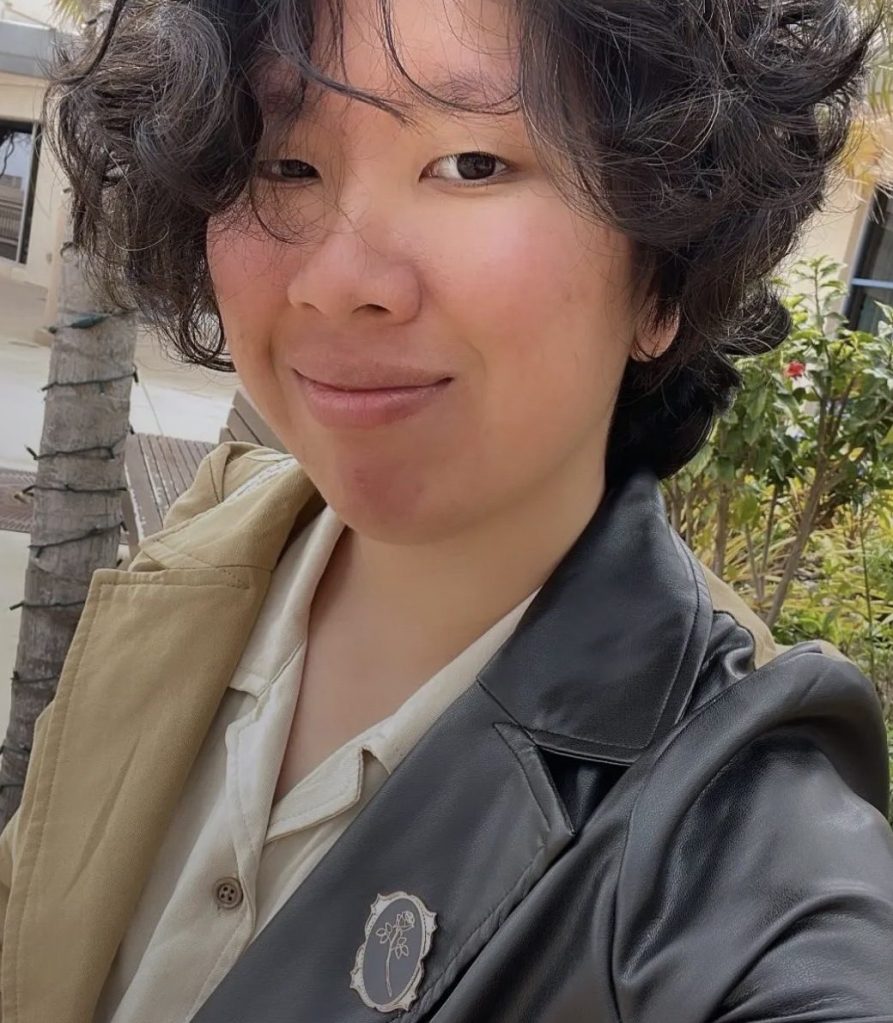
1. Hi! We’re so glad you’re here. Can you introduce yourself to the Invisible Cake Society with your name, pronouns, and any identity labels you feel like sharing?
Hello! I’m Ell Huang (she/they). I’m apothisexual (sex averse) asexual and aromantic.
If I were to get more particular, my desires can be summed up as hetero-queerplatonic (I’m interested in an opposite gender platonic life partner) and demi-sensual (emotional bond needed first, craves physical touch but not sexual).
Gender is a matter of curiosity for me right now.
I am also second generation immigrant Taiwanese American and autistic.
2. What do you like to spend your time doing, online or in person, creatively and/or professionally?
I LOVE engaging deeply with art such as books and movies. I love being in deep conversation about all sorts of ways stories are in conversation with one another, especially the fantasy, fairytale/folklore, Gothic, and horror genres. I also love writing, directing skits, and making videos.
3. When did you hear about aromanticism and asexuality, and when did you realize they described you?
The internet was helpful in connecting me to that language. In high school, I secretly was beginning to suspect “asexual” described me, but I didn’t confirm until my later years in college. Partially because, I figured, I was either “really good at purity” or the soulmate God made me to be with (that is, someone I would feel this attraction for) was someone I’d meet later as an adult. I also think I quietly identified as aromantic first because I felt I didn’t even have to think about sex until later…and then it switched.
Asexuality became easier to identify with, while it became more prominently existential-crisis-inducing to realize I did not feel romantic attraction either.
Very extraordinarily well-meaning friends would tell me “being asexual doesn’t mean you have to be aromantic!” but the scary thing was…I was also aromantic. I am both aromantic and asexual, and for my personal experiences, the Venn diagram comparing the two experiences is a circle.
4. What’s your faith background and how would you describe your relationship with religion/spirituality/faith today?
I’ll call myself agnostic because I’m being honest, and I’ll call myself religious because I’m being honest.
I grew up evangelical but left that behind. Today, I resonate a lot with liberation theology. I also have a lot of reverence for what I learn from my Catholic friends. In all honesty, “agnostic” is also an accurate descriptor for how I feel some days, though it’s loose. I still choose to believe in a loving Creator and an afterlife to hope for reunion with loved ones and a second chance at life, especially for those gone too soon, and all I can do is hope.
I also believe in ghosts and spirits. We can’t be the only ones “right” about that.
5. How has your a-spec identity influenced your personal faith?
The older I get, the more my asexuality feels like it’s changed my perspective on life and the faith in it. While I didn’t care for sex + romance growing up anyway, there was still this mysterious, elusive hope for it as something to be revealed in the future. There was this pretty, romanticized Tumblr graphic I still remember influencing me for years: “Imagine a guy so focused on God that the only reason he looked up to notice you was because he heard God say, ‘That’s her.'” See, there was once a time that felt so sweet and amazing to hear, to be romanticized like that, to be the answer to someone’s prayers like that, to be hyped up so positively behind your back like that!
Now, I think it’s dumb as rocks, and rather insulting to everyone involved: me, whoever that guy is, and God.
Rather, now I have moments that I’m grateful and in awe of friendships and their capacity to grow throughout life, but I also have moments where I still struggle with existential crises and platonic heartbreak and grief. There have been moments I’ve felt “called to celibacy” (genuinely), which I think aligned with a call to authenticity for myself; and other moments I’ve mistakenly thought it was my “calling” to save people from pain at the expense of myself, perhaps making the mistake of thinking it was on me as an asexual/aromantic with “the extra time,” to self-sacrifice like Jesus. (Is there an Ace Savior Complex? Just thought of that now. Might have to think more about that).
In honesty, it feels complex now. Because I desire more platonic physical touch and a queerplatonic partner, I no longer feel “called to celibacy” now, even though I believe it was true and helpful for a time then. So I’m in the process of deconstructing that.
The other side of it, though: I don’t see Jesus in a romantic light. We repeat countless metaphors for trying to capture a relationship with the Divine, and the romantic ones never really made sense to me personally because in that case, you’d be mad to find out he loves others. A romantic relationship metaphor feels too reductive and exclusive, not to mention derailing from the type of impact Jesus’s human life on earth was dedicated to. A parenting, teaching, mentor, ancestral, or queerplatonic friendship makes sense to me as a way to see Jesus without feeling cheated that, yes, Jesus loves other people too.
6. How has your a-spec identity affected your relationship with religious or spiritual communities?
Ooooh this is a complex one as well. I’ve had different experiences. The evangelical community is actually discriminatory toward asexuals once you’re in your 20s. People have this misconception that “the church accepts you the most!” and “asexuals are the puritans oppressing everyone!” but it’s only that we camouflage within purity culture in the beginning.
The flip side is harsh: all the shame of purity culture happens to us later, and possibly for the rest of our lives for some, for not experiencing sexual attraction. I have actually even been set up without my knowledge or consent with a stranger once, and a family member responded, “Why did I have to raise you” when I said no.
On the other hand, many of my closest friends are at the intersection of queer and religious(/adjacent), and I’ve been told my coming out has helped others come out as well.
In being able to de-center heteronormativity and amatonormativity, we’ve been able to breathe in much deeper platonic friendships and share the existential crises of life together. It’s been liberating to make friends wayyyy past the purity culture panic. And that “being way past this” doesn’t mean having sex, for me. That just means deconstructing the obsession with policing or prescribing (heteronormative) sex, and getting over these arbitrary rules of gender binary and gender separation that keep us from practicing empathy with one another to full capacity.
I also remember coming out to my pastor in our small progressive Asian American church (made up of outcasts, mostly second- or 1.5-generation immigrant young adults who got kicked out of evangelical immigrant churches). It was one of the best conversations I could have asked for, the way he immediately embraced this knowledge, respected my privacy, apologized for amatonormativity in the church once he noticed it, and actively took it upon himself to make language in church more inclusive of asexuality and platonic love.
7. How has your faith affected your relationship with the a-spec or larger LGBTQIA+ community?
Once again, complex! I don’t prioritize this struggle, but I have definitely been vehemently judged or misunderstood by other queer folks as inherently a traitor to the community just for also being personally religious. I’ve once been physically cornered and urged to renounce my belief in an afterlife to prove my leftism (an absurd type of situation I’d thought evangelicals only made up!). Ironically, this took place less than 24 hours after being physically cornered in a conservative place and urged to promise I would just say yes to the next man interested in me. One after the other, I was told it was just so unheard of and wrong for me to not have sex; then I was told it was so wrong for me to believe in heaven.
I don’t believe in hell, but I don’t think it’s fair to force people to renounce belief in heaven or reunion for those they lost either. I definitely understand where a lot of the rage comes from, I mean, fuck MAGA (and I know, it’s much older than that). But it’s also hard because I feel infantilized at times for believing in anything. I look foolish, head in the clouds, “clinging to childhood” for hoping in heaven. I’m still put in this position all over again, to choose between believing God loves me (does He? do They?) and choosing authenticity in who I am as a queer person.
It’s genuinely a tightrope to walk knowing and respecting people’s triggers, prioritizing people’s safety, and still being honest if it comes up that, yeah, I do believe in something, but no, it doesn’t involve divine punishment or religious exclusivity. Not everyone wants to associate with queer religious folks, and I have to respect the space because I know people want common ground in relationships, but at the same time I don’t like when people are just sitting there making themselves angry at the existence of me and demanding the end of all religion when I’m just lighting my incense saying a prayer in my room. I don’t like it any more than people just sitting there making themselves angry at the existence of my asexual queerplatonic life and demanding I still promise to submit to sex eventually. It’s white supremacist in itself too, to call for an end to all different people’s relationship to spirituality and the divine.
On the other hand! Again, you’d be amazed at how much queerness and faith intersect in my life. It was the active hospitality of queer Christians, in multiple instances spanning over ten years of my life, that embodied the hospitality of Christ to me and restored my faith.
Every time someone has somehow restored my faith, it was a queer person. Every single time I was in need, and someone gave me a safe place to stay, it was a queer person.
8. Does your a-spec identity impact your gender identity? Or vice versa?
I used to think not, but lately? Gender is curious for me. I think my asexuality has helped reframe a lot: when I usually want masculinity in my life, it’s not because I want sex with it, but because I want to wear it, embody it, express it myself. When I want masculine friends in my life, part of that is because I want different friends in general anyway, but another part of it might be because I want positive versions of masculinity in my life as I explore it. I think what I seek in a queerplatonic relationship is a brother figure for this reason, to bring out the genderqueer or masculine side of me in a supportive safe space with a friend. Not everyone gets that, though; it’s very different from the way people even on the ace spectrum describe sexual or romantic attraction to men. Even as I say this, I’m still exploring it, so I know that could change.
As far as my socialized gender goes, growing up I was steeped in the idea that girls were romantic and boys were sexual, and un-curious folks might brush off one aspect of my identity as “that’s just being a woman.”
But a) I remain both asexual and aromantic in adulthood as a grown woman, and b) women are sexual too; they’re just shamed or endangered for it any time they express it.
The lack of safe spaces to explore didn’t make me asexual; it just made it harder to find out I was asexual. On the flip side, if I were born and socialized as a boy, it might have also been hard to find out about asexuality because compulsory sexuality so forcefully defines what it means to be a man. This might parallel the flip side of what purity culture does for asexual Christians, the camouflage and then the vulnerability.
9. What should all a-spec Christians know?
You’re not the same as purity culture, you’re not lacking in passion just because it looks different, and authenticity is never the problem. Authenticity to who you are is never contradictory to the life God made you to have. You did not just “abort” a planned soulmate by coming out as a-spec. You did not miss out on love for saying no. You can pursue love of any kind, forge relationships of any kind, and the “right person” or “right people” would never be anyone who thrives off of your suffering/stifling for life. You also don’t have to self-sacrifice. You are whole, with a whole life, too.
We are not holier than anyone else. But neither are we any less whole.
10. What do you want the larger affirming LGBTQIA and ally Christian community to know about a-spec Christians?
One way to support a-spec Christians: I’d like us to recognize and catch singlism when we hear it. For example, notice when small groups are created to try to foster deeper fellowships, and “singles” is automatically associated with younger age demographics, while “married” is associated with mature adulthood. Or when we hear sayings like “some are single for a season, some are single for a reason!” which implies singleness as either a test or a punishment, either way a negative temporary pending status to ideally relieve. Or when our automatic response to a single adult is to pray for them to end their singleness quickly.
Another thing to know: no, I actually would not thrive in a nunnery. And there is something weird about assuming that just because I am aroace and Christian, I must by default be selfless and self-sacrificing, in a way not expected of straight people. It’s an echo of the Side A/Side B “Are gay and intersex people called to celibacy” debates all over again.
But this goes hand in hand with how celibacy/singleness itself does deserve a lot more respect as a valid, informed, personal human choice too. People also don’t owe anyone sex in order to be a fully realized mature human being. Some people genuinely would thrive in a nunnery, and they deserve better than just being someone’s “puritanical” virgin joke punchline.
These identities are not the same, and all must be separated from purity culture. But the way we treat each of them is all connected in the larger conversation on deconstructing amatonormativity.
11. At Invisible Cake Society, we highlight experiences that have been erased or seem invisible to those outside of them. What’s your favorite way to show your a-spectrum Pride?
I wear a black ring on my middle finger every day! I also like to show queer art and flags in the background of my videos sometimes.
12. Do you have a favorite example of a-spec representation (whether explicitly stated or not) in media, books, public figures, theater, etc.? What about them resonated with you?
Canon: Thơ (from the short film Thơ directed by Heather Muriel Nguyễn) incredibly resonated with me. She makes her sex averseness clear to her romantic partner, that it’s more like doing someone else’s dirty dishes, but is slowly still pressured into “doing someone else’s dishes” on demand anyway, if she’s going to achieve romantic intimacy. I really felt compelled by the short’s use of dreamlike visual metaphor, vibrant colorful lighting, and tense music to creatively emphasize how such an experience of feeling expected to “earn” love by pushing through trauma would feel like. I resonated with her experience of educating others (flipping the script where she was once “educated” on “universal” things) and slowly finding that still not everyone who initially seems to accept asexuality actually respects it. Been there. And I resonated with her breaking free.
Heather’s film Thơ can be watched here: https://youtu.be/fg3p0kxWD4o?si=OtoZ7HZAlG-lj4i6
Headcanon: Wednesday Addams (Wednesday, but also The Addams Family + The Addams Family Values). Come on, what an ace icon! I love that she is in direct contrast with her doting, most passionately entangled loving parents, and they all as a family fiercely love and accept each other so unapologetically. Wednesday also shows her care for others differently and I really appreciate that she does not have to change that. In the show Wednesday, she is set up like most stone-cold protagonists to “learn how to love,” but then subverts expectations with platonic examples every time (while shutting down the boy who insists she can’t say no to him). In fact, in Season 1 when her arc involves letting herself cry (where she once thought it was weakness), one of the rare times she does show the most intense tearful emotion for someone else is not for anything romantic but when she’s rescuing Thing from the brink of death.
For me, when I get insecure about whether my asexuality or aromanticism is just naivete, “innocence,” or “fear of intimacy,” I look at how Wednesday doesn’t give a fuck. She embodies “It’s badass to know what you want and who you are.” And she also embodies all this while protecting her very enthusiastically allosexual parents and queer friends too.
13. Anything else you want readers to know?
Demisexuality isn’t purity culture either! Though I’d be so fascinated and curious to hear how demisexual Christians in particular have deconstructed purity. It’s different from my own apothisexual experience, and just would be cool to learn from!
Along those lines though: I feel like there’s a strange micro-expectation of all asexuals to turn out demisexual “if you just meet the right person,” and it’s important to know that that’s not everyone, nor is it as simple as that. And representation of one experience doesn’t cancel out others. Like with the Addams family, we can be very different but all valid!
Also: people can stop commenting, “but you don’t have to be aromantic!” lol I know. But I simply am.
14. Where can they follow your work online?
I started The Creator’s Apprentice, my semi-spiritual, film-inspired blog, as a huge movie lover and as someone who sees God in the strange and unusual. I was frustrated with how surface-level or dismissive of real issues so many evangelical Christian blogs were, and I wanted to create an alternative where faith was not threatened by good art but often shown to be enhanced or deepened by it. Gradually, the cinema-inspired reflections have become more about relating fantasy/horror to my asexuality/aromanticism, though I am still also open about my faith in them.
- The Creator’s Apprentice: worrydollsandfloatinglights.wordpress.com
- Bluesky: @nocturnalxlight
- Instagram: @nocturnalxlight
- TikTok: @ellmerryspinster
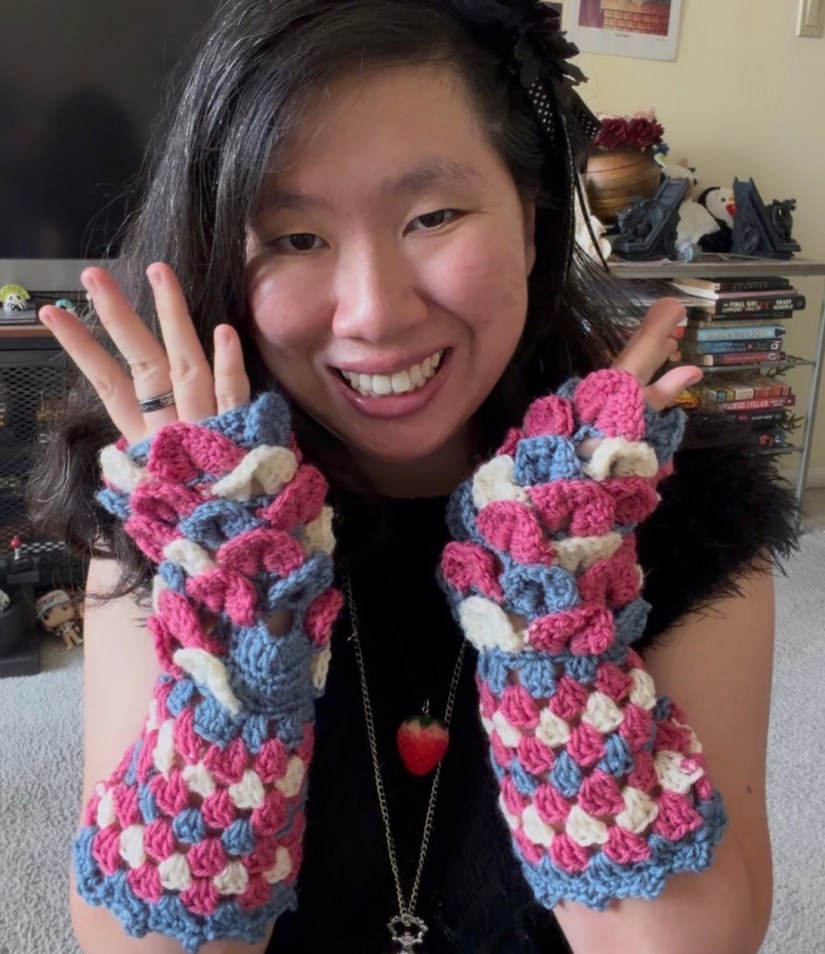
Get to know a-spectrum Christians: Beks Roen
As aromantic- and/or asexual-spectrum Christians and Jesus-adjacent people, it can be hard to believe that we are not alone. There are few examples of us in queer Christian spaces speaking about our experiences, not to mention the broader queer or Christian/faith worlds in general. I want to do my part to change that with this website and connect you with more a-spectrum Christian and Christian-ish people across the internet. This summer, I’m hosting a short Q&A series to introduce them to you.
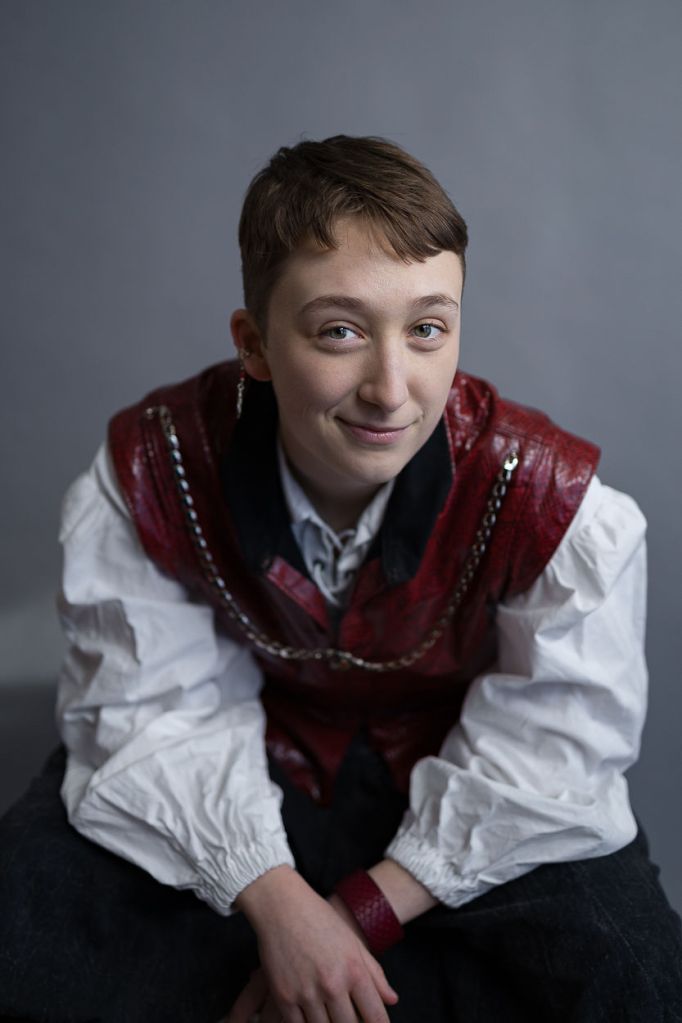
Today we have aroace actor and writer Beks Roen!
- Hi! We’re so glad you’re here. Can you introduce yourself to the Invisible Cake Society with your name, pronouns, any identity labels you feel like sharing?
Thanks for having me! I’m Beks Roen, they/he. I go by Beks and Roen interchangeably, and am transmasculine, non-binary and aroace!
- What do you like to spend your time doing, online or in person, creatively and/or professionally?
For recharge time, I love reading, seeing theatre (especially outdoor Shakespeare), hosting friends for dinner, and watching DropoutTV with loved ones. Professionally, I love writing, acting, and anything stage combat: whether I’m performing, choreographing, or teaching.
- When did you hear about aromanticism and asexuality, and when did you realize they described you?
I think I first heard about asexuality and aromanticism during the pandemic shutdown. I’d only just met a couple folks who taught me about polyamory and genderqueerness a year before, so I went right back to them after some googling and talked through it. I remember reading some PDF of “examples of shared/common ace experiences” and going, “oh. Wait. This explains a lot. Oh no how am I gonna handle this?? Uhhhh, call friends!”
- What’s your faith background and how would you describe your relationship with religion/spirituality/faith today?
My dad is a United Methodist pastor, so I grew up moving every couple of years and having a real rough time with parsonage housing. But my parents never pushed church. If I had homework or a Sunday matinee, it was okay for me to do my work first and not go to church. I’m forever grateful for their grace. I still use UMC language, but I’d describe myself as more “spiritual not religious.” I find incredible, powerful, transformational spirituality in theatre, which has a ton of structural and functional overlap with institutional religion. Theatre and writing are my spiritual disciplines because creativity and co-imagination are such powerful ways to participate with the divine, however you label it.
- How has your a-spec identity influenced your personal faith?
I don’t think it has. Realizing I’m aroace didn’t change my relationship to faith. I see aspec ideals showing up in my faith: I’ve become very community-focused, and am grounding more and more faith in people. I meditate, tap, pray, and do yoga every day, which have been super supportive spiritual practices for me (especially doing yoga every evening with my mom). As I’ve accepted myself and allowed for more ambiguity, I’ve encountered more and more unexpected blessings. Timelines, support, new friends; aligning in ways I couldn’t control, but am intensely grateful for.
- How has your a-spec identity affected your relationship with religious or spiritual communities?
My family has been incredibly supportive, which I constantly celebrate. Most of the time, though I get the blank stare of confusion more often than not, folks have been open to listening and hearing. Even in the Midwest, whether it be church or theatre, I encounter more curiosity than animosity. I’m sure a part of that open response has to do with my white privilege. It’s a lot of 101 conversations, to the point where I made a Google Doc with links to all the educators I learned from (Angela Chen, Yasmin Benoit, Ashabi at Ace in Grace, Cody Daigle-Orians at Ace Dad Advice, etc.). I’ve found a lot of support in theatre spaces, with the occasional pushback. Case in point, I’ve been hired to play an aroace Romeo at Advice to the Players this summer (July 31-August 9, 2026)! The director and team and several audience members have been incredibly supportive and excited to follow this adventure. Out of all the conversations I’ve had about it over the past year, only two people have been outright aphobic about it. Most are curious and excited to see what happens!
- How has your faith affected your relationship with the a-spec or larger LGBTQIA+ community?
I see the anti-Blackness in the ace community and my heart breaks. We can do better. We should do better. For white Christian aces: Jesus calls us to do better. Jesus’ top two commandments were about love. We are to love each other, not slam a neighbor for supporting the community.
- Does your a-spec identity impact your gender identity? Or vice versa?
I found asexuality first, which domino-ed into aromanticism and gender discovery. I used to be really focused on trying to figure this out. Where the delineation was. Trying to define each container of each label I wear. But as I continue reading more from aspec folks like Ashabi (Ace in Grace), Angela Chen, Cody Daigle-Orians and others, the more I’ve relaxed and realized that for me, I can let it be a gradient. Where a variety of things are present, but there’s no clear lines between each.
- What should all a-spec Christians know?
You’re loved. You’re not alone.
- What do you want the larger affirming LGBTQIA and ally Christian community to know about a-spec Christians?
Faith and aspec identity are not mutually exclusive. And LGBTQ+ rights and aspec identity are not mutually exclusive. We’re here, queer, biblically accurate.
- At Invisible Cake Society, we highlight experiences that have been erased or seem invisible to those outside of them. What’s your favorite way to be visible?
Theatre!! I literally started my own production company, Roguish Goblin Stories, to produce shows that highlight the trans/aspec Shakespeare resonances that feel obvious to me, and produce original adventures that center trans and aspec leads. My writing absolutely supports this as well, but the physical impact of co-experiencing an aspec character’s journey in person deepens the connection way beyond my writing alone. When I produced my first original production, Boy-ish, I had multiple conversations with audience members afterwards about the two main characters: one was aroace, the other was non-binary. The show had basically nothing to do with their labels, but it still opened people’s horizons up and made the trans and aspec audience members feel seen for the first time in their lives. That’s why I write, and produce what I write in person whenever possible: to remind people that they’re loved and not alone.
- Do you have a favorite example of a-spec representation (whether explicitly stated or not) in media, books, public figures, theater, etc.? What about them resonated with you?
Honestly, as much as I see aspec resonances over and over again in Shakespeare and other classics (Romeo, Mercutio, Orpheus, Hamlet, Benedick and Beatrice, Jacques, Coriolanus, etc.) I also see aspec love between Sam Gamgee and Frodo from Lord of the Rings. Their love is so deeply, beautifully queerplatonic. Their dedication to each other. Right from the start: Frodo’s panic when Sam tries to swim after him as the Fellowship fractures, even though Sam can’t swim. Sam’s line on Mount Doom always makes me weep: “I can’t carry the Ring, but I can carry you.” We need more relationships like Frodo and Sam in media, which is a huge part of why I became a writer.
13. Anything else you want readers to know?
I’d love to see more people, aspec or not, celebrating Soul Ace Day and supporting Black aspec folks. There’s a chat with the founders here that I found really helpful. We’re in life together, folks. You’re loved. You’re not alone.
14. Where can we follow your work online?
- My website is beksroen.org, where you can find links to my books, socials, etc.
- Roguish Goblin Stories is where I’m building my own production company: subscribers get recordings of all the shows I produce!
- I run my own Substack (free and paid options) at https://beksroen.substack.com/
- My first album of music released May 9!
Occurrences
It occurs to me tonight to put my rainbow grocery bag in the trunk. Not just because that’s where it belongs, but to not give anyone an excuse to take out their religion on my car window.
It occurs to me that if I were in a redder county, I would never have left it visible to begin with.
It occurs to me on a Walmart run after work that I should have taken off my company staff badge with the Pride flag on the back while walking alone in the dark.
It occurs to me that in other places, I would never have been allowed to put that sticker on my identification to begin with.
It occurs to me to move my black ace ring to my left ring finger in a protective lie, signaling to the men of the crowd that I am another man’s property. If they don’t respect my humanity, they may respect the rights of possession—or at least the fear of violating them.
It occurs to me that I have the privilege of safety in being gender conforming, able to chameleon my way into invisibility.
It occurs to me that I have to constantly remind people I know what I’m talking about, that my experiences are erased, that I am here too, that we are not new or a trend or a bonus feature.
It occurs to me that I do not require documents to be changed, or medicine to be seen as myself, or a search for my literal voice with the help of lessons.
It occurs to me that I am likely the only one you know. That when I speak, I must point to many others like me but not like me, so you have a broader view.
It occurs to me that I occupy a space of assumed privilege as others explain marginalization that I live every day myself. Amusing at times, but mostly frustrating.
It occurs to me that my intersections give me advantages to steward so others will be heard.
It occurs to me that most people don’t have to wonder if their friends, family, church, or job will disown them over basic identity facts. If they confess who they are, will they receive a birthday card this year, will they have any references for their job applications, will they be welcomed home at Christmas, will they still have an emergency contact?
It occurs to me that others have faced far worse: Will they still have a home, food, a functional body, their lives?
It occurs to me that there is safety in numbers, and my numbers are small, often just me and my carabiner and my rainbow T-shirt.
It occurs to me that an ally up the mountain was murdered for less.
It occurs to me that I can change my shirt, but others can’t change their voice, their government, their bones.
It occurs to me that some allies will only care to the point that it is comfortable to be with us. Our humanity is an issue on which they agree to disagree with friends and colleagues and those who can help their careers.
It occurs to me I must have patience for the indoctrinated.
It occurs to me that I don’t have the tolerance to wait.
It occurs to me, too, that even the wait is privilege. Others, our youngest, are running out of time.
The Queer Identities Flowchart

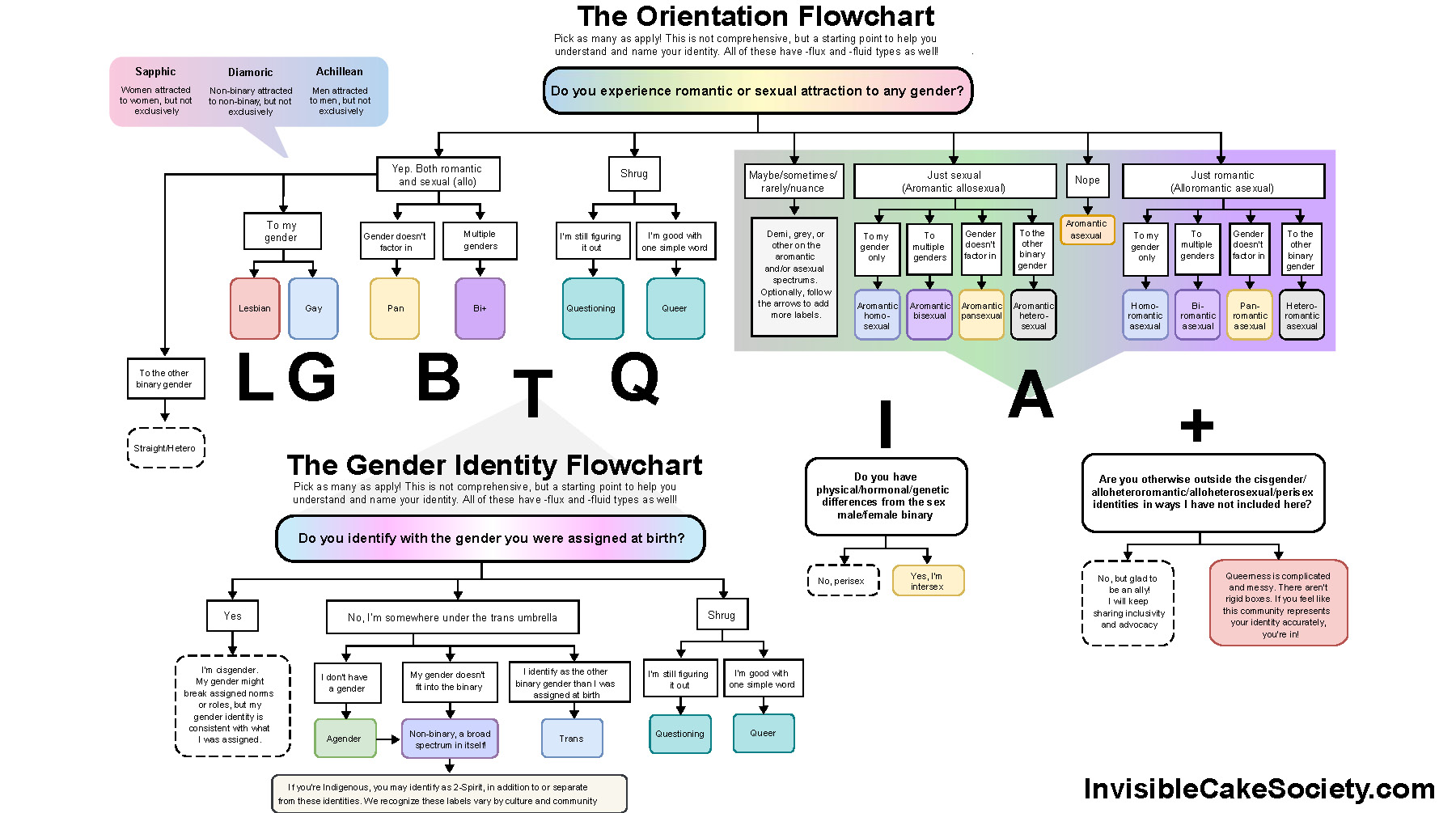
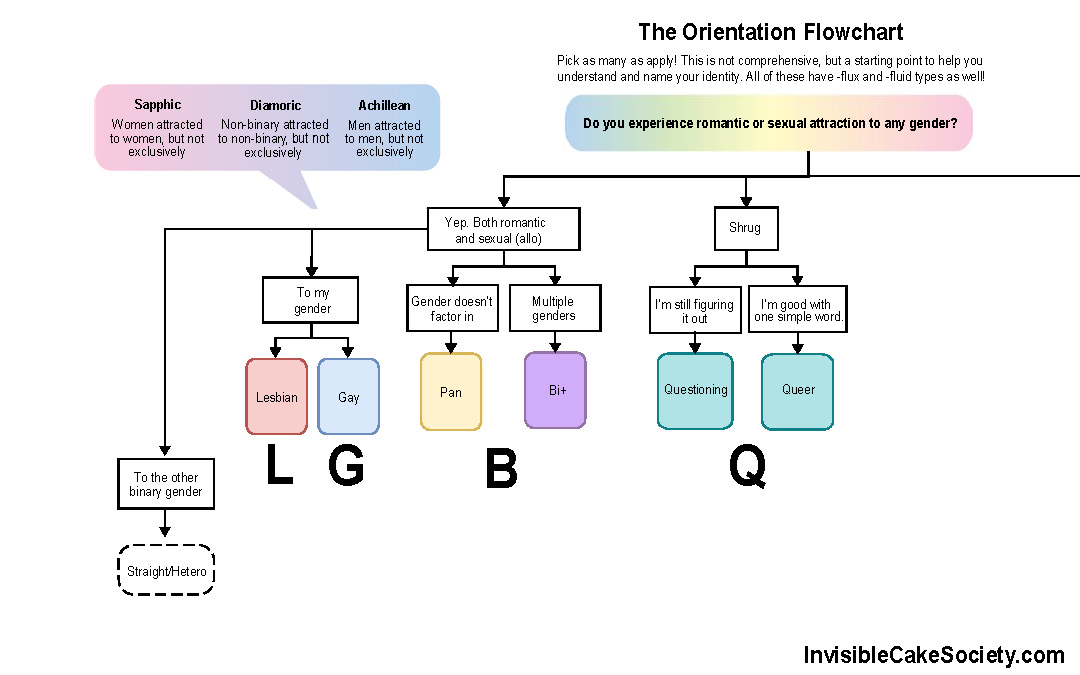
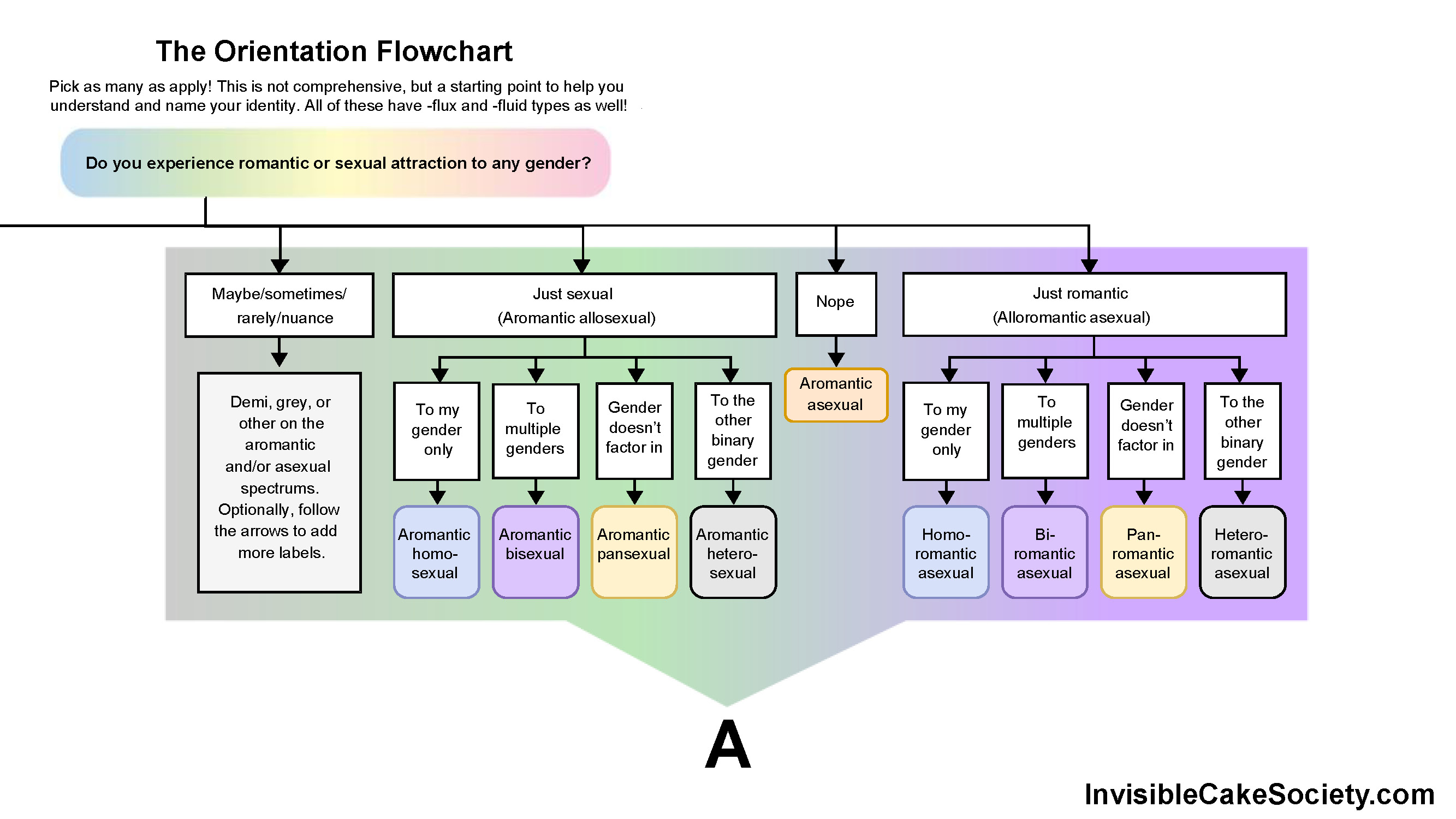
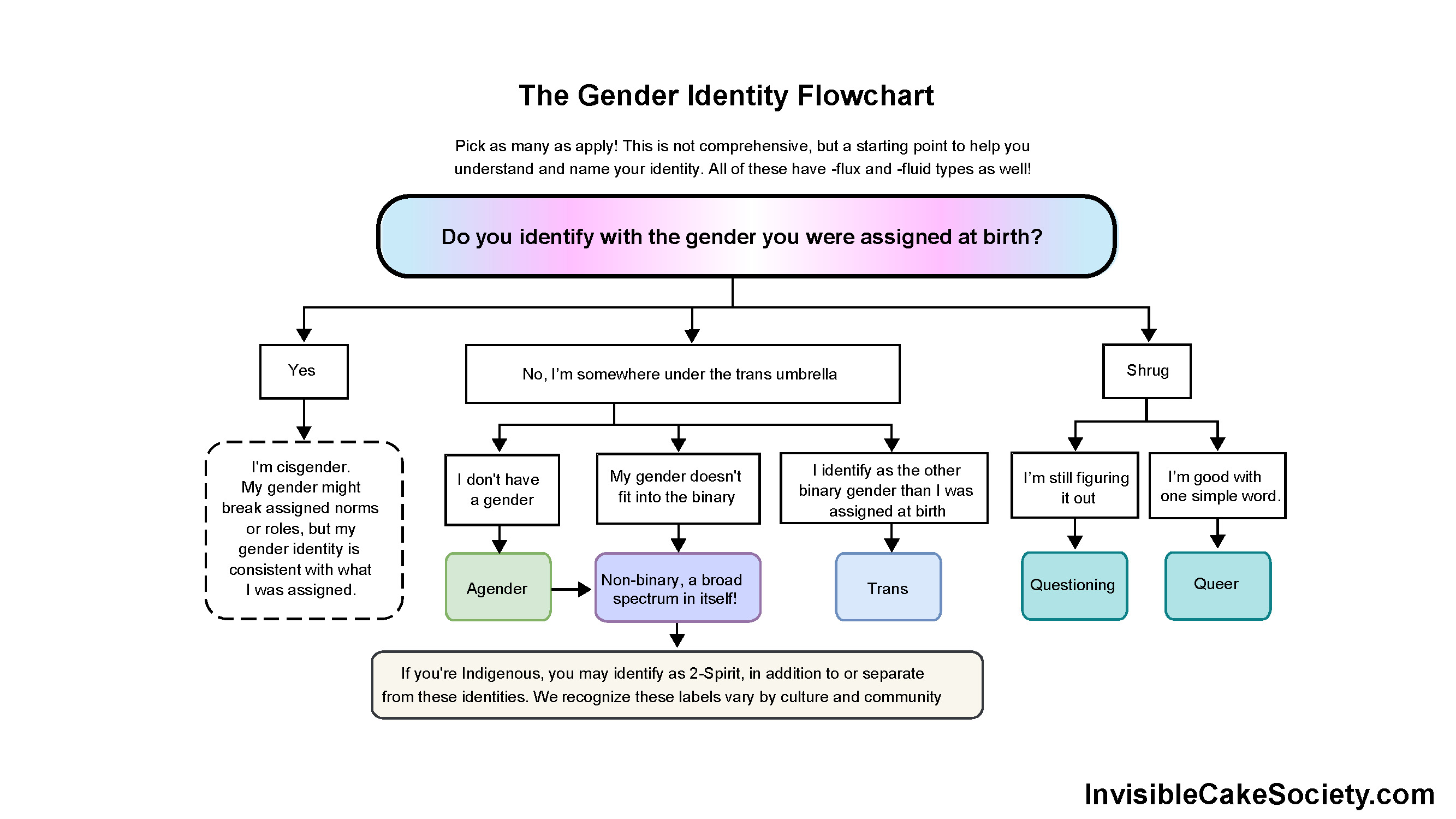
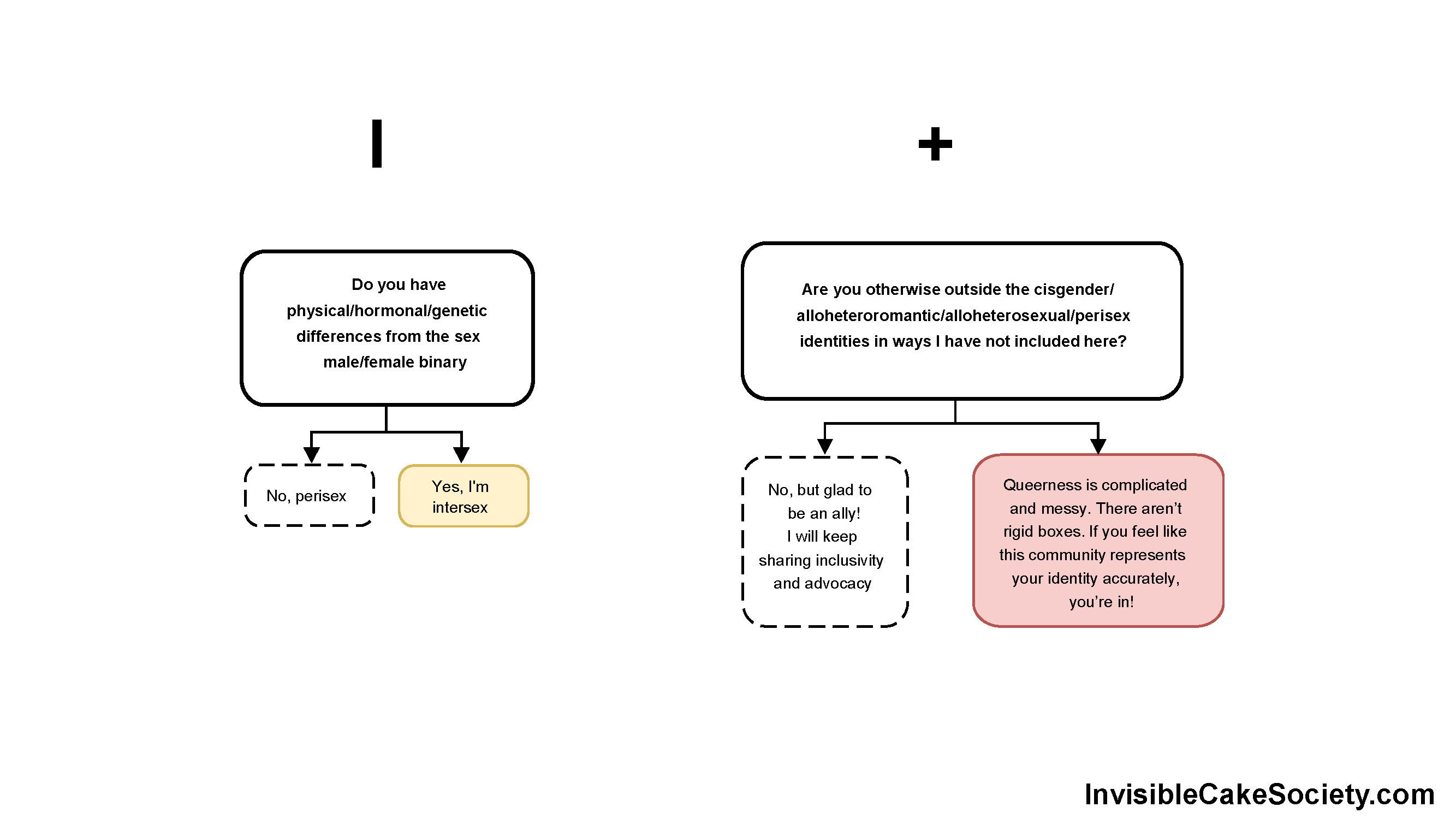
I’m hoping this flowchart can help everyone understand that the letters aren’t just a jumble of alphabet soup, but there is an organized system behind each one. It’s easier to see if you click the arrows to navigate through each slide, focusing on a specific section. These concepts are pretty much a multiple-choice test.
Orientation options include:
- Attracted to the other binary gender
- Attracted to my gender
- Gender isn’t a factor
- Attracted to multiple genders
- Don’t know/don’t need to specify
- Rarely or in certain situations
- Just sexual
- Just romantic
- None of the above
Gender options include:
- Same as the one everyone expected when I was born (“assigned at birth”)
- No gender
- Fluid or more than one gender or a gender not in the binary
- The other binary gender of the one everyone expected when I was born
Intersex identities and other variations of queerness are also included.
Open these in a new tab or zoom in to explore!
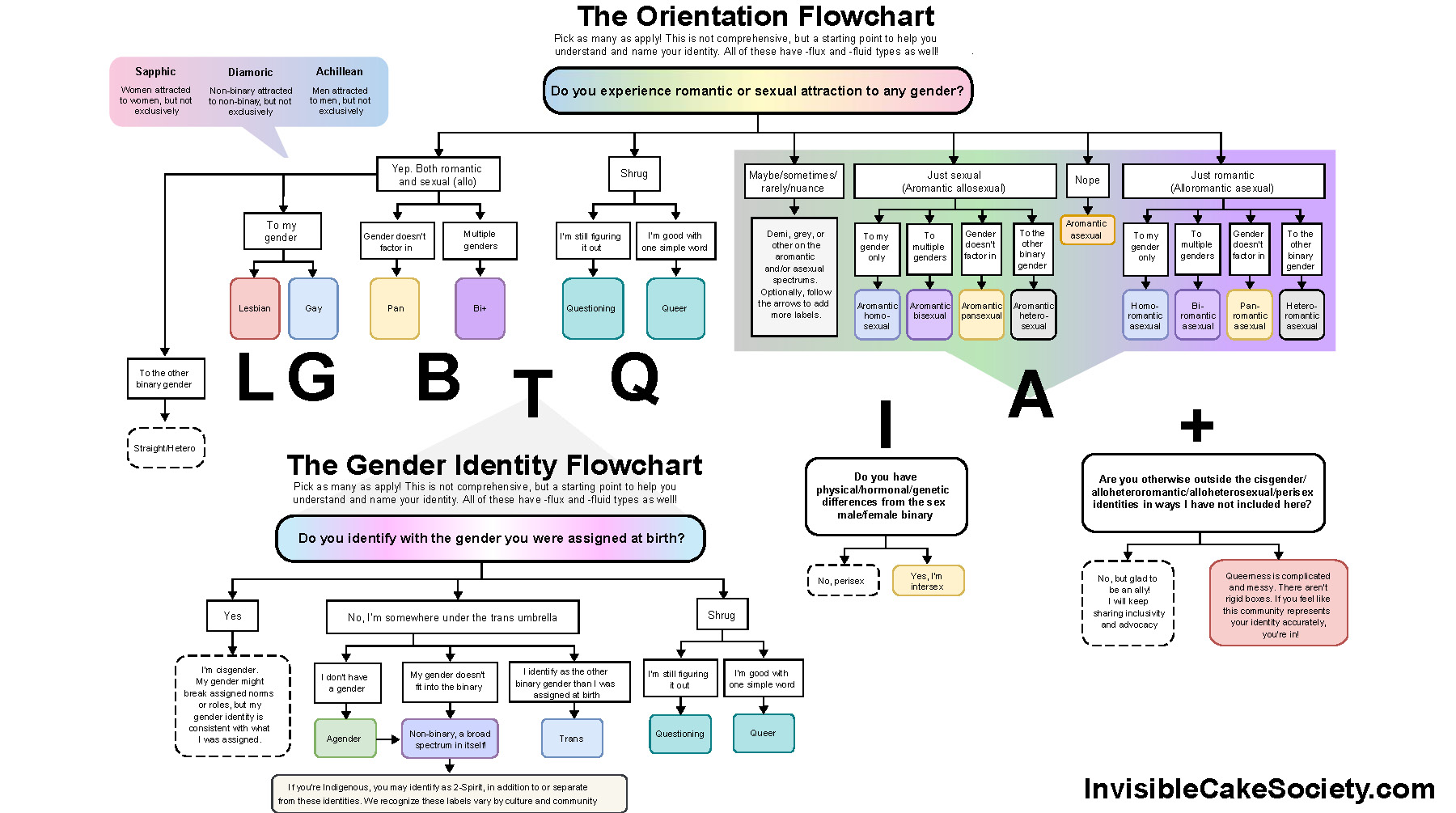
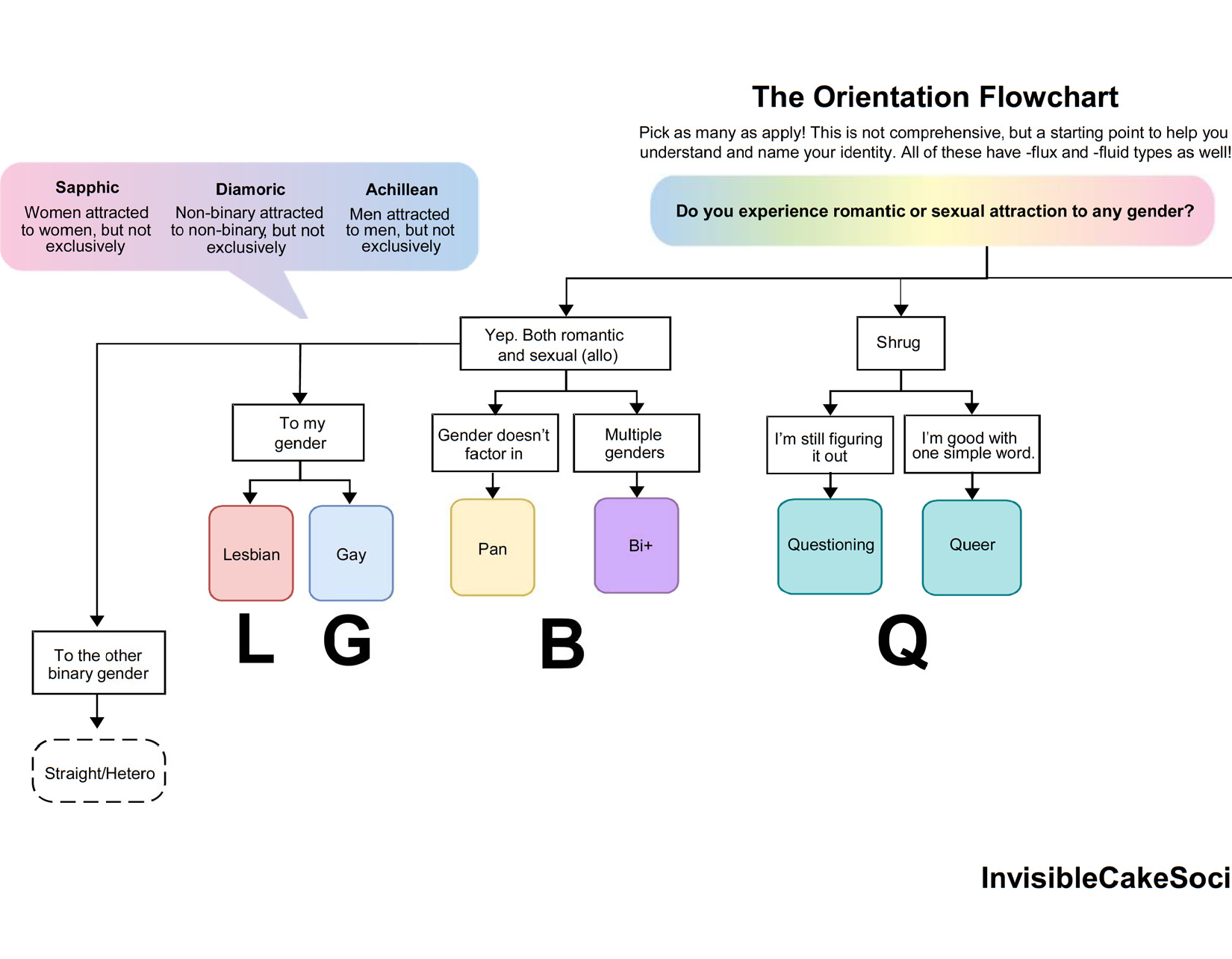


Hope these are helpful! This is meant to be the start of the conversation, not the end point. Explore more in-depth and specific identities here: https://lgbtqia.wiki/wiki/LGBTQIA%2B_Wiki:FAQ
International A-specs!
April 6 is International Asexuality Day, highlighting asexual organizations and people all over the world. Asexuality is not unique to North America or the UK. We are everywhere in every culture and country and time zone. Here are organizations highlighting not only asexuality but also aromanticism and both spectrums.
Argentina: https://twitter.com/asexualidad_ , https://twitter.com/arromanticos, https://twitter.com/Asexhh
Asia: https://linktr.ee/asexualityasia
Australia, New Zealand, Oceania, Asia Pacific: https://acearolinks.carrd.co/
Brazil: https://linktr.ee/coletivoabrace
Germany: https://aspecgerman.de/, https://twitter.com/aro_sphere, https://twitter.com/ace_arovolution
India: http://www.indianaces.org/
Ireland: https://aspecsireland.carrd.co/, https://twitter.com/IrishAsexuality
Mexico: https://asexualesmexico.com/
Netherlands: https://aseksualiteit.nl/
Nigeria: https://twitter.com/AceandNigerian
Spain: https://asexual.es/
UK: https://twitter.com/GlasgowAce
US: https://twitter.com/acelosangeles, https://twitter.com/AcesNYC
More ace and aro organizations across the U.S., Europe, and the Philippines: https://acesandaros.org/groups
More aro organizations here: https://www.aromanticism.org/en/in-person-communities
More ace organizations here: https://internationalasexualityday.org/en/local/
Can still?
When we say aros can date or aces can have sex, we aren’t appealing to normativity; we’re speaking about liberation and against gold-star gatekeeping. There is no vow of singleness or celibacy in being a-spec. You can do what you want. It’s about identity not behavior.
The context for these discussions is when allos and gatekeeping a-specs say we aren’t really ___ because they think it’s about choices. If you understand that and don’t have anyone telling you, “But you can’t be a-spec because you….” then these discussions are not for you. And that’s great!
It means we are making progress if a-spec people don’t know why it’s important and educational to separate behavior and identity. If you aren’t constantly conscious if you’re acting aro or ace enough “to count.” If you accept without question that there are many ways to be a-spec, that’s amazing because it’s proof that the last decade of activism worked!
But if you know your own community history, you understand why these phrases like “can still date” or “some aces have sex” are vital to liberation frameworks. Not long ago, this was MIND-BLOWING. And controversial.
So congrats if you don’t get it because you had elders who came before you to pave the groundwork so you don’t have to fight the need to police your behavior to prove you belong or have earned your labels.
This is not purity culture. You don’t have to repent or reform your life choices or pledge your virginity or stay single or be accountable to a leader who will determine if you are living in asexual or aromantic righteousness. THAT’S what we mean when we say you can date as an aro person or have sex while being asexual. For some people, that’s the missing piece they need to hear and is not at all as obvious to them as it is to you.

