
As aromantic- and/or asexual-spectrum Christians and Jesus-adjacent people, it can be hard to believe that we are not alone. There are few examples of us in queer Christian spaces speaking about our experiences, not to mention the broader queer or Christian/faith worlds in general. I want to do my part to change that with this website and connect you with more a-spectrum Christian and Christian-ish people across the internet. This summer, I’m hosting a short Q&A series.
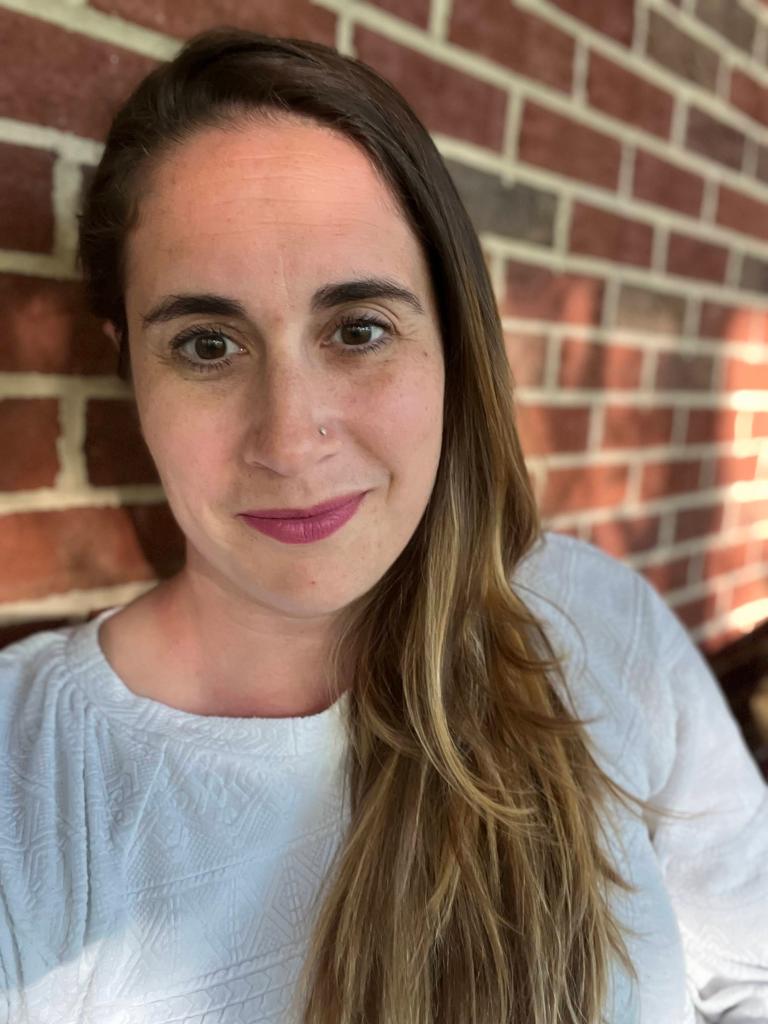
1. Hi! We’re so glad you’re here. Can you introduce yourself to the Invisible Cake Society with your name, pronouns, any identity labels you feel like sharing?
My name is Gena Thomas, she/her, and I am a demiromantic ace.
2. What do you like to spend your time doing, online or in person, creatively and/or professionally?
Writing is my intuition. Watching my kids play sports is my favorite source of entertainment these days. Playing rec sports (volleyball recently and now softball) is probably entertainment for others, and volunteering with Indivisible (the No Kings protest organization) keeps me sane in this political environment.
3. When did you hear about aromanticism and asexuality, and when did you realize they described you?
I had heard about asexuality several years ago, but it wasn’t until I was doing some research for a piece of fiction that I really understood the difference between romantic and sexual attraction—and therefore aromanticism and the spectrum of asexuality. I was in my late 30s when I realized that this was an identity that described me. Because I didn’t understand that attraction is not just attraction, but has types, I had no framework to question my struggles with sex except for purity culture and what doctors told me was a typical low sex drive for women. So for a very long time, I felt abnormal, off, and weird without believing I was and am fearfully and wonderfully made.
4. What’s your faith background and how would you describe your relationship with religion/spirituality/faith today?
Growing up in a Pentecostal church, I never really knew a day without Christ in my life, and while there is religious trauma I’m working through, I’m grateful that I was introduced to Christ at such a young age and have always believed in being like Christ. As an adult, I moved around to different evangelical churches, but never really found a denominational home especially as I deconstructed and began reconstructing my faith. Now, I attend a United Methodist church and it has been such a great fit for me theologically. Faith has always been such a huge part of who I am, and I’ve found a place where I not only feel like I belong in this moment but feel like there’s space to grow without being judged for how that evolving takes shape as I continue to reconstruct.
5. How has your a-spec identity influenced your personal faith?
Love Beyond Sex, a book I’m currently working on, is my attempt to answer this very important question. When you grow up believing that queerness is sin, it’s a long road to loving your queer self. Especially when you identify as the identity that feels like one of the most queer in the queer community because it pushes the boundaries of what sexual liberation actually is. That is, can sexual liberation include not wanting sex or only wanting it under certain circumstances — and I have you, Jenna, to thank for seeing asexuality so clearly through this lens.
I’m often so grateful that I became an affirming Christian before I realized I was ace. It was like the Spirit was guiding me on a journey of truly learning to love others as a way of leading me back toward fully loving myself. I’ve often heard the phrase, “You can’t give what you don’t have” as a way of communicating the need to love oneself first before loving others. But I think it goes both ways. Sometimes you can’t have what you don’t give. For me, making space for queerness in my theology first resulted in me being able to ask myself the courageous questions about love and sex and attraction. I never had to personally ask myself the very unjust question that many queer people are asking: Does God still love me? My expanded faith opened up the path to immediately know the answer to that question the moment I saw my ace identity: Yes, always and forever, God loves me.
6. How has your a-spec identity affected your relationship with religious or spiritual communities?
Even as an affirming person of faith in a church whose values were more conservative than my own, I felt OK staying put for other reasons. But when I started feeling the need to really show up authentically, it felt impossible to stay at an evangelical church. If people began talking about “those queers over there,” they were talking about me whether they knew it or not. For my own spiritual health, it was time to leave. But to be honest, I miss the people there and our shared values. It was a multiethnic church, and it stretched me in ways that a monoethnic church cannot.
On the other hand, in working on the book, I’ve been privileged to meet many Christian aces across the world, and even though many of my interactions with them were specific to a survey or a short video interview, just knowing them feels like its own sense of belonging. From these interactions came this concept of eternal identity that I talk about in my book:
From the moment I began to belong to this word, I also began to belong to the community—past, present, and future—behind that word. The word became flesh, and yet, it had always been flesh—always been right there in my bones, in my blood, in my marrow. And in the world around me. The meaning of the word has existed from the beginning. It was created, just as the stars and the grass were created. It’s much easier looking back to see its eternality. … because of my experience with the weight of the word asexual, I now grasp how something can exist before our understanding of it. I better understand how a personhood, an identity, can bring with it life and light. I better understand how words take on flesh and that a moment or series of moments can change the trajectory of our lives. I understand how one word can bring with it both the heaviest sense of darkness and simultaneously the most piercing, bright light. The word asexual was made flesh for me, and everything came into light because of it.
7. How has your faith affected your relationship with the a-spec or larger LGBTQIA+ community?
I’m not sure it has.
8. Does your a-spec identity impact your gender identity? Or vice versa?
No, it doesn’t.
9. What should all a-spec Christians know?
If you are ace and your Christian community is making you ask of yourself, “Does God love me as I am?” that question is unjust. It’s a reflection of your community that it would cause you to ask the question. It is not a reflection of you. Yes, always and forever, God loves you as you are. And there are churches and/or spiritual communities that can and are ready and willing to affirm that in you.
10. What do you want the larger affirming LGBTQIA+ and ally Christian community to know about a-spec Christians?
We may be the last letter in some of the acronyms and not in others, but we exist. Please take the time to ask us questions and learn from us. True inclusivity requires mutuality and just respecting our presence isn’t the end goal. We need allies too. We need awareness too. And that goes both ways. As aces, we need to constantly ask ourselves: who are we leaving out? Who are we merely respecting but not learning from?
I truly believe the ace community has much to teach the Church, as I wrote about in my article under my pen name at Red Letter Christians, but I hope that more and more, we can see resources, white papers, and theological articles at queer and ally Christian spaces on asexuality. There are too few.
11. At Invisible Cake Society, we highlight experiences that have been erased or seem invisible to those outside of them. What’s your favorite way to be visible?
Writing: it’s actually how I become visible to myself first and then beyond myself to the world around me.
12. Do you have a favorite example of a-spec representation (whether explicitly stated or not) in media, books, public figures, theater, etc.? What about them resonated with you?
I really enjoyed the ace characters in Elatsoe and The Charm Offensive. While both main characters are ace and both have aspects that really resonated with me, it was reading them both near each other that helped me see the ace spectrum come alive.
When I can, which has not been much lately, I jump into a piece of fiction I’ve started that follows the life of a 20-something ace. Her name is Mattie and she’s helped me process a lot myself: a family history of breast cancer, religious trauma, emotionally immature parental figures, and how being asexual intersects with all of these things. I hope one day others will get to meet her.
13. Anything else you want readers to know?
I want to speak to any closeted aces. There are many reasons that queer people do and don’t come out, and it’s no different for the ace community. If you are reading this and thinking, “I wish I felt safe enough to come out,” whether you are referring to folks in your real life or online spaces or both, please know that you aren’t alone. And know that this journey you are on is not one you have to be on alone. You can be fully ace and fully quiet about it at the same time, these are not mutually exclusive.
14. Where can they follow your work online?
Best places for people to find me:
 Invisible Cake Society