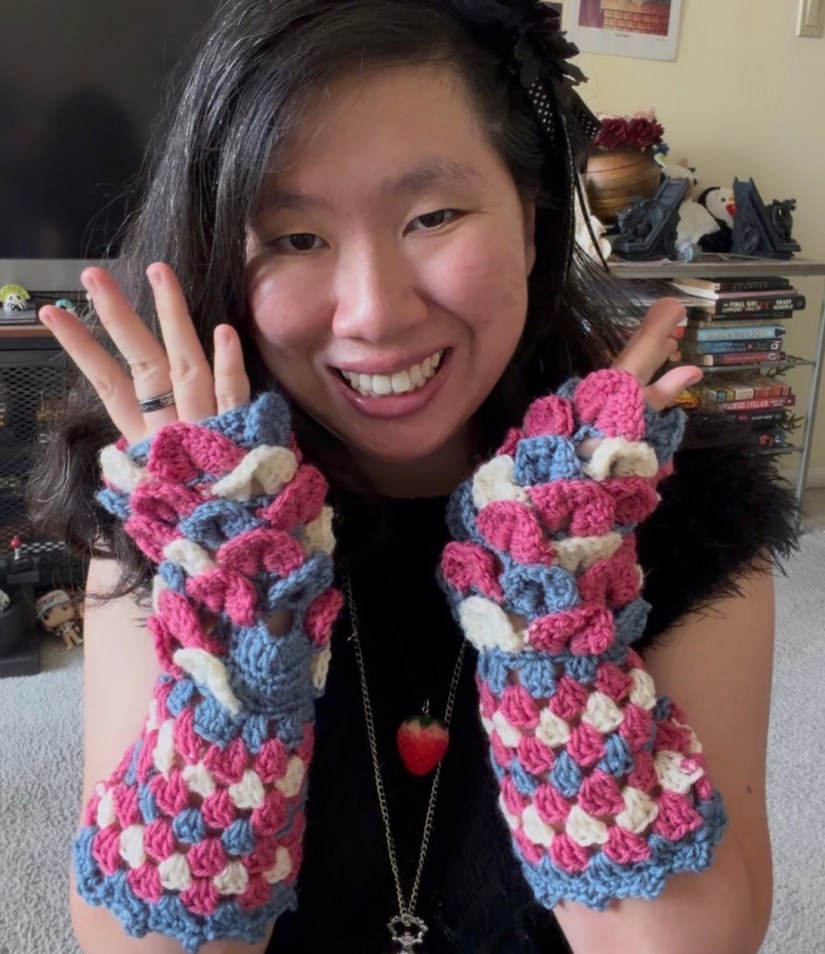
As aromantic- and/or asexual-spectrum Christians and Jesus-adjacent people, it can be hard to believe that we are not alone. There are few examples of us in queer Christian spaces speaking about our experiences, not to mention the broader queer or Christian/faith worlds in general. I want to do my part to change that with this website and connect you with more a-spectrum Christian and Christian-ish people across the internet. This summer, I’m hosting a short Q&A series to introduce us to you.
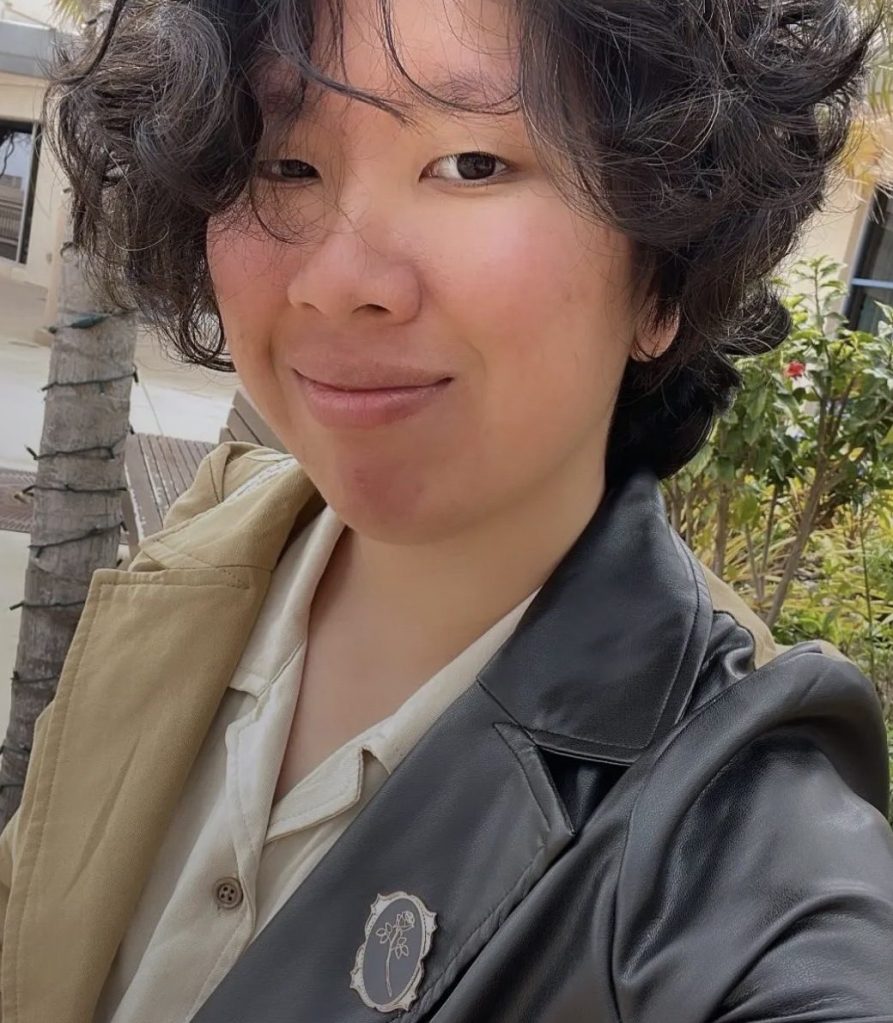
1. Hi! We’re so glad you’re here. Can you introduce yourself to the Invisible Cake Society with your name, pronouns, and any identity labels you feel like sharing?
Hello! I’m Ell Huang (she/they). I’m apothisexual (sex averse) asexual and aromantic.
If I were to get more particular, my desires can be summed up as hetero-queerplatonic (I’m interested in an opposite gender platonic life partner) and demi-sensual (emotional bond needed first, craves physical touch but not sexual).
Gender is a matter of curiosity for me right now.
I am also second generation immigrant Taiwanese American and autistic.
2. What do you like to spend your time doing, online or in person, creatively and/or professionally?
I LOVE engaging deeply with art such as books and movies. I love being in deep conversation about all sorts of ways stories are in conversation with one another, especially the fantasy, fairytale/folklore, Gothic, and horror genres. I also love writing, directing skits, and making videos.
3. When did you hear about aromanticism and asexuality, and when did you realize they described you?
The internet was helpful in connecting me to that language. In high school, I secretly was beginning to suspect “asexual” described me, but I didn’t confirm until my later years in college. Partially because, I figured, I was either “really good at purity” or the soulmate God made me to be with (that is, someone I would feel this attraction for) was someone I’d meet later as an adult. I also think I quietly identified as aromantic first because I felt I didn’t even have to think about sex until later…and then it switched.
Asexuality became easier to identify with, while it became more prominently existential-crisis-inducing to realize I did not feel romantic attraction either.
Very extraordinarily well-meaning friends would tell me “being asexual doesn’t mean you have to be aromantic!” but the scary thing was…I was also aromantic. I am both aromantic and asexual, and for my personal experiences, the Venn diagram comparing the two experiences is a circle.
4. What’s your faith background and how would you describe your relationship with religion/spirituality/faith today?
I’ll call myself agnostic because I’m being honest, and I’ll call myself religious because I’m being honest.
I grew up evangelical but left that behind. Today, I resonate a lot with liberation theology. I also have a lot of reverence for what I learn from my Catholic friends. In all honesty, “agnostic” is also an accurate descriptor for how I feel some days, though it’s loose. I still choose to believe in a loving Creator and an afterlife to hope for reunion with loved ones and a second chance at life, especially for those gone too soon, and all I can do is hope.
I also believe in ghosts and spirits. We can’t be the only ones “right” about that.
5. How has your a-spec identity influenced your personal faith?
The older I get, the more my asexuality feels like it’s changed my perspective on life and the faith in it. While I didn’t care for sex + romance growing up anyway, there was still this mysterious, elusive hope for it as something to be revealed in the future. There was this pretty, romanticized Tumblr graphic I still remember influencing me for years: “Imagine a guy so focused on God that the only reason he looked up to notice you was because he heard God say, ‘That’s her.'” See, there was once a time that felt so sweet and amazing to hear, to be romanticized like that, to be the answer to someone’s prayers like that, to be hyped up so positively behind your back like that!
Now, I think it’s dumb as rocks, and rather insulting to everyone involved: me, whoever that guy is, and God.
Rather, now I have moments that I’m grateful and in awe of friendships and their capacity to grow throughout life, but I also have moments where I still struggle with existential crises and platonic heartbreak and grief. There have been moments I’ve felt “called to celibacy” (genuinely), which I think aligned with a call to authenticity for myself; and other moments I’ve mistakenly thought it was my “calling” to save people from pain at the expense of myself, perhaps making the mistake of thinking it was on me as an asexual/aromantic with “the extra time,” to self-sacrifice like Jesus. (Is there an Ace Savior Complex? Just thought of that now. Might have to think more about that).
In honesty, it feels complex now. Because I desire more platonic physical touch and a queerplatonic partner, I no longer feel “called to celibacy” now, even though I believe it was true and helpful for a time then. So I’m in the process of deconstructing that.
The other side of it, though: I don’t see Jesus in a romantic light. We repeat countless metaphors for trying to capture a relationship with the Divine, and the romantic ones never really made sense to me personally because in that case, you’d be mad to find out he loves others. A romantic relationship metaphor feels too reductive and exclusive, not to mention derailing from the type of impact Jesus’s human life on earth was dedicated to. A parenting, teaching, mentor, ancestral, or queerplatonic friendship makes sense to me as a way to see Jesus without feeling cheated that, yes, Jesus loves other people too.
6. How has your a-spec identity affected your relationship with religious or spiritual communities?
Ooooh this is a complex one as well. I’ve had different experiences. The evangelical community is actually discriminatory toward asexuals once you’re in your 20s. People have this misconception that “the church accepts you the most!” and “asexuals are the puritans oppressing everyone!” but it’s only that we camouflage within purity culture in the beginning.
The flip side is harsh: all the shame of purity culture happens to us later, and possibly for the rest of our lives for some, for not experiencing sexual attraction. I have actually even been set up without my knowledge or consent with a stranger once, and a family member responded, “Why did I have to raise you” when I said no.
On the other hand, many of my closest friends are at the intersection of queer and religious(/adjacent), and I’ve been told my coming out has helped others come out as well.
In being able to de-center heteronormativity and amatonormativity, we’ve been able to breathe in much deeper platonic friendships and share the existential crises of life together. It’s been liberating to make friends wayyyy past the purity culture panic. And that “being way past this” doesn’t mean having sex, for me. That just means deconstructing the obsession with policing or prescribing (heteronormative) sex, and getting over these arbitrary rules of gender binary and gender separation that keep us from practicing empathy with one another to full capacity.
I also remember coming out to my pastor in our small progressive Asian American church (made up of outcasts, mostly second- or 1.5-generation immigrant young adults who got kicked out of evangelical immigrant churches). It was one of the best conversations I could have asked for, the way he immediately embraced this knowledge, respected my privacy, apologized for amatonormativity in the church once he noticed it, and actively took it upon himself to make language in church more inclusive of asexuality and platonic love.
7. How has your faith affected your relationship with the a-spec or larger LGBTQIA+ community?
Once again, complex! I don’t prioritize this struggle, but I have definitely been vehemently judged or misunderstood by other queer folks as inherently a traitor to the community just for also being personally religious. I’ve once been physically cornered and urged to renounce my belief in an afterlife to prove my leftism (an absurd type of situation I’d thought evangelicals only made up!). Ironically, this took place less than 24 hours after being physically cornered in a conservative place and urged to promise I would just say yes to the next man interested in me. One after the other, I was told it was just so unheard of and wrong for me to not have sex; then I was told it was so wrong for me to believe in heaven.
I don’t believe in hell, but I don’t think it’s fair to force people to renounce belief in heaven or reunion for those they lost either. I definitely understand where a lot of the rage comes from, I mean, fuck MAGA (and I know, it’s much older than that). But it’s also hard because I feel infantilized at times for believing in anything. I look foolish, head in the clouds, “clinging to childhood” for hoping in heaven. I’m still put in this position all over again, to choose between believing God loves me (does He? do They?) and choosing authenticity in who I am as a queer person.
It’s genuinely a tightrope to walk knowing and respecting people’s triggers, prioritizing people’s safety, and still being honest if it comes up that, yeah, I do believe in something, but no, it doesn’t involve divine punishment or religious exclusivity. Not everyone wants to associate with queer religious folks, and I have to respect the space because I know people want common ground in relationships, but at the same time I don’t like when people are just sitting there making themselves angry at the existence of me and demanding the end of all religion when I’m just lighting my incense saying a prayer in my room. I don’t like it any more than people just sitting there making themselves angry at the existence of my asexual queerplatonic life and demanding I still promise to submit to sex eventually. It’s white supremacist in itself too, to call for an end to all different people’s relationship to spirituality and the divine.
On the other hand! Again, you’d be amazed at how much queerness and faith intersect in my life. It was the active hospitality of queer Christians, in multiple instances spanning over ten years of my life, that embodied the hospitality of Christ to me and restored my faith.
Every time someone has somehow restored my faith, it was a queer person. Every single time I was in need, and someone gave me a safe place to stay, it was a queer person.
8. Does your a-spec identity impact your gender identity? Or vice versa?
I used to think not, but lately? Gender is curious for me. I think my asexuality has helped reframe a lot: when I usually want masculinity in my life, it’s not because I want sex with it, but because I want to wear it, embody it, express it myself. When I want masculine friends in my life, part of that is because I want different friends in general anyway, but another part of it might be because I want positive versions of masculinity in my life as I explore it. I think what I seek in a queerplatonic relationship is a brother figure for this reason, to bring out the genderqueer or masculine side of me in a supportive safe space with a friend. Not everyone gets that, though; it’s very different from the way people even on the ace spectrum describe sexual or romantic attraction to men. Even as I say this, I’m still exploring it, so I know that could change.
As far as my socialized gender goes, growing up I was steeped in the idea that girls were romantic and boys were sexual, and un-curious folks might brush off one aspect of my identity as “that’s just being a woman.”
But a) I remain both asexual and aromantic in adulthood as a grown woman, and b) women are sexual too; they’re just shamed or endangered for it any time they express it.
The lack of safe spaces to explore didn’t make me asexual; it just made it harder to find out I was asexual. On the flip side, if I were born and socialized as a boy, it might have also been hard to find out about asexuality because compulsory sexuality so forcefully defines what it means to be a man. This might parallel the flip side of what purity culture does for asexual Christians, the camouflage and then the vulnerability.
9. What should all a-spec Christians know?
You’re not the same as purity culture, you’re not lacking in passion just because it looks different, and authenticity is never the problem. Authenticity to who you are is never contradictory to the life God made you to have. You did not just “abort” a planned soulmate by coming out as a-spec. You did not miss out on love for saying no. You can pursue love of any kind, forge relationships of any kind, and the “right person” or “right people” would never be anyone who thrives off of your suffering/stifling for life. You also don’t have to self-sacrifice. You are whole, with a whole life, too.
We are not holier than anyone else. But neither are we any less whole.
10. What do you want the larger affirming LGBTQIA and ally Christian community to know about a-spec Christians?
One way to support a-spec Christians: I’d like us to recognize and catch singlism when we hear it. For example, notice when small groups are created to try to foster deeper fellowships, and “singles” is automatically associated with younger age demographics, while “married” is associated with mature adulthood. Or when we hear sayings like “some are single for a season, some are single for a reason!” which implies singleness as either a test or a punishment, either way a negative temporary pending status to ideally relieve. Or when our automatic response to a single adult is to pray for them to end their singleness quickly.
Another thing to know: no, I actually would not thrive in a nunnery. And there is something weird about assuming that just because I am aroace and Christian, I must by default be selfless and self-sacrificing, in a way not expected of straight people. It’s an echo of the Side A/Side B “Are gay and intersex people called to celibacy” debates all over again.
But this goes hand in hand with how celibacy/singleness itself does deserve a lot more respect as a valid, informed, personal human choice too. People also don’t owe anyone sex in order to be a fully realized mature human being. Some people genuinely would thrive in a nunnery, and they deserve better than just being someone’s “puritanical” virgin joke punchline.
These identities are not the same, and all must be separated from purity culture. But the way we treat each of them is all connected in the larger conversation on deconstructing amatonormativity.
11. At Invisible Cake Society, we highlight experiences that have been erased or seem invisible to those outside of them. What’s your favorite way to show your a-spectrum Pride?
I wear a black ring on my middle finger every day! I also like to show queer art and flags in the background of my videos sometimes.
12. Do you have a favorite example of a-spec representation (whether explicitly stated or not) in media, books, public figures, theater, etc.? What about them resonated with you?
Canon: Thơ (from the short film Thơ directed by Heather Muriel Nguyễn) incredibly resonated with me. She makes her sex averseness clear to her romantic partner, that it’s more like doing someone else’s dirty dishes, but is slowly still pressured into “doing someone else’s dishes” on demand anyway, if she’s going to achieve romantic intimacy. I really felt compelled by the short’s use of dreamlike visual metaphor, vibrant colorful lighting, and tense music to creatively emphasize how such an experience of feeling expected to “earn” love by pushing through trauma would feel like. I resonated with her experience of educating others (flipping the script where she was once “educated” on “universal” things) and slowly finding that still not everyone who initially seems to accept asexuality actually respects it. Been there. And I resonated with her breaking free.
Heather’s film Thơ can be watched here: https://youtu.be/fg3p0kxWD4o?si=OtoZ7HZAlG-lj4i6
Headcanon: Wednesday Addams (Wednesday, but also The Addams Family + The Addams Family Values). Come on, what an ace icon! I love that she is in direct contrast with her doting, most passionately entangled loving parents, and they all as a family fiercely love and accept each other so unapologetically. Wednesday also shows her care for others differently and I really appreciate that she does not have to change that. In the show Wednesday, she is set up like most stone-cold protagonists to “learn how to love,” but then subverts expectations with platonic examples every time (while shutting down the boy who insists she can’t say no to him). In fact, in Season 1 when her arc involves letting herself cry (where she once thought it was weakness), one of the rare times she does show the most intense tearful emotion for someone else is not for anything romantic but when she’s rescuing Thing from the brink of death.
For me, when I get insecure about whether my asexuality or aromanticism is just naivete, “innocence,” or “fear of intimacy,” I look at how Wednesday doesn’t give a fuck. She embodies “It’s badass to know what you want and who you are.” And she also embodies all this while protecting her very enthusiastically allosexual parents and queer friends too.
13. Anything else you want readers to know?
Demisexuality isn’t purity culture either! Though I’d be so fascinated and curious to hear how demisexual Christians in particular have deconstructed purity. It’s different from my own apothisexual experience, and just would be cool to learn from!
Along those lines though: I feel like there’s a strange micro-expectation of all asexuals to turn out demisexual “if you just meet the right person,” and it’s important to know that that’s not everyone, nor is it as simple as that. And representation of one experience doesn’t cancel out others. Like with the Addams family, we can be very different but all valid!
Also: people can stop commenting, “but you don’t have to be aromantic!” lol I know. But I simply am.
14. Where can they follow your work online?
I started The Creator’s Apprentice, my semi-spiritual, film-inspired blog, as a huge movie lover and as someone who sees God in the strange and unusual. I was frustrated with how surface-level or dismissive of real issues so many evangelical Christian blogs were, and I wanted to create an alternative where faith was not threatened by good art but often shown to be enhanced or deepened by it. Gradually, the cinema-inspired reflections have become more about relating fantasy/horror to my asexuality/aromanticism, though I am still also open about my faith in them.
- The Creator’s Apprentice: worrydollsandfloatinglights.wordpress.com
- Bluesky: @nocturnalxlight
- Instagram: @nocturnalxlight
- TikTok: @ellmerryspinster