As aromantic- and/or asexual-spectrum Christians and Jesus-adjacent people, it can be hard to believe that we are not alone. There are few examples of us in queer Christian spaces speaking about our experiences, not to mention the broader queer or Christian/faith worlds in general. I want to do my part to change that with this website and connect you with more a-spectrum Christian and Christian-ish people across the internet. This summer, I’m hosting a short Q&A series to introduce them to you.
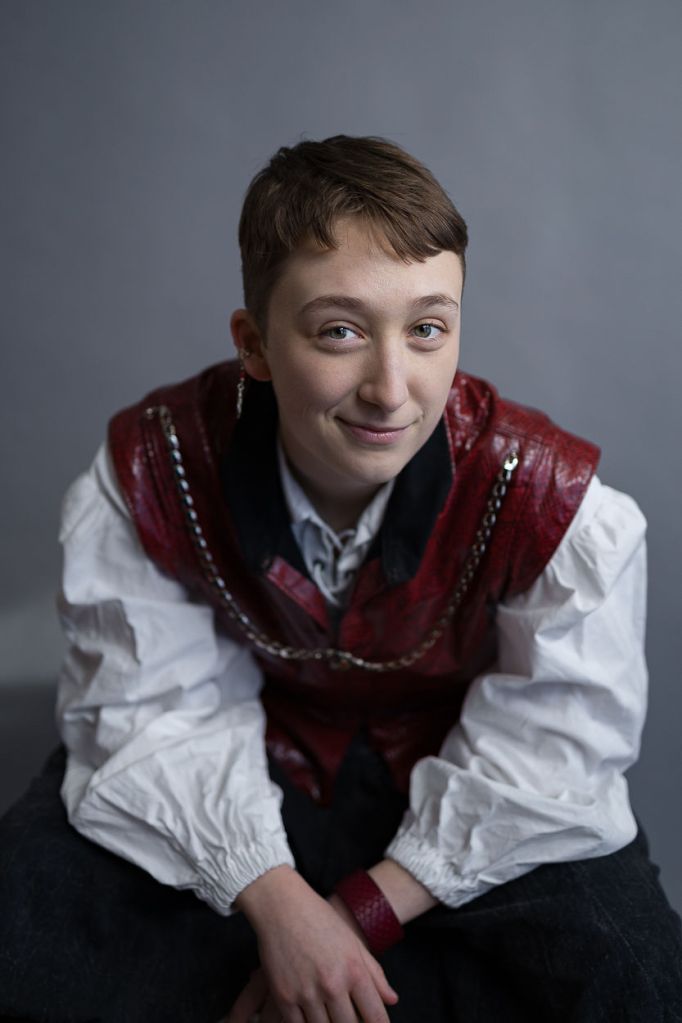
Today we have aroace actor and writer Beks Roen!
- Hi! We’re so glad you’re here. Can you introduce yourself to the Invisible Cake Society with your name, pronouns, any identity labels you feel like sharing?
Thanks for having me! I’m Beks Roen, they/he. I go by Beks and Roen interchangeably, and am transmasculine, non-binary and aroace!
- What do you like to spend your time doing, online or in person, creatively and/or professionally?
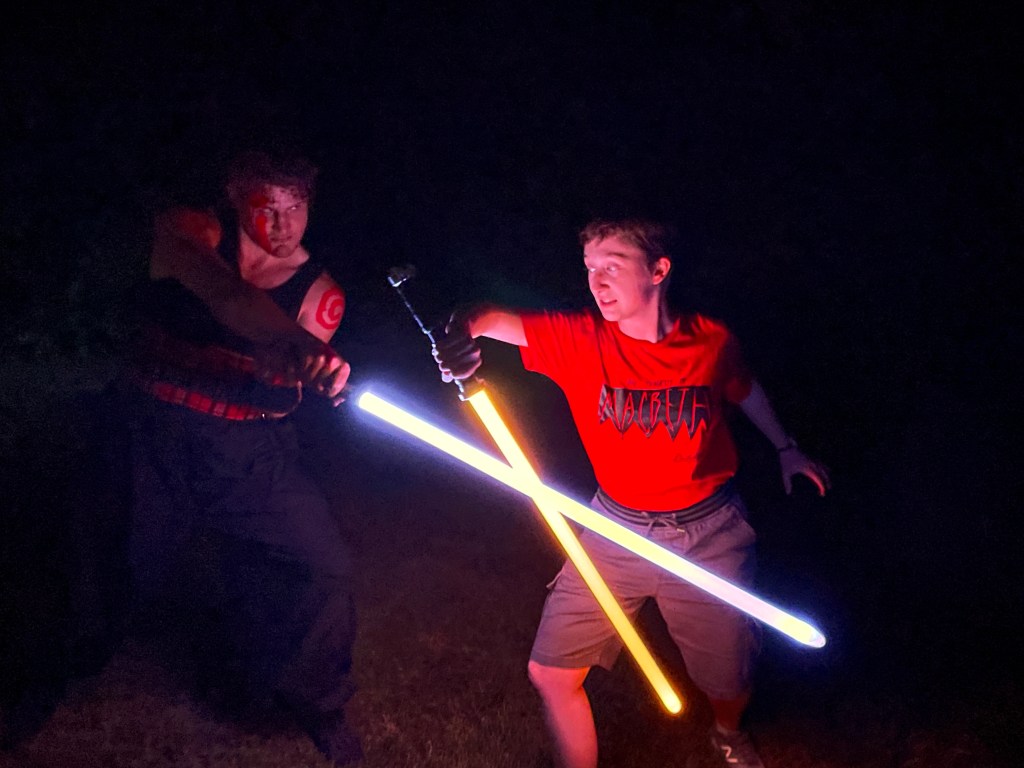
For recharge time, I love reading, seeing theatre (especially outdoor Shakespeare), hosting friends for dinner, and watching DropoutTV with loved ones. Professionally, I love writing, acting, and anything stage combat: whether I’m performing, choreographing, or teaching.
- When did you hear about aromanticism and asexuality, and when did you realize they described you?
I think I first heard about asexuality and aromanticism during the pandemic shutdown. I’d only just met a couple folks who taught me about polyamory and genderqueerness a year before, so I went right back to them after some googling and talked through it. I remember reading some PDF of “examples of shared/common ace experiences” and going, “oh. Wait. This explains a lot. Oh no how am I gonna handle this?? Uhhhh, call friends!”
- What’s your faith background and how would you describe your relationship with religion/spirituality/faith today?
My dad is a United Methodist pastor, so I grew up moving every couple of years and having a real rough time with parsonage housing. But my parents never pushed church. If I had homework or a Sunday matinee, it was okay for me to do my work first and not go to church. I’m forever grateful for their grace. I still use UMC language, but I’d describe myself as more “spiritual not religious.” I find incredible, powerful, transformational spirituality in theatre, which has a ton of structural and functional overlap with institutional religion. Theatre and writing are my spiritual disciplines because creativity and co-imagination are such powerful ways to participate with the divine, however you label it.
- How has your a-spec identity influenced your personal faith?
I don’t think it has. Realizing I’m aroace didn’t change my relationship to faith. I see aspec ideals showing up in my faith: I’ve become very community-focused, and am grounding more and more faith in people. I meditate, tap, pray, and do yoga every day, which have been super supportive spiritual practices for me (especially doing yoga every evening with my mom). As I’ve accepted myself and allowed for more ambiguity, I’ve encountered more and more unexpected blessings. Timelines, support, new friends; aligning in ways I couldn’t control, but am intensely grateful for.
- How has your a-spec identity affected your relationship with religious or spiritual communities?
My family has been incredibly supportive, which I constantly celebrate. Most of the time, though I get the blank stare of confusion more often than not, folks have been open to listening and hearing. Even in the Midwest, whether it be church or theatre, I encounter more curiosity than animosity. I’m sure a part of that open response has to do with my white privilege. It’s a lot of 101 conversations, to the point where I made a Google Doc with links to all the educators I learned from (Angela Chen, Yasmin Benoit, Ashabi at Ace in Grace, Cody Daigle-Orians at Ace Dad Advice, etc.). I’ve found a lot of support in theatre spaces, with the occasional pushback. Case in point, I’ve been hired to play an aroace Romeo at Advice to the Players this summer (July 31-August 9, 2026)! The director and team and several audience members have been incredibly supportive and excited to follow this adventure. Out of all the conversations I’ve had about it over the past year, only two people have been outright aphobic about it. Most are curious and excited to see what happens!
- How has your faith affected your relationship with the a-spec or larger LGBTQIA+ community?
I see the anti-Blackness in the ace community and my heart breaks. We can do better. We should do better. For white Christian aces: Jesus calls us to do better. Jesus’ top two commandments were about love. We are to love each other, not slam a neighbor for supporting the community.
- Does your a-spec identity impact your gender identity? Or vice versa?
I found asexuality first, which domino-ed into aromanticism and gender discovery. I used to be really focused on trying to figure this out. Where the delineation was. Trying to define each container of each label I wear. But as I continue reading more from aspec folks like Ashabi (Ace in Grace), Angela Chen, Cody Daigle-Orians and others, the more I’ve relaxed and realized that for me, I can let it be a gradient. Where a variety of things are present, but there’s no clear lines between each.
- What should all a-spec Christians know?
You’re loved. You’re not alone.
- What do you want the larger affirming LGBTQIA and ally Christian community to know about a-spec Christians?
Faith and aspec identity are not mutually exclusive. And LGBTQ+ rights and aspec identity are not mutually exclusive. We’re here, queer, biblically accurate.
- At Invisible Cake Society, we highlight experiences that have been erased or seem invisible to those outside of them. What’s your favorite way to be visible?
Theatre!! I literally started my own production company, Roguish Goblin Stories, to produce shows that highlight the trans/aspec Shakespeare resonances that feel obvious to me, and produce original adventures that center trans and aspec leads. My writing absolutely supports this as well, but the physical impact of co-experiencing an aspec character’s journey in person deepens the connection way beyond my writing alone. When I produced my first original production, Boy-ish, I had multiple conversations with audience members afterwards about the two main characters: one was aroace, the other was non-binary. The show had basically nothing to do with their labels, but it still opened people’s horizons up and made the trans and aspec audience members feel seen for the first time in their lives. That’s why I write, and produce what I write in person whenever possible: to remind people that they’re loved and not alone.
- Do you have a favorite example of a-spec representation (whether explicitly stated or not) in media, books, public figures, theater, etc.? What about them resonated with you?
Honestly, as much as I see aspec resonances over and over again in Shakespeare and other classics (Romeo, Mercutio, Orpheus, Hamlet, Benedick and Beatrice, Jacques, Coriolanus, etc.) I also see aspec love between Sam Gamgee and Frodo from Lord of the Rings. Their love is so deeply, beautifully queerplatonic. Their dedication to each other. Right from the start: Frodo’s panic when Sam tries to swim after him as the Fellowship fractures, even though Sam can’t swim. Sam’s line on Mount Doom always makes me weep: “I can’t carry the Ring, but I can carry you.” We need more relationships like Frodo and Sam in media, which is a huge part of why I became a writer.
13. Anything else you want readers to know?
I’d love to see more people, aspec or not, celebrating Soul Ace Day and supporting Black aspec folks. There’s a chat with the founders here that I found really helpful. We’re in life together, folks. You’re loved. You’re not alone.
14. Where can we follow your work online?
- My website is beksroen.org, where you can find links to my books, socials, etc.
- Roguish Goblin Stories is where I’m building my own production company: subscribers get recordings of all the shows I produce!
- I run my own Substack (free and paid options) at https://beksroen.substack.com/
- My first album of music released May 9!