
essays, queer

What’s one thing every queer Christian/Jesus-adjacent person of faith should do at least once in their lives?

Perhaps cliche, perhaps meaning more from someone with social anxiety:

Please, at least once, attend a Pride festival. Find one that’s in a mid-size town (mine was Aurora, Illinois, for example!) and bring a friend or acquaintance if you’re nervous. You don’t have to use your legal name to go, you don’t have to be IN the parade, you don’t have to understand or know all the trivia first, you don’t have to drink alcohol or have sex, you don’t even have to know your labels or if you’re queer at all. Go observe, play some street fair games, buy from a local artisan, wear bright colors or rainbows or things that look like your flag if you know what it is.
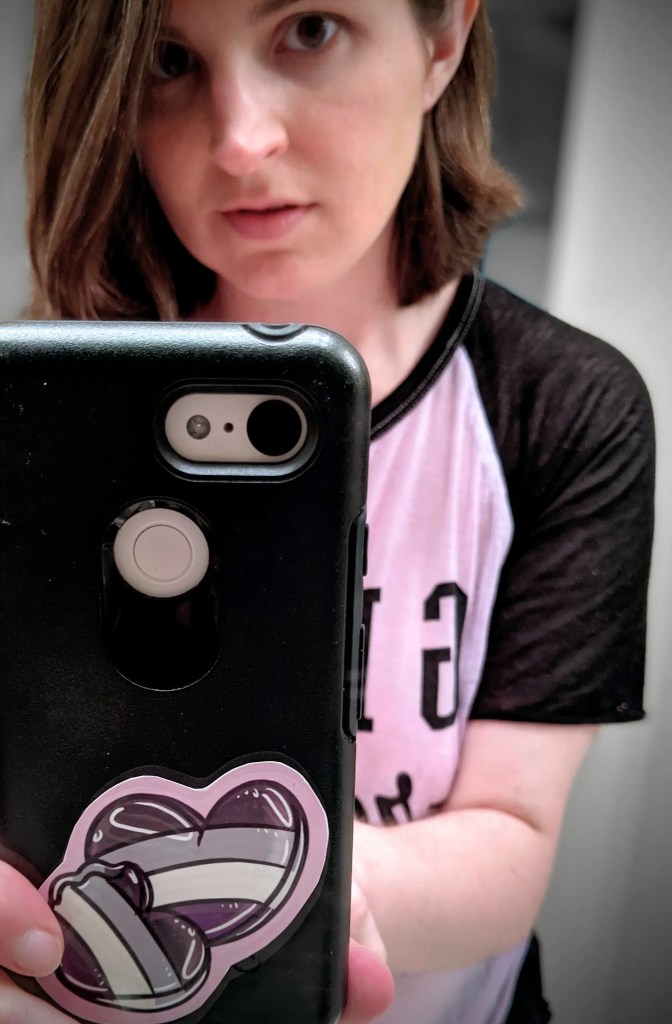
Selfie of a girl with an asexual heart sticker on a phone case
More subtle Pride selfie

For example, as an asexual girl, I wore black shorts and sandals, a purple and black shirt with a vague feminist Girls Rule the World (ironically from Victoria’s Secret haha), and a white undershirt. You CAN be as bold and bright as you want, but you can also be subtle too. Go at your own pace and comfort level. If you’re up for sloppy buzzed at drag brunch on mimosas and PDA with your visibly queer partner, go for it! If you’re just stopping by anonymously on your way to the store because you “love local culture” and “celebrate community in your city,” hear me when I say that is okay!

The scariest part is the conservative protestors. Stay away from them your first time. Don’t get into Bible battles or argue theology. Ignore, walk around, cross the street, pick a spot far from them where the music drowns out their hate, strike up conversations with people standing around unoccupied near you, especially if they have kids or are new to this too or look like they know what they are doing and are just chilling. This may require some small talk, so if that’s emotionally draining for you, don’t stress about it. Just know if you need to to feel safe or if you have a question, everyone NOT shouting is pretty friendly.

If a parade is too much, look at the schedule and just attend the markets and shows so you can leave at any time. Mind the temperature and dress accordingly (including sunscreen and WATER water water). But don’t be afraid to go. It’s just rainbow Fourth of July (or insert local parade holiday here) in small and mid-size cities.
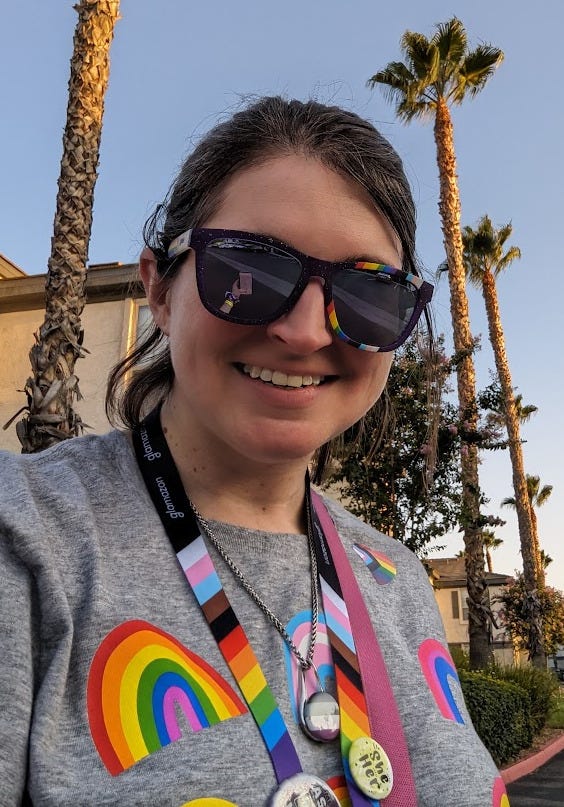
A girl in Pride gear
Me after Pride now haha

Even better is asking your affirming organization/hobby group/small business/sports team/school committee/club/church to host a booth (get connected to the festival organizers and then pass along what they say to your own leaders to have a finance/planning/outreach/service committee meeting about it NOW and don’t wait until the week before in May or June). You can use the booth to hand out water, stickers, magnets, flyers with your clear affirming stance and info to get connected, etc. Or you can join the Human Rights Campaign, Free Mom/Dad Hugs, PFLAG, or another similar organization always looking for volunteers. Leave time to walk around and enjoy Pride yourself too.

But even if you are an introvert’s introvert, or a socially anxious neurodivergent of any energy personality type, at least once when geographically possible, go be with our people in all your rainbow glory. It may take more than once to feel comfortable there. That’s okay. Just go and be in the same physical space and feel less isolated and despairing as you marinate in the joy and community and connection. Even if you don’t make a new friend or join a new group or sing karaoke or have a party bone in your body. Bring home a sticker or ribbon or locally crafted item or something, just to remind yourself every day that you were there and it is real still, in every queer and allied heart around you.

aromanticism, asexuality, essays, queer

You Are Not Bad Representation: A list of things you don’t have to do

1. You don’t have to be perfect as a queer person to prove that queerness is good. For the Christians, this might show up as pressure to individually always display fruit of the spirit to prove we are morally okay. While queer-affirming theology does lead to fruit of the spirit at a population level, you individually don’t have to be perfect to prove queerness as a whole is okay.

2. You don’t have to be content or fulfilled as a single aromantic and/or asexual person. There’s a lot of pressure on us to prove we aren’t missing out or scared of commitment or broken. But it’s okay to feel lonely because honestly life is lonely sometimes, and being a-spec in an amatonormative world is hard.

3. You don’t have to want to date or have sex even if you are allo and queer. Liberation isn’t about checking off a list of formerly forbidden behaviors. It just makes what you DO want possible because you have the freedom to choose.

4. You don’t have to want poly, open, or otherwise ethical nonmonogamous relationships in order to be supportive of others’ choices and desires. It’s okay to say this isn’t for you while advocating for others to have the same freedom of choice in the opposite direction.

5. You can decide your labels were wrong and change them, add more, or stay questioning forever. There’s no deadline to join a faction or house or cabin. This is not a fictional school or dystopian society. Even if it means detransitioning or deciding you aren’t attracted to your gender or realizing you aren’t on the a-spectrum after all. You’re always welcome as long as it’s helpful, and you’re welcome back if you change your mind or find better language. Keep fighting for your former community and be a well-informed ally.

6. You don’t have to date or have sex with someone of your same gender. You don’t have to dress androgynous as a nonbinary person or pass as cis if you’re transitioning. You don’t have to change your appearance or music or media tastes or hobbies to fit in. It’s about identity, not behavior.

7. You don’t have to renounce everyone you’ve been with or every term you previously identified with. You don’t have to have been born this way or have known as a kid. There’s no “must have exhibited symptoms before age ___” diagnostic criteria. Your whole story is your story, whether you’ve always known or just realized at age 80. Fluidity, self-awareness, and learning new terms are all valid reasons to identify differently than you did when you were younger.

8. You do not have to drink alcohol.

9. You don’t have to be feminine to be a gay man or masculine to be a lesbian. You don’t have to hate Valentine’s and rom-coms to be aro or hate sexual humor or erotica to be asexual. You don’t have to be hyperfeminine to be a trans woman or hypermasculine to be a trans man. Or feel completely androgynous to be nonbinary or agender. You can have as many genders as you want or any self-experience or expression.

10. Relatedly, you don’t have to stick to gender roles. The point is that we’re breaking free of heteronormativity, not recreating it in a more inclusive way. Stop expecting trans men or butch lesbians or bear gay men to fill patriarchal “man of the house ” “wears the pants” roles, and stop treating trans women and femme lesbians and twink gay men to be the delicate or incapable or weak one. What choices work for you is between you and your partner, not the “shoulds” of rebranded patriarchy.

faith, Poetry, queer

Politicized

We say

Your theology leads to harm

You say

That’s tough love for rebels

We say

Your politics lead to death

You say

Words can’t hurt

We say stop killing us

You say

Stop being dramatic

We grieve at headlines

We cry in news photos

We raise the alarm

And violence still comes

We say we told you so

You say now is not the time

To politicize a tragedy.

faith, queer, resources

Queer Christian resources

It’s not an easy spot to be in. The Christian community tells us to be straight. The LGBTQIA+ community tells us to leave behind religion. But we are living proof that there is a vibrant, welcoming, loving family where you can be both, fully Christian and no less queer. These sites below can connect you to church finders, resources, advocacy groups, small groups, books, social media accounts, newsletters, job listings, events, podcasts, and more.

Continue reading “Queer Christian resources”