allyship, asexuality, faith, queer

The point of all this

I want to be absolutely clear: The end goal is no more nonaffirming churches. Not a “diversity of thought” that’s just rewriting purity codes. Not a “range of opinions” with a variety of ways to exclude and dehumanize and tolerate “separate but equal.” Not a bare minimum. Not an “I love you but.”

Whether these churches accept correct, just, God-honoring theology or simply fade into history as factories of shame and harm and fake-nice, the collective liberation vision does not include nonaffirming theologies. Affirming theology *is* correct theology. We have beat around the bush long enough.

The mainline squandered opportunity after opportunity to draw that line, and we’re seeing the fruit of that, but we’re also seeing the fruit of the risk, the courage, the willingness to say NO to fence-riding and big-tent and “inclusive of all, the marginalized and the powers behind marginalization.”

In Christ, gender is not a factor for whether a marriage is holy, for whether sex is sinful, for whether someone is qualified to lead, serve, parent, teach, adopt, or write, for when passion is lust or love is healthy. That doesn’t mean we abandon discernment, but that gender isn’t relevant to it.

We are uncompromising in that. Lesbian, gay, bi/pan/+, trans/nonbinary/genderqueer, intersex, asexual/aromantic/agender, and all other kinds of queerness are not just permitted but *required* for the full reflection of the image of God and the accurate representation of the Kingdom come on earth.

Churches that factor in gender to who is permitted to do what are not only harmful, even deadly, for a small subset of the population. That is too minimizing. They are lacking in faithfulness. They are missing out on our gifts and our presence, but they are also missing out on the real, true God.

Conviction isn’t the enemy. Just like how becoming affirming isn’t “throwing out sexual ethics” or “there are no rules” or “rewriting history/the Bible,” it also isn’t an accommodation we’re asking for, a way to boost your Good Person points, or a secondary issue. It’s accurate, correct, right.

Have the courage to say so. Have the willingness to exclude the intolerant beliefs and opinions while honoring the need to listen, learn, grow, influence, and teach. It’s not about excluding individuals; it’s about setting our doctrinal truth, our policies, our reason for being.

Conservatives will panic: “See, the crazy liberals want to erase us! They want to eradicate us! They discriminate against us! The intolerant left!” Yes. I do. I want to erase the possibility that any queer kid grows up thinking God hates, Jesus is ashamed, or the Spirit would take away their joy.

I want to eradicate queer death, suffering, rejection, and homelessness. I do discriminate against bigotry and hate and fear-peddling propaganda lies. I want the world to stop tolerating violence, inequality, and terror in the name of “religious freedom,” “thought diversity,” and “broad umbrellas.”

We refuse anything less as the destination. The future is one where every church is practicing and preaching the truth, the life, the freedom, and the blessing that is only reflected with full queer welcome, inclusion, affirmation, belonging, and leadership at every level.

allyship, aromanticism, asexuality, Poetry, queer

Occurrences

It occurs to me tonight to put my rainbow grocery bag in the trunk. Not just because that’s where it belongs, but to not give anyone an excuse to take out their religion on my car window.

It occurs to me that if I were in a redder county, I would never have left it visible to begin with.

It occurs to me on a Walmart run after work that I should have taken off my company staff badge with the Pride flag on the back while walking alone in the dark.

It occurs to me that in other places, I would never have been allowed to put that sticker on my identification to begin with.

It occurs to me to move my black ace ring to my left ring finger in a protective lie, signaling to the men of the crowd that I am another man’s property. If they don’t respect my humanity, they may respect the rights of possession—or at least the fear of violating them.

It occurs to me that I have the privilege of safety in being gender conforming, able to chameleon my way into invisibility.

It occurs to me that I have to constantly remind people I know what I’m talking about, that my experiences are erased, that I am here too, that we are not new or a trend or a bonus feature.

It occurs to me that I do not require documents to be changed, or medicine to be seen as myself, or a search for my literal voice with the help of lessons.

It occurs to me that I am likely the only one you know. That when I speak, I must point to many others like me but not like me, so you have a broader view.

It occurs to me that I occupy a space of assumed privilege as others explain marginalization that I live every day myself. Amusing at times, but mostly frustrating.

It occurs to me that my intersections give me advantages to steward so others will be heard.

It occurs to me that most people don’t have to wonder if their friends, family, church, or job will disown them over basic identity facts. If they confess who they are, will they receive a birthday card this year, will they have any references for their job applications, will they be welcomed home at Christmas, will they still have an emergency contact?

It occurs to me that others have faced far worse: Will they still have a home, food, a functional body, their lives?

It occurs to me that there is safety in numbers, and my numbers are small, often just me and my carabiner and my rainbow T-shirt.

It occurs to me that an ally up the mountain was murdered for less.

It occurs to me that I can change my shirt, but others can’t change their voice, their government, their bones.

It occurs to me that some allies will only care to the point that it is comfortable to be with us. Our humanity is an issue on which they agree to disagree with friends and colleagues and those who can help their careers.

It occurs to me I must have patience for the indoctrinated.

It occurs to me that I don’t have the tolerance to wait.

It occurs to me, too, that even the wait is privilege. Others, our youngest, are running out of time.

allyship, essays

Look to the Helpers

man in blue crew neck t-shirt standing beside brown cardboard boxes

Photo by Ismael Paramo on Unsplash

I often see people saying “Look for the helpers is for kids, you’re the adult, YOU’RE the helper!” a lot, but Mr. Rogers wouldn’t have said kids can’t help, and he definitely wouldn’t have said adults should “just do it” instead of looking around for people who are already doing the work, learning from them and following their lead, and then joining in with where their abilities meet the actual needs and requests of those they are helping. The work is already being done, and we can’t just “be the helper” without understanding it and our place in it.

You are not too young to be a helper. And you are not too old to need help, to defeat despair with hope, and to join in the work already in motion. Remember it’s about when we are shocked by tragedy and overwhelmed by suffering. It’s about what you do when you’re staring down images of death and disaster, and then it’s about where to look next. You see the debris on TV. You see the virus totals. You see the crying kids. But then… you see the firefighters, doctors, nurses, volunteers, etc. Ah. There.

It’s still Giving Tuesday as I’m writing this, and maybe you can be a helper in a recurring or one-time donation. Maybe you don’t have money but you have a few hours to spare, if you bring the kids along with you. Maybe you don’t have time or money, but you have a social media following to inform others, a place of influence in policy, an organization you lead, a church or club you can rally, a professional skill you can use pro bono, a boat or a car or a business to run aid and relief efforts from.

Whether you’re defending human rights by filing suits and explaining contracts, or book-keeping for a nonprofit, or paying a construction crew out of your own pocket to rebuild the community center after a big storm, there’s a way to help. You can be an 8-year-old shopping for an Angel Tree gift or a 90-year-old knitting blankets for foster babies or a 60-year-old making phone calls and grocery runs for a disabled neighbor. You can look, LEARN from the helpers, and go do it too.

But please, I say this delicately, do not jump in like a missionary, hero-complex White savior and try to just “help” without looking to the helpers first. No one needs the worn-out-snow-coats sent to Haiti after the earthquake incident ever again. No one wants your broken appliance as a “donation” they have to be grateful for. Nonprofits can’t spend all their time making you feel needed. No finding youth pastors a house in a Latin American country for teens to paint over and over each summer as a mission trip or service project. Remember when the hospitals asked us to stop hand-making masks and dropping them off at the start of COVID because they aren’t adequate medical PPE and weren’t safe/sterile/tested, and well-intentioned crafters bringing them in might be carrying the virus?

Looking to the helpers was Mr. Rogers’ way of redirecting attention from despair to hope, from overwhelm and panic into action and progress. But it’s also just exactly what a wise, veteran minister or leader would say after seeing so much suffering to shepherd people through. Who’s already doing the work? Who already has systems and strategies and coalitions and networks? Who is asking and what are they asking for? How can I help and serve, not how can I make myself feel like a hero? Look and ask and follow before leaping into “helping.”

Fred Rogers was a Presbyterian, but in a moment of ecumenism he might have appreciated, I’ll add an Extremely Methodist Take for you.

You’ll often hear me say “Stop trying to ~manifest~ a miracle to save the world. You are the miracle!” I’m a social gospel Methodist always asking people to get up from begging for supernatural shows of power and divine interventions to BE the body of Christ in the world. It’s us! We’re the answer God has provided to the problem of pain! We are the divine intervention. But know that it is always with this context: root yourself in the Wesleyan quadrilateral first. “Tradition” aka, learn from the past and from those around you who’ve been doing it. Reason, aka, does it make sense in facts and data, is it actually what anyone needs or wants or is asking for? And the experience of the Spirit within you will remind you how far you’ve come and what’s been impossible made possible before you, and They will lead you forward, even when the odds seem against you and hope is scarce and the problem is too big for you or your group alone. We trust the Spirit of Love, higher than us, to work to bring us all together so each person or group’s contribution matters in a bigger picture we can’t see from here.

Look to the helpers in humility when you need help, in example when you need an education, and in leadership when you are ready to serve and join in to be a helper yourself, in any age, ability, skills, gift, contribution, or capacity you can bring to the work of collective liberation.

allyship, essays

If it’s not for all of us, I don’t want it

Collective liberation is not found in violent revenge and dreams of becoming oppressors. Collective liberation is not about demanding fealty and enemies bowing at your feet. Collective liberation is refusing to accept such and rejection of oppressive systems.

It is an invitation with an expectation: No dehumanization allowed. It does ask something of us, a dress code of sorts, that we bring love, real love, to the party. We come with the understanding and shared value that no one is an acceptable casualty of liberation.

Civil rights march on Washington, D.C
Photo by Library of Congress on Unsplash

Sometimes we must remember the long road. We must take the closest imperfect bus to our destination when it doesn’t go all the way and march our way down the road, generation after generation. Passing along what we have gained and refusing to go back.

Collective liberation doesn’t see my freedom as your continued harm. If you are freed, I cannot be your new target to get the acceptance of oppressors. Exclusion is the thing we exclude. Vitally, we do have one thing we must agree on, that we are tyrants for: No more tyrants.

a group of people walking down a street holding a banner that says Equality without exemptions
Photo by Nikolas Gannon on Unsplash

From Cone to Kendi, from Stonewall to Sherronda J. Brown and Judith Butler and my friends on social media, from the earliest church to the women of modern books, Substacks, podcasts still resisting a patriarchal faith, we learn the only liberation worth having is collective.

If our gospel leads to death for some, it isn’t the Words of Life for any. If our work is only legitimized by those we leave out of it, it isn’t the work of Christ. We start imperfectly and evolve continually to be better. If we uphold the harm, we cannot liberate from it.

Signs saying Boys will be held accountable
Photo by Michelle Ding on Unsplash

allyship, aromanticism, asexuality, queer, resources

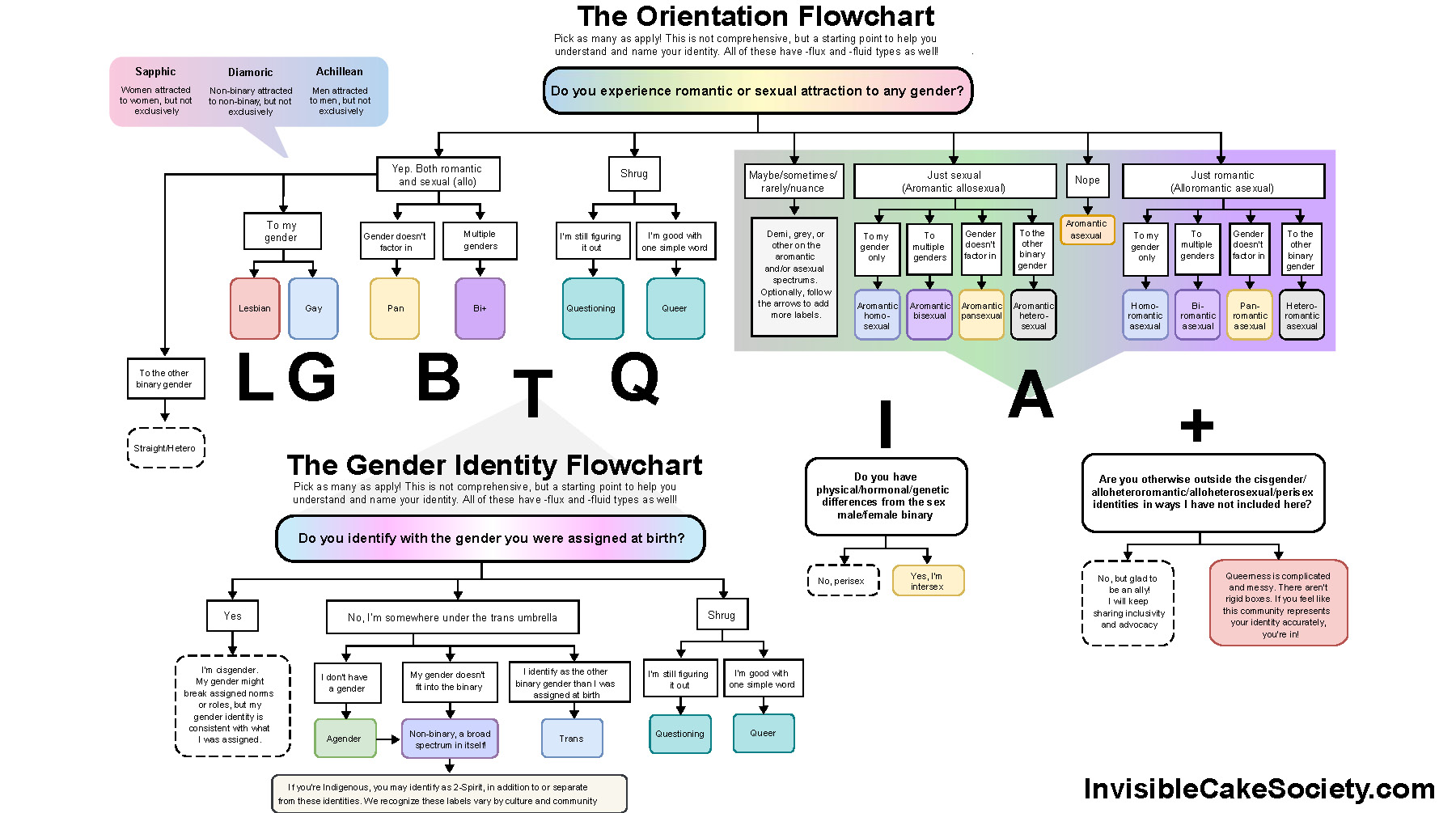
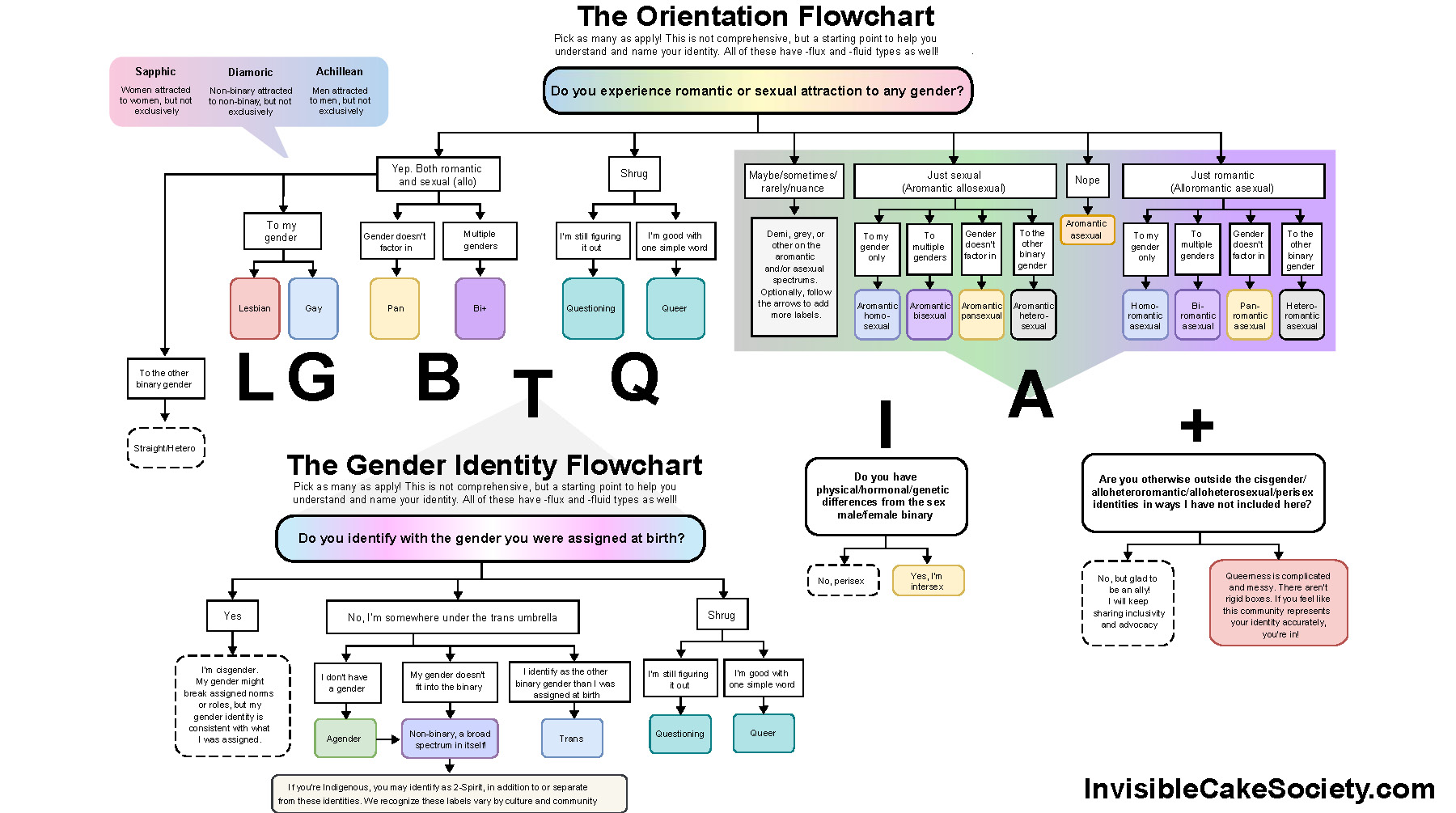
The Queer Identities Flowchart

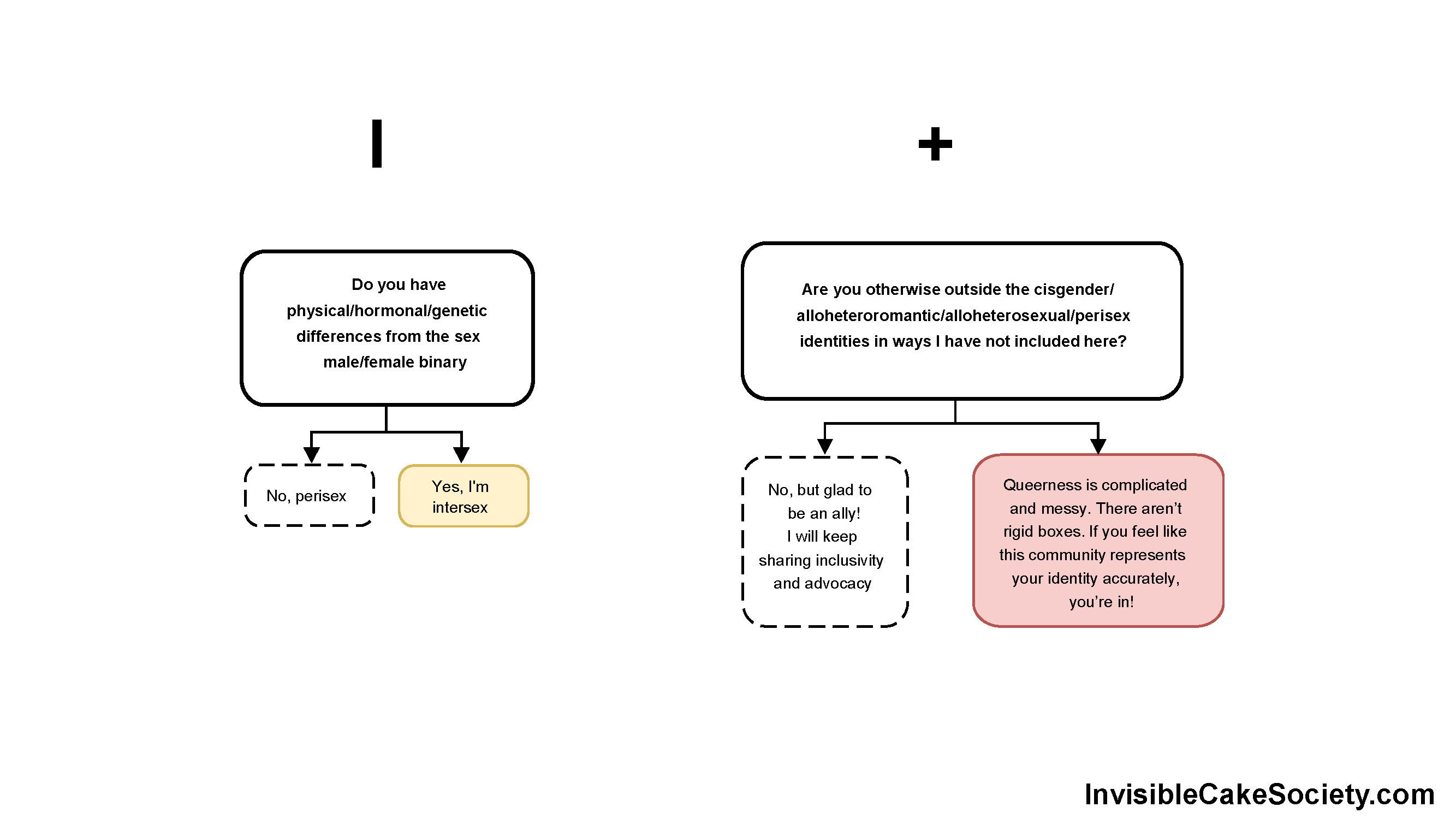
  • LGBTQIA overview
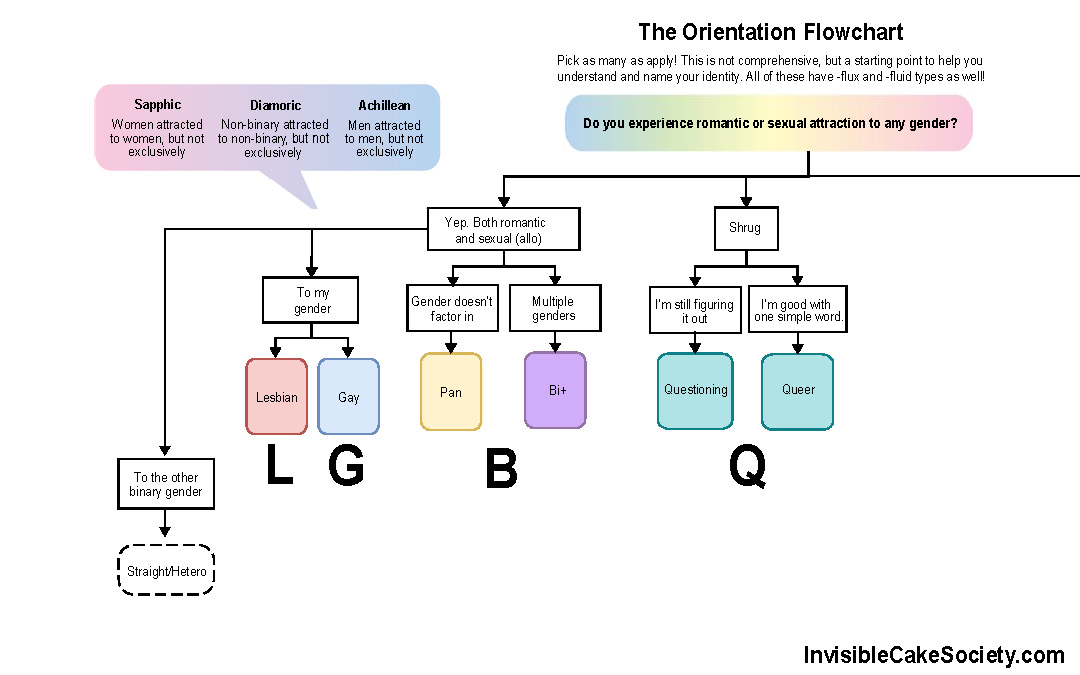
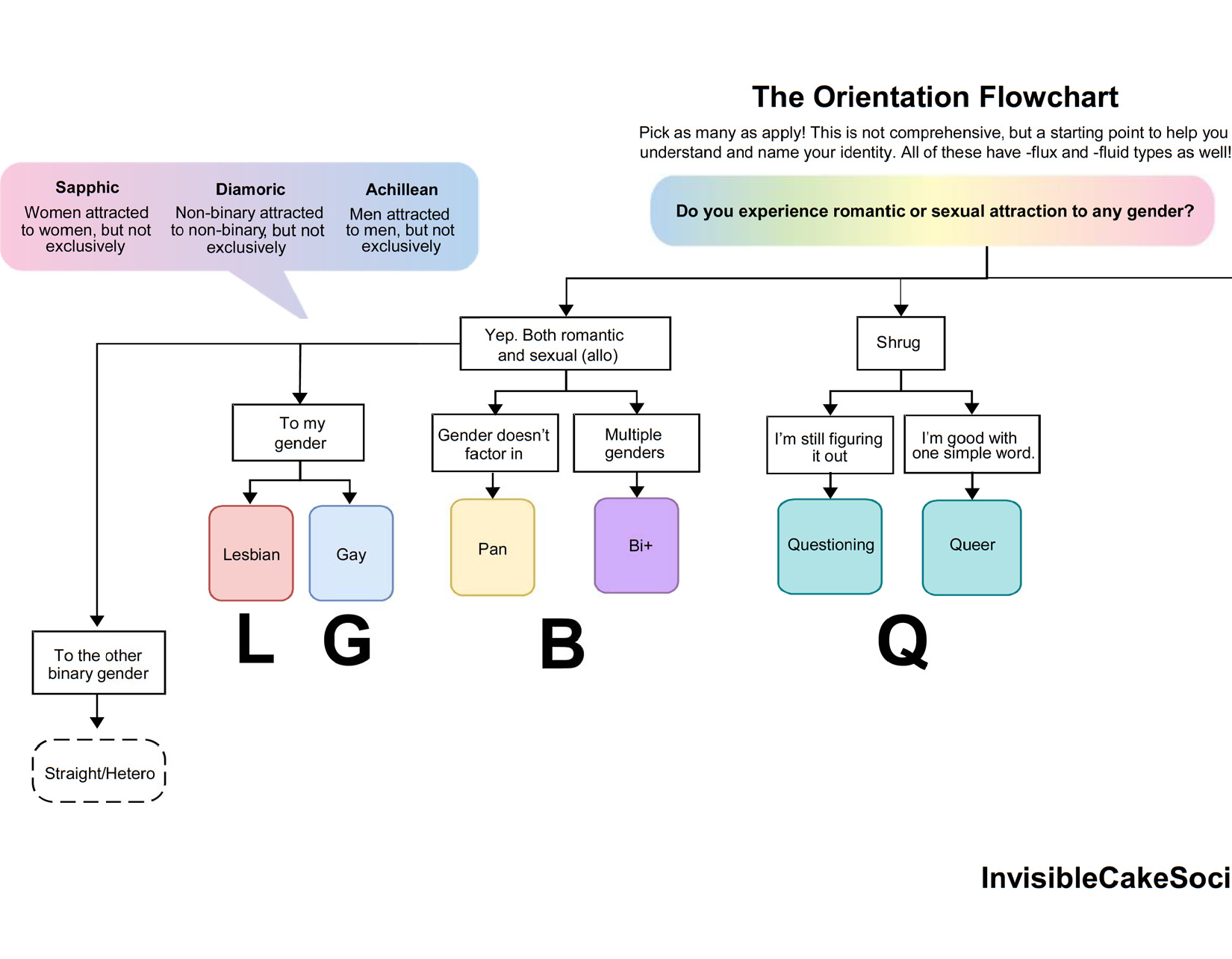
  • L G B and Q
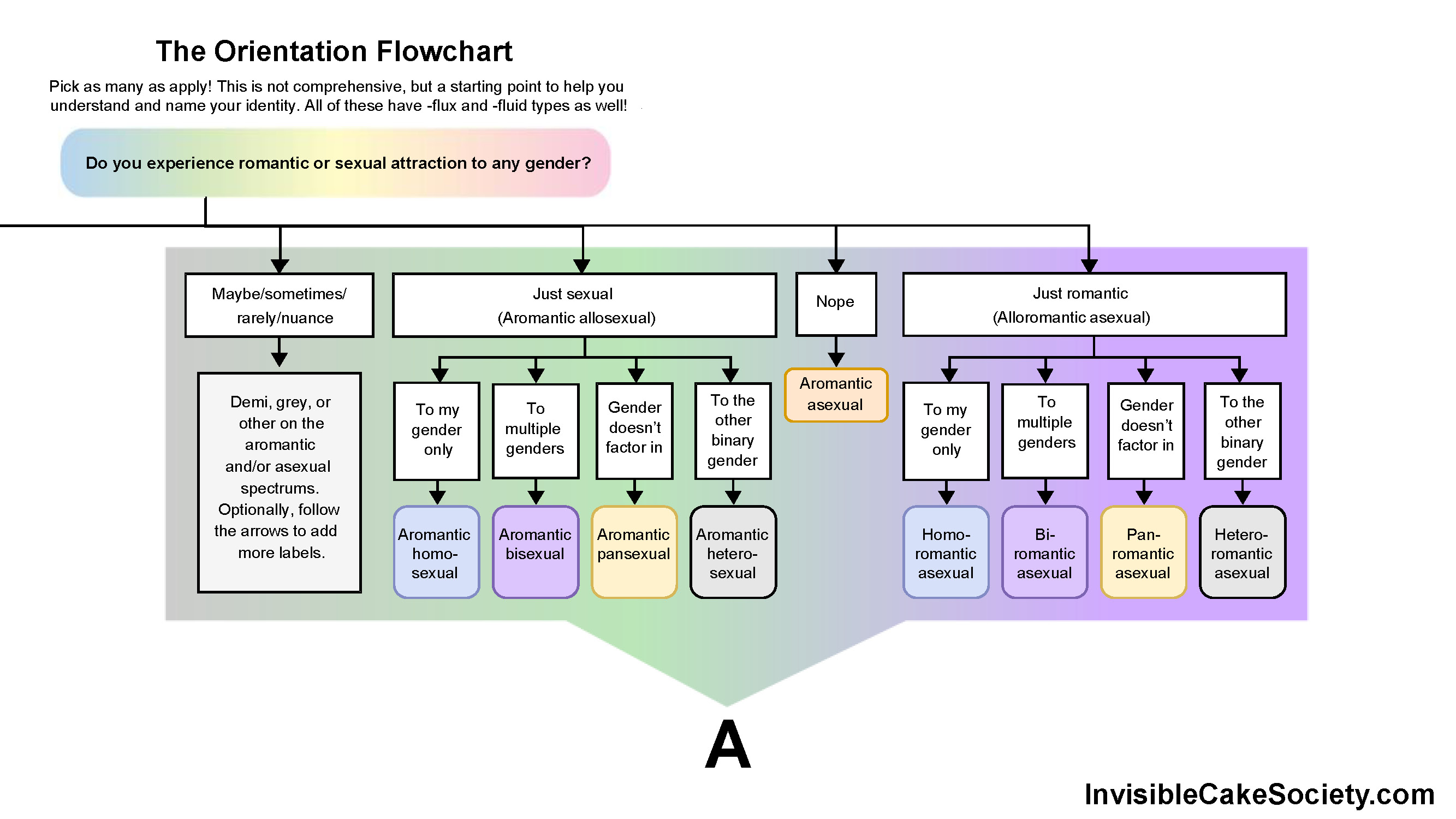
  • A spectrum
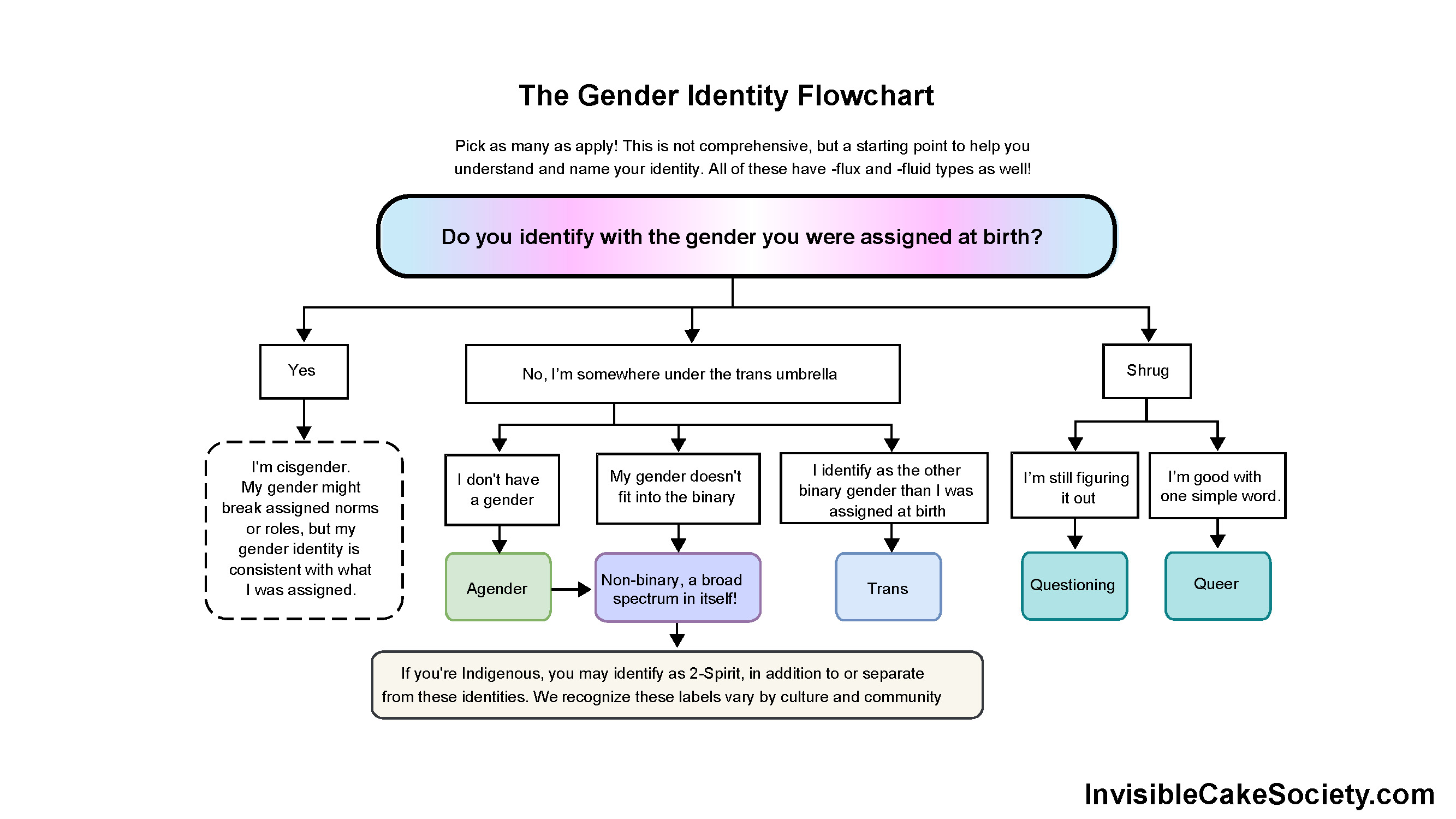
  • Gender spectrum
  • Intersex and plus

I’m hoping this flowchart can help everyone understand that the letters aren’t just a jumble of alphabet soup, but there is an organized system behind each one. It’s easier to see if you click the arrows to navigate through each slide, focusing on a specific section. These concepts are pretty much a multiple-choice test.

Orientation options include:

  • Attracted to the other binary gender
  • Attracted to my gender
  • Gender isn’t a factor
  • Attracted to multiple genders
  • Don’t know/don’t need to specify
  • Rarely or in certain situations
  • Just sexual
  • Just romantic
  • None of the above

Gender options include:

  • Same as the one everyone expected when I was born (“assigned at birth”)
  • No gender
  • Fluid or more than one gender or a gender not in the binary
  • The other binary gender of the one everyone expected when I was born

Intersex identities and other variations of queerness are also included.

Open these in a new tab or zoom in to explore!

LGBTQIA overview
A spectrum
Gender spectrum
Intersex and plus

Hope these are helpful! This is meant to be the start of the conversation, not the end point. Explore more in-depth and specific identities here: https://lgbtqia.wiki/wiki/LGBTQIA%2B_Wiki:FAQ

allyship, faith, queer, resources

Worship resources for affirming churches

Explore the links on this page for liturgies, devotionals, worship services, naming rites, marriage ceremonies, prayers, songs, Bible commentaries, and more.

A Sanctified Art

Word Made Queer

Our Bible

Enfleshed

A Place in God’s Heart, A Place at Christ’s Table published by the National Gay & Lesbian Task Force

Illustrated Ministry graphics

Many Voices

Common Word

Sam Lundquist

Out in Scripture reflections on the HRC

Creating Sanctuary UK – Prayers and reflections guide

Parity

Music

Worship resources created by denominational LGBTQIA+ advocacy organizations but open to all churches:

See the Queer Christian resources list for more!

allyship, essays, faith, queer

Why I don’t do queer apologetics

Here’s the thing about arguing for queer rights and dignity. I can give them the ACLU map of ~500 anti-LGBTQ bills in the US. They will say those bills are good, actually. I can give them book lists, but they’ll say those are made up for profit.

I can give them story after story, but it’s just anecdotes, not hard data. I can give them data from the best experts, but they will say it’s flawed and poor quality and biased. I can show them history, but they will say that’s in the past, not today.

I can explain rainbow capitalism, but they will say that’s just evidence we control society and are oppressing THEM, actually, by forcing them to see we exist. I can tell them straightphobia isn’t real. I can say that accountability is not bullying. But their hearts are hardened.

I can say religion doesn’t actually require you to oppress us, and allowing our existence is not religious persecution, but they say I’m a heretic and leading others astray because their god is cisheteropatriarchy. I can say they are called to love. They say their harm IS love.

If I don’t use religion, they say I abandoned my faith. If I do, they say I’m manipulating it to fit what I want it to say. If I use science, they will say science isn’t reliable and researchers are under pressure from liberals. If I don’t, they’ll say science is on their side.

If I rehash my trauma and every other queer person’s, it won’t be enough and I’m just an emotional, irrational, delusional victim of the conveniently amorphous and vaguely defined “culture.” If I point out the reality of our queerphobic culture, they say I’m exaggerating. If I try to give them evidence, the cycle restarts, ad nauseam.

So that’s why I block instead of educating those I can tell are unwilling to learn. It’s an unwinnable system. I’d rather spend my limited time on equipping queer people and allies. If you have genuine questions and want to learn, you are welcome here. Take a look around.

allyship, essays, queer

The rainbow baton

I’ve been marveling a little at how far we’ve come in our lifetimes. There’s so much queer content now, not just coded but stated clearly, that it’s a major party platform to ban it.

That entire religious denominations are splitting in half (half with us!) and have to go to extreme financial and legal lengths to fight against us. City councils and school boards have allies at them, vocal and not anonymous! Support is so high that the haters have to resort to coordinated campaigns and recycle their fear-mongering and dig out Anita Bryant’s old catchphrases to make Florida the leader in hate again instead of just taking it for granted that we are society’s undesirables.

Continue reading “The rainbow baton”
allyship, aromanticism, asexuality, disability, faith, Mental health, neurodivergence, queer, resources

Naming

As you might assume from my content on this site, I carry a lot of labels. Some are less well-known than others, and some carry inaccurate connotations. Some I am constantly working for greater awareness of, and others I keep quieter about. These labels have been immensely helpful for me, whether they are as specific as a microlabel on the spectrum of aromantic and asexual identity or as broad as the unifying and nebulous umbrella terms that I’m not sure where all I fit within.

Naming is important to self-concept and acceptance of our identity, but there are equally important stages that we move through before and after we first say, “Hi, my name is ____ and I’m ____.” These aren’t strictly linear, but they are numbered for the sake of organization:

Continue reading “Naming”
allyship, essays, faith, guest post, queer

Raising affirming kids when you weren’t raised that way

I’m honored to introduce you to my friend and former coworker Bekah McNeel. Bekah is an author, journalist, and podcaster (check out our episode together here!) who works tirelessly for those on the margins to have their voices heard and to bring about real change through the power of storytelling. I asked her if she would be willing to share with us her perspective on raising kids in affirming theology and modeling allyship as a parent. Read her wisdom here and then read her book, Bringing Up Kids When Church Lets You Down: A Guide for Parents Questioning Their Faith, which covers many more topics relevant to this community. 

Continue reading “Raising affirming kids when you weren’t raised that way”