aromanticism, asexuality, disability, essays, faith, Mental health, neurodivergence, queer

A complicated year

I started this year with a specific Word of the Year, a tradition in Christian women’s circles dating back to the heyday of the “blogsphere.” I usually don’t remember mine by April, but this year was different. This year the word that came to me, or that I picked (depending on what you believe about such things), was “complicated.”

As in, letting myself be.

I refused to simplify myself any longer. I would not pretend to be straight for others’ comfort. I would not pretend to be the perfect gold-star aromantic asexual person while denying the reality of my vague sapphic attractions, while accepting that I would never be fully accepted in the lesbian community either. Aromantic and yet a romantic. A cis woman and yet deeply, intrinsically, queerly, asexually so.

I would not hide that I have nontraditionally presenting ADHD in addition to my variety pack of mental illnesses. I would give up trying to screen and test myself over and over for autism, which I probably don’t actually have but also don’t not have entirely. I would be hyperactive and exhausted, both wrapped in brain fog and begging for someone quick enough to catch up with my twice-exceptional brain that has already put the pieces together. I would live into the reality of my disabilities despite feeling unqualified to use that term. I would respect my body’s needs and differences as my own and not the object of others’ expectations.

Continue reading “A complicated year”
essays, faith, queer

The persuasive power of queer joy

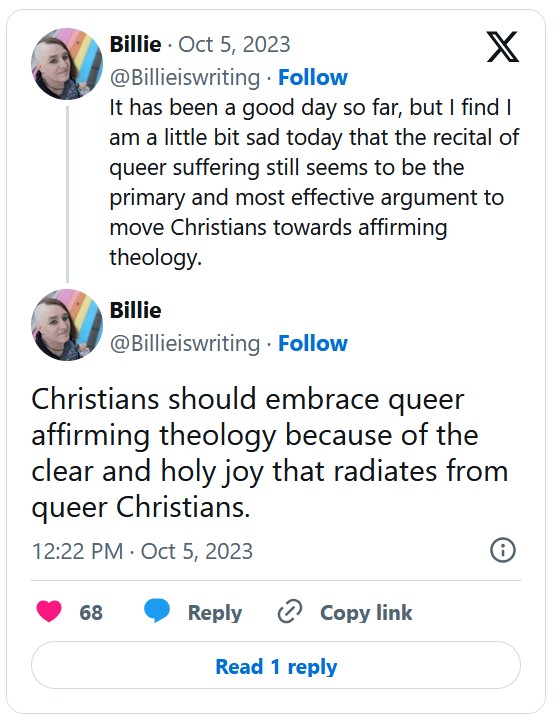
Yesterday, my Twitter friend Billie Hoard wrote out this thread and I was blown away by how true it resonated with me and so many. I asked her if I could include it as a guest post here so you could save it, return to it, and share it with those who need to hear it.


I find I am a little bit sad today that the recital of queer suffering still seems to be the primary and most effective argument to move Christians towards affirming theology.

Christians should embrace queer affirming theology because of the clear and holy joy that radiates from queer Christians.

Christians should embrace queer affirming theology because “look at how they love one another” while lacking everywhere, is more true of the queer community as a whole, despite our infighting and fractures, than it is of the Christian community as a whole.

Christians should embrace queer affirming theology because God’s Holy Spirit is moving among queer Christians and who are they to deny inclusion to those the Lord God has already included.

Christians should embrace queer affirming theology as a joyful embrace of God’s diverse and diversifying Creation.

Christians should embrace queer affirming theology because queer weddings are some of the most beautiful images of God’s love for Their Bride, the church, that anyone will ever witness.

Christians should embrace queer affirming theology because the sparkle in the eye of a trans girl who gets her first dress is a window into the absolute dancing Joy of the Holy Spirit as She witnesses our sanctification.

Christians should embrace queer affirming theology because our ace and aro siblings carry so much of God’s joy and wisdom regarding connection and being in the world.

Christians should embrace queer affirming theology because our non-binary siblings are some of the most free and beautiful humans on this planet of ours and the dance of their lives teaches us so so much about the Trinity and ourselves.

Christians should embrace queer affirming theology because without queer people the Body of Christ is incomplete and bleeding.

Christians should embrace queer affirming theology because trans men have so much to teach us all about what is and is not healthy in our culture’s take on masculinity. They show us the masculinity of Christ.

Christians should embrace queer affirming theology because of the glory, passion, and wholeness that our bi and pan siblings bring to this world.

RT or reply on Twitter to add your own positive reasons why Christians should embrace queer affirming theology without reference to or need for showcasing queer suffering!


Billie Hoard is a transgender lesbian wife and father, a high school teacher, an author, and a queer Anabaptist radical. A consummate generalist, she holds an MA in liberal arts, and she writes on topics ranging from fairy tales and C. S. Lewis to theology, queerness, and philosophy.

Follow her on Substack (https://billieiswriting.substack.com) and @billieiswriting on Twitter, BlueSky, and Threads.

allyship, essays, faith, queer

Why I don’t do queer apologetics

Here’s the thing about arguing for queer rights and dignity. I can give them the ACLU map of ~500 anti-LGBTQ bills in the US. They will say those bills are good, actually. I can give them book lists, but they’ll say those are made up for profit.

I can give them story after story, but it’s just anecdotes, not hard data. I can give them data from the best experts, but they will say it’s flawed and poor quality and biased. I can show them history, but they will say that’s in the past, not today.

I can explain rainbow capitalism, but they will say that’s just evidence we control society and are oppressing THEM, actually, by forcing them to see we exist. I can tell them straightphobia isn’t real. I can say that accountability is not bullying. But their hearts are hardened.

I can say religion doesn’t actually require you to oppress us, and allowing our existence is not religious persecution, but they say I’m a heretic and leading others astray because their god is cisheteropatriarchy. I can say they are called to love. They say their harm IS love.

If I don’t use religion, they say I abandoned my faith. If I do, they say I’m manipulating it to fit what I want it to say. If I use science, they will say science isn’t reliable and researchers are under pressure from liberals. If I don’t, they’ll say science is on their side.

If I rehash my trauma and every other queer person’s, it won’t be enough and I’m just an emotional, irrational, delusional victim of the conveniently amorphous and vaguely defined “culture.” If I point out the reality of our queerphobic culture, they say I’m exaggerating. If I try to give them evidence, the cycle restarts, ad nauseam.

So that’s why I block instead of educating those I can tell are unwilling to learn. It’s an unwinnable system. I’d rather spend my limited time on equipping queer people and allies. If you have genuine questions and want to learn, you are welcome here. Take a look around.

allyship, essays, queer

The rainbow baton

I’ve been marveling a little at how far we’ve come in our lifetimes. There’s so much queer content now, not just coded but stated clearly, that it’s a major party platform to ban it.

That entire religious denominations are splitting in half (half with us!) and have to go to extreme financial and legal lengths to fight against us. City councils and school boards have allies at them, vocal and not anonymous! Support is so high that the haters have to resort to coordinated campaigns and recycle their fear-mongering and dig out Anita Bryant’s old catchphrases to make Florida the leader in hate again instead of just taking it for granted that we are society’s undesirables.

Continue reading “The rainbow baton”
allyship, aromanticism, asexuality, disability, faith, Mental health, neurodivergence, queer, resources

Naming

As you might assume from my content on this site, I carry a lot of labels. Some are less well-known than others, and some carry inaccurate connotations. Some I am constantly working for greater awareness of, and others I keep quieter about. These labels have been immensely helpful for me, whether they are as specific as a microlabel on the spectrum of aromantic and asexual identity or as broad as the unifying and nebulous umbrella terms that I’m not sure where all I fit within.

Naming is important to self-concept and acceptance of our identity, but there are equally important stages that we move through before and after we first say, “Hi, my name is ____ and I’m ____.” These aren’t strictly linear, but they are numbered for the sake of organization:

Continue reading “Naming”
essays, faith, queer

What do we do with all this grief

Today, Sarah Bessey asked her readers on her Substack about all the losses that come with deconstruction/faith evolution. It made me think of a related, often simultaneous loss when that deconstruction is part of coming out as queer:

There’s something I tell queer people when they come out and lose so much (or publicly identify as allies). Yes, you will lose belonging and comfort. Maybe your job, church, friends, family, sense of stable identity, certainty, easy acceptance into your communities, even safety. But by being vulnerable, that courage opens many doors as well. You are not alone in this. You are welcome to grieve together with others who have lost the same. You are now part of a free, inclusive, authentic family. It is so so so painful, and there is so much to mourn and lament in the rage and tears. No, it isn’t fair. Yes, it would have hurt so much less if people saw and loved the full, real you.

Continue reading “What do we do with all this grief”
faith, Poetry, queer

Politicized

We say

Your theology leads to harm

You say

That’s tough love for rebels

We say

Your politics lead to death

You say

Words can’t hurt

We say stop killing us

You say

Stop being dramatic

We grieve at headlines

We cry in news photos

We raise the alarm

And violence still comes

We say we told you so

You say now is not the time

To politicize a tragedy.

allyship, essays, faith, guest post, queer

Raising affirming kids when you weren’t raised that way

I’m honored to introduce you to my friend and former coworker Bekah McNeel. Bekah is an author, journalist, and podcaster (check out our episode together here!) who works tirelessly for those on the margins to have their voices heard and to bring about real change through the power of storytelling. I asked her if she would be willing to share with us her perspective on raising kids in affirming theology and modeling allyship as a parent. Read her wisdom here and then read her book, Bringing Up Kids When Church Lets You Down: A Guide for Parents Questioning Their Faith, which covers many more topics relevant to this community. 

Continue reading “Raising affirming kids when you weren’t raised that way”
asexuality, queer, resources

Ace and allo partnerships

Recently, I was asked about ace and allo marriages, and I didn’t have any resources about marriage/partnership and asexuality, especially when one of those partners is allo. In fact, there really aren’t many resources like this out there in general. I’ve never been in a partnership like this as an adult, so I don’t have any experience in this area to draw from. However, aces and their allo partners on Twitter were eager to help and share what they have learned. We all hope these stories and links can strengthen ace/allo marriages and long-term committed partnerships of all kinds. 

My thanks to M.J. Weissenberger, Mitchell Atencio, Grey, Loxley Blaine, Russ Walker, Case, Cody Daigle-Orians, Kate Wood, our anonymous friends, and everyone who replied to my tweet here.

Many mentioned setting boundaries, trying nontraditional things that work for you (separate beds or bedrooms, for example), honest communication, being willing to compromise when you can but be honest when you can’t, and learning more about various ace labels and experiences to have clearer language to communicate your needs and desires. While therapy in general is a good fit for this kind of relationship issue, many therapists are not ace-informed, especially marriage and relationship therapists, so be careful going in to choose someone who understands your situation and won’t pressure you into sex or relationship structures that don’t work for you. For example, some ace/allo partners found polyamory was a good fit and enjoy multiple relationships, but others didn’t and resented how it was assumed or presented as the “solution” to fix their relationship. Some of these answers may work for you and some won’t. They are not blanket solutions, simply lived experiences of those in these partnerships.

Here’s more of what aces and allos in relationships with aces had to say:

Continue reading “Ace and allo partnerships”