
asexuality, essays, faith

Shame boxes and liberation

You’re going to hear me say a phrase a lot: “Sexual liberation includes the choice not to have sex.” What do I mean?

Sex-negative purity culture and celibacy-shaming culture are part of the same harmful system with moving goalposts. Both force sex on us.

The fight is not purity culture vs. hookup culture. The fight is true sexual liberation and self-agency against mandates controlling our bodies. No one can tell you you have to have sex in order to be good, normal, healthy, or mature. Not in marriage, not in singleness.

If sex positivity ends when “no” is said too often, expressed too confidently, or extends to a certain age before it’s “not normal! Humans NEED sex!”, that’s not sex positivity. It’s still a form of purity culture with a different set of rules you’re forced to play by. Other people’s standards.

Purity culture isn’t about abstaining from sex. It’s about putting strict rules on when you *must* have it. Secular culture simply removes the marriage element. There’s something “wrong” with you if you’re a “sad virgin” at 21, they say. “He just needs to get laid.” “What a frigid bitch.” etc.

If you don’t have sex, whether in marriage or out of it, you’re a freak. Doctors want to find out why you’re sick. Therapists worry about you and think if you just tried dating or hooking up, you’d find healing. Friends don’t trust you because surely you have to have something wrong with you.

No, maybe family doesn’t kick you out, but they sure as hell pity you and look down on you and shame you. You’re a joke. You’re a political jab. You’re a concern. The GOP wants to make you an example of all the things wrong with this country. “Your body, my choice” they scream now.

trigger warning: SA

You have to worry about getting pregnant even if you don’t want to have sex ever because telling men that leads to them thinking it’s a challenge. We call it corrective rape. Correcting what’s wrong with us.

Meanwhile conversion therapy plays out for us every day because we’re considered mentally or physically ill if we don’t have sex by (16? 18? 22? 30? 45?). No one has to make a “Side X” or “nonaffirming” camp for asexuality because it’s the air we breathe. It’s everyone around us.

Even those who consider themselves affirming of us think of it as a niche, for “those people.” Good for them, but for NORMAL people, you know, real humans need sex. Real adults mature into wanting sex. Real liberated people say “yes.” The consent is for us to feel morally, culturally pure about it, not for you to actually refuse over and over. And certainly not forever. Eventually, you’re “supposed to” want it.

But maybe you don’t. Whether by orientation or interest or opinion or lack of suitable options.

I’m not at risk of being excommunicated for staying celibate and single by church policy. I’m at risk of being excommunicated from society by refusing to let men use my body for things I don’t want just so I can meet some developmental norm or perceived biological need (of theirs, of course) or hit a milestone or rite of passage to prove I’m not “weird” or “broken” or making others uncomfortable.

Is it better than being kicked out of a home as a teen? Sure. Am I still fighting every day to get people to see the harm of amatonormativity and allonormativity? Now and always.

Liberation and bodily autonomy.

If that’s what you’re for, you are united with us in the same fight against purity culture. If this feels like a threat to you, consider liberating yourself and those around you from the shame boxes altogether. Both the purity culture box and the not-sexual-enough shame box.

Collective liberation is for all of us to have the freedom to determine our own choices, about our bodies and identities and lives. It’s shaping the kind of society we want to live in. We have to think bigger than judging people for the sex they have or haven’t had. That’s not enough. Liberation respects, trusts, and honors each of us living as our whole selves authentically true to our needs and what is freedom to us.
allyship, faith, queer, resources

Worship resources for affirming churches

Explore the links on this page for liturgies, devotionals, worship services, naming rites, marriage ceremonies, prayers, songs, Bible commentaries, and more.

A Sanctified Art

Word Made Queer

Our Bible

Enfleshed

A Place in God’s Heart, A Place at Christ’s Table published by the National Gay & Lesbian Task Force

Illustrated Ministry graphics

Many Voices

Common Word

Sam Lundquist

Out in Scripture reflections on the HRC

Creating Sanctuary UK – Prayers and reflections guide

Parity

Music

Worship resources created by denominational LGBTQIA+ advocacy organizations but open to all churches:

See the Queer Christian resources list for more!

aromanticism, asexuality, resources

International A-specs!

April 6 is International Asexuality Day, highlighting asexual organizations and people all over the world. Asexuality is not unique to North America or the UK. We are everywhere in every culture and country and time zone. Here are organizations highlighting not only asexuality but also aromanticism and both spectrums.

Argentina: https://twitter.com/asexualidad_ , https://twitter.com/arromanticos, https://twitter.com/Asexhh

Asia: https://linktr.ee/asexualityasia

Australia, New Zealand, Oceania, Asia Pacific: https://acearolinks.carrd.co/

Brazil: https://linktr.ee/coletivoabrace

Germany: https://aspecgerman.de/, https://twitter.com/aro_sphere, https://twitter.com/ace_arovolution

India: http://www.indianaces.org/

Ireland: https://aspecsireland.carrd.co/, https://twitter.com/IrishAsexuality

Mexico: https://asexualesmexico.com/

Netherlands: https://aseksualiteit.nl/

Nigeria: https://twitter.com/AceandNigerian

Spain: https://asexual.es/

UK: https://twitter.com/GlasgowAce

US: https://twitter.com/acelosangeles, https://twitter.com/AcesNYC

More ace and aro organizations across the U.S., Europe, and the Philippines: https://acesandaros.org/groups

More aro organizations here: https://www.aromanticism.org/en/in-person-communities

More ace organizations here: https://internationalasexualityday.org/en/local/

aromanticism, asexuality, essays

Can still?

When we say aros can date or aces can have sex, we aren’t appealing to normativity; we’re speaking about liberation and against gold-star gatekeeping. There is no vow of singleness or celibacy in being a-spec. You can do what you want. It’s about identity not behavior.

The context for these discussions is when allos and gatekeeping a-specs say we aren’t really ___ because they think it’s about choices. If you understand that and don’t have anyone telling you, “But you can’t be a-spec because you….” then these discussions are not for you. And that’s great!

It means we are making progress if a-spec people don’t know why it’s important and educational to separate behavior and identity. If you aren’t constantly conscious if you’re acting aro or ace enough “to count.” If you accept without question that there are many ways to be a-spec, that’s amazing because it’s proof that the last decade of activism worked!

But if you know your own community history, you understand why these phrases like “can still date” or “some aces have sex” are vital to liberation frameworks. Not long ago, this was MIND-BLOWING. And controversial.

So congrats if you don’t get it because you had elders who came before you to pave the groundwork so you don’t have to fight the need to police your behavior to prove you belong or have earned your labels.

This is not purity culture. You don’t have to repent or reform your life choices or pledge your virginity or stay single or be accountable to a leader who will determine if you are living in asexual or aromantic righteousness. THAT’S what we mean when we say you can date as an aro person or have sex while being asexual. For some people, that’s the missing piece they need to hear and is not at all as obvious to them as it is to you.

aromanticism, asexuality, essays, queer

You Are Not Bad Representation: A list of things you don’t have to do

1. You don’t have to be perfect as a queer person to prove that queerness is good. For the Christians, this might show up as pressure to individually always display fruit of the spirit to prove we are morally okay. While queer-affirming theology does lead to fruit of the spirit at a population level, you individually don’t have to be perfect to prove queerness as a whole is okay.

2. You don’t have to be content or fulfilled as a single aromantic and/or asexual person. There’s a lot of pressure on us to prove we aren’t missing out or scared of commitment or broken. But it’s okay to feel lonely because honestly life is lonely sometimes, and being a-spec in an amatonormative world is hard.

3. You don’t have to want to date or have sex even if you are allo and queer. Liberation isn’t about checking off a list of formerly forbidden behaviors. It just makes what you DO want possible because you have the freedom to choose.

4. You don’t have to want poly, open, or otherwise ethical nonmonogamous relationships in order to be supportive of others’ choices and desires. It’s okay to say this isn’t for you while advocating for others to have the same freedom of choice in the opposite direction.

5. You can decide your labels were wrong and change them, add more, or stay questioning forever. There’s no deadline to join a faction or house or cabin. This is not a fictional school or dystopian society. Even if it means detransitioning or deciding you aren’t attracted to your gender or realizing you aren’t on the a-spectrum after all. You’re always welcome as long as it’s helpful, and you’re welcome back if you change your mind or find better language. Keep fighting for your former community and be a well-informed ally.

6. You don’t have to date or have sex with someone of your same gender. You don’t have to dress androgynous as a nonbinary person or pass as cis if you’re transitioning. You don’t have to change your appearance or music or media tastes or hobbies to fit in. It’s about identity, not behavior.

7. You don’t have to renounce everyone you’ve been with or every term you previously identified with. You don’t have to have been born this way or have known as a kid. There’s no “must have exhibited symptoms before age ___” diagnostic criteria. Your whole story is your story, whether you’ve always known or just realized at age 80. Fluidity, self-awareness, and learning new terms are all valid reasons to identify differently than you did when you were younger.

8. You do not have to drink alcohol.

9. You don’t have to be feminine to be a gay man or masculine to be a lesbian. You don’t have to hate Valentine’s and rom-coms to be aro or hate sexual humor or erotica to be asexual. You don’t have to be hyperfeminine to be a trans woman or hypermasculine to be a trans man. Or feel completely androgynous to be nonbinary or agender. You can have as many genders as you want or any self-experience or expression.

10. Relatedly, you don’t have to stick to gender roles. The point is that we’re breaking free of heteronormativity, not recreating it in a more inclusive way. Stop expecting trans men or butch lesbians or bear gay men to fill patriarchal “man of the house ” “wears the pants” roles, and stop treating trans women and femme lesbians and twink gay men to be the delicate or incapable or weak one. What choices work for you is between you and your partner, not the “shoulds” of rebranded patriarchy.

aromanticism, asexuality, disability, essays, faith, Mental health, neurodivergence, queer

A complicated year

I started this year with a specific Word of the Year, a tradition in Christian women’s circles dating back to the heyday of the “blogsphere.” I usually don’t remember mine by April, but this year was different. This year the word that came to me, or that I picked (depending on what you believe about such things), was “complicated.”

As in, letting myself be.

I refused to simplify myself any longer. I would not pretend to be straight for others’ comfort. I would not pretend to be the perfect gold-star aromantic asexual person while denying the reality of my vague sapphic attractions, while accepting that I would never be fully accepted in the lesbian community either. Aromantic and yet a romantic. A cis woman and yet deeply, intrinsically, queerly, asexually so.

I would not hide that I have nontraditionally presenting ADHD in addition to my variety pack of mental illnesses. I would give up trying to screen and test myself over and over for autism, which I probably don’t actually have but also don’t not have entirely. I would be hyperactive and exhausted, both wrapped in brain fog and begging for someone quick enough to catch up with my twice-exceptional brain that has already put the pieces together. I would live into the reality of my disabilities despite feeling unqualified to use that term. I would respect my body’s needs and differences as my own and not the object of others’ expectations.

Continue reading “A complicated year”
essays, faith, queer

The persuasive power of queer joy

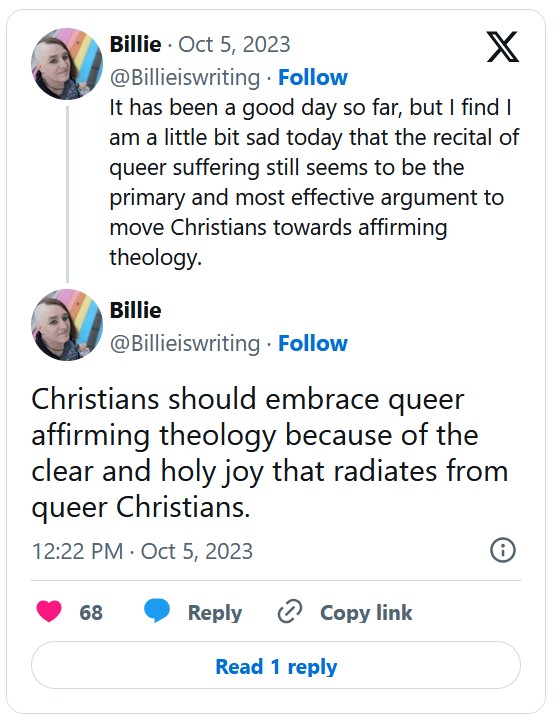
Yesterday, my Twitter friend Billie Hoard wrote out this thread and I was blown away by how true it resonated with me and so many. I asked her if I could include it as a guest post here so you could save it, return to it, and share it with those who need to hear it.


I find I am a little bit sad today that the recital of queer suffering still seems to be the primary and most effective argument to move Christians towards affirming theology.

Christians should embrace queer affirming theology because of the clear and holy joy that radiates from queer Christians.

Christians should embrace queer affirming theology because “look at how they love one another” while lacking everywhere, is more true of the queer community as a whole, despite our infighting and fractures, than it is of the Christian community as a whole.

Christians should embrace queer affirming theology because God’s Holy Spirit is moving among queer Christians and who are they to deny inclusion to those the Lord God has already included.

Christians should embrace queer affirming theology as a joyful embrace of God’s diverse and diversifying Creation.

Christians should embrace queer affirming theology because queer weddings are some of the most beautiful images of God’s love for Their Bride, the church, that anyone will ever witness.

Christians should embrace queer affirming theology because the sparkle in the eye of a trans girl who gets her first dress is a window into the absolute dancing Joy of the Holy Spirit as She witnesses our sanctification.

Christians should embrace queer affirming theology because our ace and aro siblings carry so much of God’s joy and wisdom regarding connection and being in the world.

Christians should embrace queer affirming theology because our non-binary siblings are some of the most free and beautiful humans on this planet of ours and the dance of their lives teaches us so so much about the Trinity and ourselves.

Christians should embrace queer affirming theology because without queer people the Body of Christ is incomplete and bleeding.

Christians should embrace queer affirming theology because trans men have so much to teach us all about what is and is not healthy in our culture’s take on masculinity. They show us the masculinity of Christ.

Christians should embrace queer affirming theology because of the glory, passion, and wholeness that our bi and pan siblings bring to this world.

RT or reply on Twitter to add your own positive reasons why Christians should embrace queer affirming theology without reference to or need for showcasing queer suffering!


Billie Hoard is a transgender lesbian wife and father, a high school teacher, an author, and a queer Anabaptist radical. A consummate generalist, she holds an MA in liberal arts, and she writes on topics ranging from fairy tales and C. S. Lewis to theology, queerness, and philosophy.

Follow her on Substack (https://billieiswriting.substack.com) and @billieiswriting on Twitter, BlueSky, and Threads.

allyship, essays, faith, queer

Why I don’t do queer apologetics

Here’s the thing about arguing for queer rights and dignity. I can give them the ACLU map of ~500 anti-LGBTQ bills in the US. They will say those bills are good, actually. I can give them book lists, but they’ll say those are made up for profit.

I can give them story after story, but it’s just anecdotes, not hard data. I can give them data from the best experts, but they will say it’s flawed and poor quality and biased. I can show them history, but they will say that’s in the past, not today.

I can explain rainbow capitalism, but they will say that’s just evidence we control society and are oppressing THEM, actually, by forcing them to see we exist. I can tell them straightphobia isn’t real. I can say that accountability is not bullying. But their hearts are hardened.

I can say religion doesn’t actually require you to oppress us, and allowing our existence is not religious persecution, but they say I’m a heretic and leading others astray because their god is cisheteropatriarchy. I can say they are called to love. They say their harm IS love.

If I don’t use religion, they say I abandoned my faith. If I do, they say I’m manipulating it to fit what I want it to say. If I use science, they will say science isn’t reliable and researchers are under pressure from liberals. If I don’t, they’ll say science is on their side.

If I rehash my trauma and every other queer person’s, it won’t be enough and I’m just an emotional, irrational, delusional victim of the conveniently amorphous and vaguely defined “culture.” If I point out the reality of our queerphobic culture, they say I’m exaggerating. If I try to give them evidence, the cycle restarts, ad nauseam.

So that’s why I block instead of educating those I can tell are unwilling to learn. It’s an unwinnable system. I’d rather spend my limited time on equipping queer people and allies. If you have genuine questions and want to learn, you are welcome here. Take a look around.

allyship, essays, queer

The rainbow baton

I’ve been marveling a little at how far we’ve come in our lifetimes. There’s so much queer content now, not just coded but stated clearly, that it’s a major party platform to ban it.

That entire religious denominations are splitting in half (half with us!) and have to go to extreme financial and legal lengths to fight against us. City councils and school boards have allies at them, vocal and not anonymous! Support is so high that the haters have to resort to coordinated campaigns and recycle their fear-mongering and dig out Anita Bryant’s old catchphrases to make Florida the leader in hate again instead of just taking it for granted that we are society’s undesirables.

Continue reading “The rainbow baton”