allyship, asexuality, faith, queer

The point of all this

I want to be absolutely clear: The end goal is no more nonaffirming churches. Not a “diversity of thought” that’s just rewriting purity codes. Not a “range of opinions” with a variety of ways to exclude and dehumanize and tolerate “separate but equal.” Not a bare minimum. Not an “I love you but.”

Whether these churches accept correct, just, God-honoring theology or simply fade into history as factories of shame and harm and fake-nice, the collective liberation vision does not include nonaffirming theologies. Affirming theology *is* correct theology. We have beat around the bush long enough.

The mainline squandered opportunity after opportunity to draw that line, and we’re seeing the fruit of that, but we’re also seeing the fruit of the risk, the courage, the willingness to say NO to fence-riding and big-tent and “inclusive of all, the marginalized and the powers behind marginalization.”

In Christ, gender is not a factor for whether a marriage is holy, for whether sex is sinful, for whether someone is qualified to lead, serve, parent, teach, adopt, or write, for when passion is lust or love is healthy. That doesn’t mean we abandon discernment, but that gender isn’t relevant to it.

We are uncompromising in that. Lesbian, gay, bi/pan/+, trans/nonbinary/genderqueer, intersex, asexual/aromantic/agender, and all other kinds of queerness are not just permitted but *required* for the full reflection of the image of God and the accurate representation of the Kingdom come on earth.

Churches that factor in gender to who is permitted to do what are not only harmful, even deadly, for a small subset of the population. That is too minimizing. They are lacking in faithfulness. They are missing out on our gifts and our presence, but they are also missing out on the real, true God.

Conviction isn’t the enemy. Just like how becoming affirming isn’t “throwing out sexual ethics” or “there are no rules” or “rewriting history/the Bible,” it also isn’t an accommodation we’re asking for, a way to boost your Good Person points, or a secondary issue. It’s accurate, correct, right.

Have the courage to say so. Have the willingness to exclude the intolerant beliefs and opinions while honoring the need to listen, learn, grow, influence, and teach. It’s not about excluding individuals; it’s about setting our doctrinal truth, our policies, our reason for being.

Conservatives will panic: “See, the crazy liberals want to erase us! They want to eradicate us! They discriminate against us! The intolerant left!” Yes. I do. I want to erase the possibility that any queer kid grows up thinking God hates, Jesus is ashamed, or the Spirit would take away their joy.

I want to eradicate queer death, suffering, rejection, and homelessness. I do discriminate against bigotry and hate and fear-peddling propaganda lies. I want the world to stop tolerating violence, inequality, and terror in the name of “religious freedom,” “thought diversity,” and “broad umbrellas.”

We refuse anything less as the destination. The future is one where every church is practicing and preaching the truth, the life, the freedom, and the blessing that is only reflected with full queer welcome, inclusion, affirmation, belonging, and leadership at every level.

essays, faith

Bread Trek 2025

I had two big goals for the year: I wanted to watch all of Star Trek, and I wanted to bake my own bread. Neither of which I had any experience in.

With the exception of the 3D animated show Star Trek: Prodigy, I have accomplished the first through a year of binge watching. But the second is not one of those things you just do once and check off the list.

Dough dripping over the side into the oven

It started out rough, as I was warned it might. The dough overwhelmed the pan and dripped all over the oven because I didn’t know to put a baking sheet underneath. The dough was messy and sticky, and so much got on my hands that I wondered if it would affect the size of the loaf. I didn’t have a stand mixer, and this was far beyond the capabilities of my hand mixer, so I tried using a wooden spoon to knead instead, which was much harder and not very effective.

Continue reading “Bread Trek 2025”
faith, queer, resources

Queer Christian History

We have a long, complicated history as a queer Christian community. It’s crucial that we preserve, learn, and grow from that history with each generation that follows so we know who we are, that we are not a new trend, and that “tradition” is in the eye of the historian. We are proud to have a deep, rich history of faithful love and justice work, standing strong in our God-given identities. LGBTQIA+ Christians have always been here. Our stories were just erased. Make the invisible visible again in remembering them:

The LGBTQ+ Religious Archives Network

The LGBTQ Religious Archives Network (LGBTQ-RAN) is an innovative venture in preserving history and encouraging scholarly study of lesbian, gay, bisexual, transgender and queer (LGBTQ) religious movements around the world. LGBTQ-RAN has a two-fold basic purpose.

Second, LGBTQ-RAN provides an electronic information clearinghouse for these archival collections and other historical data about LGBTQ religious history for the use of historians, researchers and other interested persons.

First, it assists LGBTQ religious leaders and groups in determining how best to preserve their records and papers in appropriate repositories.

Center for LGBTQ and Gender Studies in Religion

The Center for LGBTQ and Gender Studies in Religion (CLGS) was established at Pacific School of Religion in Berkeley, California and opened its doors in the fall of 2000.

Whosoever Magazine

Since 1996, Whosoever has existed to publish resources, primarily in the form of curated content, for those who seek a deeper understanding of the truly loving God, whose unconditional love is experienced as boundless grace.

Queer Saints Project

The Queer Saints Project began as a collaboration between the artist, Jason Tseng, and Judson Memorial Church, a historic church located in New York City’s West Village neighborhood. In 2018, Judson commissioned Tseng to create icons of LGBTQIA+ ancestors, to celebrate their inherent divinity, honor their contributions, and reclaim them as queer saints. The goal is to raise awareness and funds for the LGBTQIA+ community using these transcendent images that glorify and celebrate the miracle that is queerness.

The LGBTQ History Project

QSpirit: LGBTQ Saints, Queer Saints

Kittredge Cherry provides profiles and a saints day calendar that ask “What if” in queering the Bible and Christian history, as well as recognizing modern-day and historical queer people of faith in ways the church has largely ignored. Dare to imagine, explore, question, and enjoy beyond the normative and cisheteropatriarchical-assumed stories we’ve been taught.

Making Gay History: Rev. Carolyn Mobley-Bowie

Growing up in the segregated South, Rev. Carolyn Mobley-Bowie knew the challenge of finding an accepting place in the world—a challenge that only grew when her attraction to women came into conflict with her devotion to God. The predominantly gay Metropolitan Community Church offered refuge.

OutHistory: Religion and Homosexuality in the United States, by John D’Emilio and His Students

An essay by historian John D’Emilio “On Teaching Religion and Homosexuality in the U.S.,” and six chronologies on religion and homosexuality in the United States. First published on OutHistory in 2014.

Associated Press: A brief and incomplete, but helpful, overview of mainline denominations’ shifts on LGBTQIA+ inclusion in ordination, leadership, and marriage.

This timeline highlights key milestones and flashpoints within the UMC, Presbyterian Church (U.S.A.), Episcopal Church, Evangelical Lutheran Church in America, United Church of Christ, as well as in civic life.

By affirming denomination

Your experience may vary, but overall, these denominations have come to a broadly LGBTQIA+ affirming stance and hold socially progressive theology.

Metropolitan Community Church

When We All Get to Heaven

When We All Get to Heaven is a documentary project that tells the story of one of the first gay-positive churches, the Metropolitan Community Church of San Francisco, and how it faced the personal, social, and political trials of the AIDS epidemic, including the deaths of 500 of its members.

The Classical Ideas Podcast: EP 197: We Who Must Die Demand a Miracle and MCC San Francisco w/Dr. Lynne Gerber

Dr. Lynne Gerber (she/her/hers) is an independent scholar. She is the author of Seeking the Straight and Narrow: Weight Loss and Sexual-Reorientation in Evangelical America (Chicago, 2011). She is currently working on a history of religion and HIV/AIDS in San Francisco.

Queercore podcast: The Radical Priest: Rev Troy Perry (Season 4; Ep 8)

He’s preaching revolution! In this episode, Reverend Troy Perry, founder of the Metropolitan Community Church, joins us to chart his unlikely journey from Southern Baptist roots to gay‐affirming ministry and queer liberation. He recalls founding MCC in his living room in 1968, officiating groundbreaking same-sex marriages, and fighting for dignity when society told him faith and queerness could never co-exist.

There were fires—literal and metaphorical—that threatened his church, courtroom battles, and protests in the street. Through it all, he held onto something radical: that God loves us all, fully and without apology. Tune in to witness faith as resistance and prophecy as sanctuary.

United Methodist LGBTQIA+ History

Affirmation was founded in 1972 and went on to establish Reconciling Ministries. Affirmation was the first group to include Transgender people and was the first to provide direct support to LGBTQ+ people in Uganda and Kenya.

As the Church embraces a more inclusive and hopeful future, the Center exists to intentionally collect, preserve, and share the stories of Queer individuals whose voices, ministries, and faith have long been marginalized. Through this work, the LGBTQ+ UMC Heritage Board is tasked with ensuring LGBTQ+ people and their legacy in the Church can move forward unapologetically to be seen, celebrated, and empowered in the fullness of who they are.

Dedicated page for profiles of notable clergy and lay people, oral histories, online exhibits, and digital archive collections from the UMC.

Episcopal LGBTQIA+ History

  • TransEpiscopal – TransEpiscopal is a group of transgender, nonbinary, and allied Episcopalians dedicated to fostering the full embrace of trans and nonbinary people, and our loved ones within the Episcopal Church and to inspiring faith-based advocacy for trans and nonbinary justice in the wider world.
  • LGBTQIA+ Episcopal History – Faithful Episcopalians have been working toward a greater understanding and radical inclusion of all of God’s children for nearly a half-century.

United Church of Christ LGBTQIA+ History

  • Open and Affirming Coalition – Beginning in 1969, the United Church of Christ has advocated for the LGBT community. From the campaign to decriminalize same-sex relationships to support for marriage equality, the UCC has made a difference in the lives of LGBT citizens and their families. The issues have changed over the decades, but the basic commitment to full inclusion and human rights remains the same.

Presbyterian Church USA LGBTQIA+ History

  • Timeline of LGBTQIA+ History – The Presbyterian Historical Society has created a timeline of LGBTQIA+ related history in the Presbyterian Church (U.S.A.). The stories included show how church members’ perspectives as well as the language used to speak about sexuality shifted throughout decades of advocacy work by LGBTQIA+ Presbyterians and allies.

ELCA (Lutheran) LGBTQIA+ History

Brethren and Mennonite Council LGBTQIA+ History

  • Oral history project at the Center for Queer Studies – Amy Short, in her work on the BMC Elder History Project, has been busy collecting stories, primarily from older BMC individuals, but also from some younger ones as well. Currently she has over 40 hours of taped interviews that will be preserved for their archives, with some utilized for trainings or simply shared as a celebration of their strength and variety as a community.
  • “Repent of the Sins of Homophobia”: The Rise of Queer Mennonite Leaders by Rachel Waltner Goossen

United Church of Canada

Quakers in Britain

Other notable groups in LGBTQIA+ Christian History:


Many more to come! If you have more queer Christian history/archival sites to suggest, please submit them via DMs on Bsky, Threads, Instagram, Substack, Discord, or Facebook (all under @ jennadewitt), or send me an email at jennadewitt (at) gmail (dot) com.

essays, faith, queer

Your life is not a hero trial

And God isn’t interested in creating obstacles for you to earn heaven points.

photo of man walking on rope tree
Photo by Stephanie Ecate on Unsplash

“Everything within me wants [romantic and sexual] love, but as queer Christians, we have to trust that if God is denying us what we desire and making us suffer, then it’s for the best!”

OR perhaps you can trust that not only does God create you with good and holy desires but you weren’t meant to reject them. God is not interested in crafting tests for you so that you can prove you’re worthy. Trust God enough to see the evidence around you that you can call goodness good and not wait around for a secret mystical reveal that you can earn more holiness, prosperity, heavenly treasure, or a bigger payoff through a morality obstacle course divinely designed to trip you up.

The mythology of gods who make games of people’s lives out of boredom or demand tests to prove loyalty and worthiness are not our stories. That’s not Christianity rightly practiced, even if that’s Christianity traditionally practiced. We can stop doing this. The world has enough loneliness and suffering as it is. God has bigger stuff going on than toying with you or creating hero trials.

Collective liberation theology is the antidote to this. You do not have to manufacture pain for yourself. If you are denying healthy, natural, freeing love in favor of imposed suffering, there is nothing of God in that. We have too much to do here to be distracted by “how far is too far” rules.

God does not create you with an orientation or gender you are supposed to spend all your time, energy, resources, etc. changing or suppressing or creating elaborate rules for. Our time, energy, resources, and more are so precious and limited. Just be who you are and get to work for justice and good. The needs and crises around us are too great.

We have far too much pain in the world already that we are the God-given answer to. We are the solution, not burdened with creating more fake problems. When we’re busy over here debating whose romantic and sexual relationships are valid or who gets to be their gender, we can’t fulfill our calling.

I don’t understand those seeing hunger, loneliness, homelessness, fear, addiction, despair, prejudice, injustice, and more and then going, “You know what we need? MORE of this! God must have a plan to redeem it if we just trust and obey gender roles! That’s where our money and energy and time should go! More sex rules, exclusion, and rigid gender boxes!”

Collective liberation means affirming theology isn’t about “selfishness,” etc. It’s about getting all of this legalistic shit out of the way so we can be free to focus on the real work. Let people live, love, transition, marry, and be how they were made. The real stuff is too urgent.

If your “values” and “beliefs” are about creating gender-based rules and sexual morality codes and labeling it a “calling” to suffer through for the sake of holiness than creating more peace, hope, joy, and love in the world, change your values and reset your priorities. We have too many actual, practical problems we must act on. We can’t waste our lives policing our thoughts and behaviors and relationships to keep them from trying to align in integrity with our God-given identities. Not to mention other people’s relationships and bodies that don’t affect us! Every minute spent on trying to adhere to a norm we can never fit and creating more suffering to be one day rewarded for our heroic self-denial is a minute that could have been spent on alleviating the actual suffering in the world, including our own very real problems and the fallout of others’ queerphobia.

Biblical celibacy is part of biblical sexuality: It isn’t about which genders get married or have sex. Biblical celibacy and biblical sexuality are when you aren’t distracted from the real calling of loving others by rule-following, drama, angst, self-imposed or church-imposed misery, loneliness, temptation-resisting tests, and all the other manufactured fears and obstacles. These keep us focused on ourselves and our own purity so that we never get to the part where we get free, where we dismantle injustice, where we oppose and defeat patriarchy, White supremacy, queerphobia, ableism, systemic poverty, xenophobia, and all other evils.

You have to do what is more effective and efficient for the real work of bringing justice and flourishing, on earth as it is in heaven. Be celibate if that’s what is freeing you to do the work in authenticity, in wholeness, without distraction (like it is for me!). Have sex if that’s what frees you to do the work in authenticity, in wholeness, without distraction. Living your values should empower you to do justice and love mercy, not burden you with morality hand-wringing and pearl-clutching. Follow the fruit of the Spirit in your life toward liberation for all. That will have you focused more on bringing love, hope, and flourishing to the world than looking at your own behaviors and purity performance to pass a vague and cruel divine test.

Our God is not abusive or cruel or bored or dangling a carrot while hitting us with a stick. God is not a drill sergeant or a prosperity promiser or a manipulator or a lab rat maze designer or a puppet master. God doesn’t work like a capitalist or a merit badge system or a game show host or a trickster con man.

God IS Love. That love is demonstrated, unashamed, and unearned. It is not deception or a hustle or a scheme. It doesn’t create problems for the sake of a trust exercise or set contradictory expectations to raise life’s difficulty level. Love doesn’t hide at the finish line after a lifetime of gold stars and perfect grades and queerness-control performance reviews. Ours is the God of vibrant life, of integrity and of constancy, a God of Creation and joy, of overflowing goodness and hope and peace, a God of gentleness and patience, of faithfulness and kindness, of the self-control that comes with empathy and generosity. The truth sets us free, and with that freedom, we can tear down obstacles like holy hustle tests, purity culture, gender roles, unnecessary distractions, and systems of oppression. With collective liberation, we can focus on spreading love and flourishing throughout all the world.

disability, faith, Mental health, neurodivergence, resources

Progressive Christianity and neurodivergence

Justin, Ell, and I hosted a gathering for neurodivergent progressive Christians for Disability Pride Month 2025. Though this year’s event was not specifically for asexual and aromantic people, there is significant overlap with these communities, which was reflected in this discussion. (See our previous conversations about the a-spec Christian intersection here.)  

Discussion questions:

  1. How has your neurodivergence affected your experience of Christianity? 
  1. How has your faith affected your experience of being neurodivergent?
  1. How have you been supported by your community?
  1. What challenges have you encountered in your communities?
  1. How can the Christian community as a whole better support and uplift neurodivergent people? What can Christianity learn from neurodivergent people and their lived experience?
  1. What encouragement/words of affirmation can you share with other neurodivergent Christians?
  2. What spiritual practices, resources or supports have helped you with your neurodivergence and faith?

asexuality, essays, faith

Asexuality and the gospel of liberation

It makes sense why queer Christian theology is often heavily sexually centered, given our history, but the best queer theologians balance it with ace inclusion. Not just as a footnote, but as a core goal. The point is ending amatonormativity and gaining collective liberation, which takes all of us—of every gender, orientation, relationship style, race, ability, culture, and more. Rightfully practiced, Christianity—with the words of Jesus at the center—drives us forward to this goal.

Jesus is as clear of an aromantic asexual Christian role model as we could ever ask for! Embracing found family and breaking gender and class binaries are foundational to his life. There’s just no way to read the gospels and come away with a factual interpretation that centers amatonormativity. That doesn’t stop the global church (now or historically), of course, because institutions and patriarchal power structures are best served by amatonormativity and all that comes with it.

When women are free to earn their own money, when singles are equal to married people, when everyone has the same rights and respect regardless of gender or orientation or relationship status or race or disability, we can liberate ourselves from the oppression that power structures are built on. That’s gospel, as Christlike as it gets, but it’s the exact opposite of what those in power want because it would require true humility, servant leadership, the Beatitudes, sacrifice, and loving others as themselves. It would be for the benefit of all, including themselves, but there’s nothing that scares them more than the risk and exposure of vulnerability.

I truly believe the only way forward is shame resilience, tolerance of vulnerability, finding belonging within, and developing healthy, boundaried empathy that leads to freedom beyond anything gatekeeping or virtue signals or scarcity can achieve. That’s work each of us can do, whether by reading books by Brene Brown, Aundi Kolber, and Matthias Roberts; or doing therapy one on one or as a part of a couple or in a group; or listening to podcasts, lectures, or wise friends and leaders who can guide us there.

When we liberate our minds and hearts, we are free to see others who are unimaginably different than us as a gift to the Body of Christ. We aren’t threatened or defensive because we honor what other identities and perspectives can bring that we can’t.

With the fruit of the Spirit as our guide, we lead from a common goal that all will be free: asexual and allosexual, aromantic and alloromantic, queer and allocishet, and more. Single or partnered, parents and childfree, living alone or with others, sexually celibate or abstinent or solo or partnered or open or any combination. Everyone.

But we can’t get there while asexuality (and aromanticism and our respective spectrums) remain erased and invisible in the church. We are vital to the liberation of Christ. We queer queer theology. We challenge norms in ways that rewriting gender rules alone can’t. We defy expectations and push beyond affirming marriage or ordination or any one label or issue in our unique ways, as all letters do if given proper consideration. But for asexuality, it isn’t as simple as churches might think. We are going to ask more than a flag at Pride or a language change, but a mentality shift that will require surrender of structures and norms and old visions and false realities.

But don’t fear. It’s the surrender of flight, falling into the ways of Jesus and finding ourselves held by the wings of love the whole time. That is, if only we have the courage to listen to asexuals, end amatonormativity, and become something so much better: the family of God.

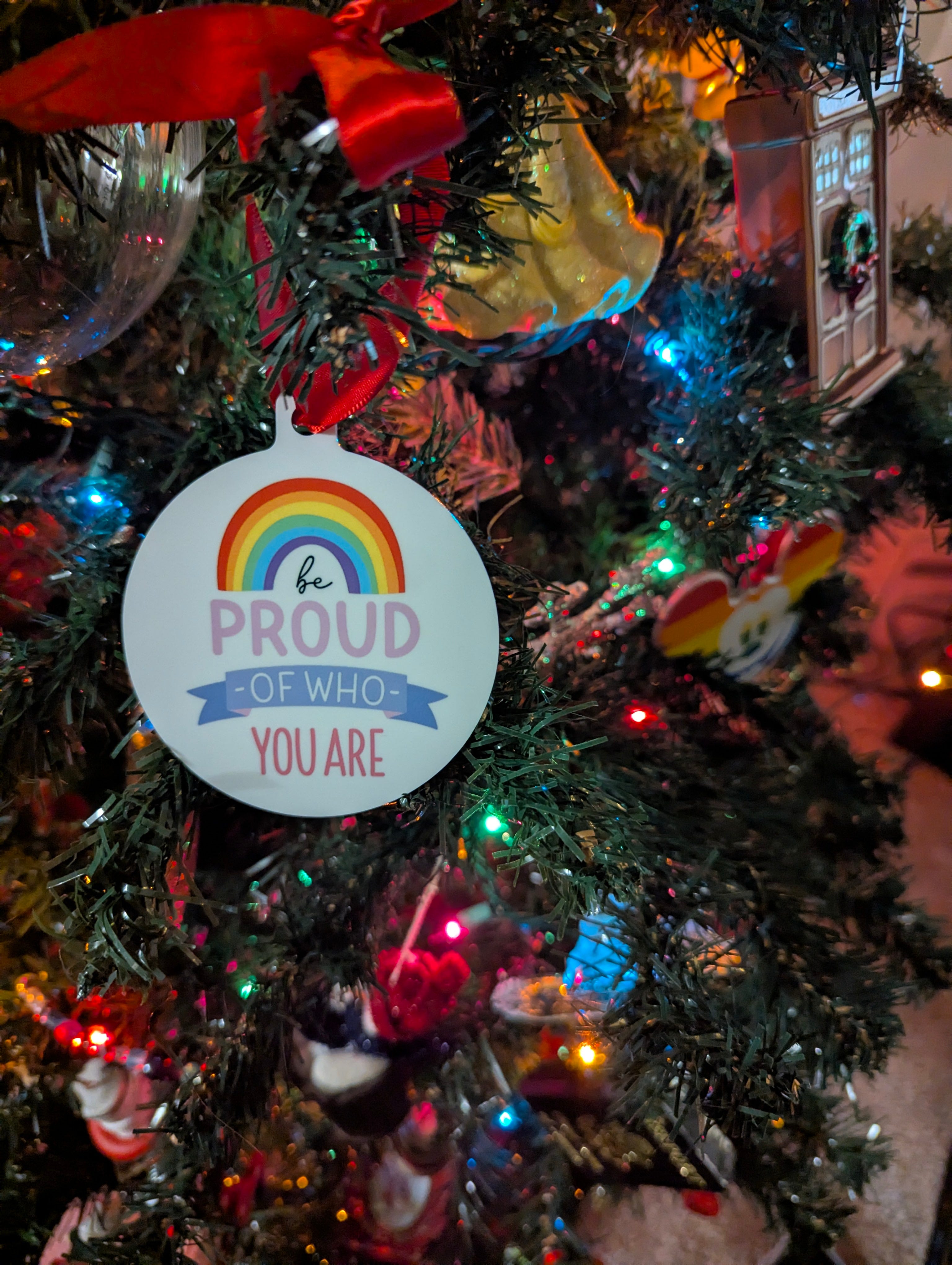
Ornament on a Christmas tree that says Be Proud of Who You Are

asexuality, essays, faith

Shame boxes and liberation

You’re going to hear me say a phrase a lot: “Sexual liberation includes the choice not to have sex.” What do I mean?

Sex-negative purity culture and celibacy-shaming culture are part of the same harmful system with moving goalposts. Both force sex on us.

The fight is not purity culture vs. hookup culture. The fight is true sexual liberation and self-agency against mandates controlling our bodies. No one can tell you you have to have sex in order to be good, normal, healthy, or mature. Not in marriage, not in singleness.

If sex positivity ends when “no” is said too often, expressed too confidently, or extends to a certain age before it’s “not normal! Humans NEED sex!”, that’s not sex positivity. It’s still a form of purity culture with a different set of rules you’re forced to play by. Other people’s standards.

Purity culture isn’t about abstaining from sex. It’s about putting strict rules on when you *must* have it. Secular culture simply removes the marriage element. There’s something “wrong” with you if you’re a “sad virgin” at 21, they say. “He just needs to get laid.” “What a frigid bitch.” etc.

If you don’t have sex, whether in marriage or out of it, you’re a freak. Doctors want to find out why you’re sick. Therapists worry about you and think if you just tried dating or hooking up, you’d find healing. Friends don’t trust you because surely you have to have something wrong with you.

No, maybe family doesn’t kick you out, but they sure as hell pity you and look down on you and shame you. You’re a joke. You’re a political jab. You’re a concern. The GOP wants to make you an example of all the things wrong with this country. “Your body, my choice” they scream now.

trigger warning: SA

You have to worry about getting pregnant even if you don’t want to have sex ever because telling men that leads to them thinking it’s a challenge. We call it corrective rape. Correcting what’s wrong with us.

Meanwhile conversion therapy plays out for us every day because we’re considered mentally or physically ill if we don’t have sex by (16? 18? 22? 30? 45?). No one has to make a “Side X” or “nonaffirming” camp for asexuality because it’s the air we breathe. It’s everyone around us.

Even those who consider themselves affirming of us think of it as a niche, for “those people.” Good for them, but for NORMAL people, you know, real humans need sex. Real adults mature into wanting sex. Real liberated people say “yes.” The consent is for us to feel morally, culturally pure about it, not for you to actually refuse over and over. And certainly not forever. Eventually, you’re “supposed to” want it.

But maybe you don’t. Whether by orientation or interest or opinion or lack of suitable options.

I’m not at risk of being excommunicated for staying celibate and single by church policy. I’m at risk of being excommunicated from society by refusing to let men use my body for things I don’t want just so I can meet some developmental norm or perceived biological need (of theirs, of course) or hit a milestone or rite of passage to prove I’m not “weird” or “broken” or making others uncomfortable.

Is it better than being kicked out of a home as a teen? Sure. Am I still fighting every day to get people to see the harm of amatonormativity and allonormativity? Now and always.

Liberation and bodily autonomy.

If that’s what you’re for, you are united with us in the same fight against purity culture. If this feels like a threat to you, consider liberating yourself and those around you from the shame boxes altogether. Both the purity culture box and the not-sexual-enough shame box.

Collective liberation is for all of us to have the freedom to determine our own choices, about our bodies and identities and lives. It’s shaping the kind of society we want to live in. We have to think bigger than judging people for the sex they have or haven’t had. That’s not enough. Liberation respects, trusts, and honors each of us living as our whole selves authentically true to our needs and what is freedom to us.

allyship, faith, queer, resources

Worship resources for affirming churches

Explore the links on this page for liturgies, devotionals, worship services, naming rites, marriage ceremonies, prayers, songs, Bible commentaries, and more.

A Sanctified Art

Word Made Queer

Our Bible

Enfleshed

A Place in God’s Heart, A Place at Christ’s Table published by the National Gay & Lesbian Task Force

Illustrated Ministry graphics

Many Voices

Common Word

Sam Lundquist

Out in Scripture reflections on the HRC

Creating Sanctuary UK – Prayers and reflections guide

Parity

Music

Worship resources created by denominational LGBTQIA+ advocacy organizations but open to all churches:

See the Queer Christian resources list for more!

essays, faith

Rise – Easter sermon 2024

I had the honor of preaching for the Rise community at our Easter service this year. Here is the text of that sermon!


Happy Easter, my friends. I’m going to make this participatory in a simple way. I’m going to say He is risen, and that’s your cue to say or type in the chat or just think to yourself, He is risen indeed. Let’s try it. 

He is risen! (He is risen indeed!) Good, good. Remember that, we’ll come back to it. 


Do you remember the poster of the kitten hanging on the branch? Or “Shoot for the moon, even if you fail, you’re land among the stars.” “It doesn’t matter how slow you go, so long as you do not stop.” I was a kid in the 1990s, and schools were full of posters like this. One of them had a point, though. “What matters isn’t the number of times you fall, but the number of times you get back up.”

Teachers, parents, everyone loved these quotes, as evidenced by their Facebook posts to this day. But the achiever in me found it hard to believe them. If you fall, even if you finish the race, everyone’s going to see that you’re covered in dirt, right? If you go at your own pace, what happens when you get left behind? And do they know how far apart the stars and moon are?!

But then we grew up and all along the way, boy howdy did we fall. We learned to fail. We learned what it was to experience shame and rejection. We endured pain and suffering. We were disbelieved and discounted, our worth in the dust with our dreams. We lost people we thought we couldn’t live without and somehow we’re still taking in each breath, no matter how much it aches to keep going. We had the doors slammed in our faces and “moved through” stages of grief like a tennis ball in a dryer.

And then, like Job, maybe we have friends come along and lament with us for a while but the questions start like “What did you do to cause this?” and “Have you tried just ……….. [fill in the blank]?” The friends we thought we could count on get tired of our pain and our needs and we have to seek community who get us, who know what it’s like to feel trapped behind a stone in the dark. We start to wonder where we went wrong, or if God is that kind of deity who plays with people’s lives out of jealousy or testing or insecurity.

And we know we’re far from perfect, but hear this: you did not earn your suffering through either a need to prove your holiness or as punishment for some sin. That’s not Love. Sometimes the only answer we get is that we can’t know. Sometimes there is no why. Sometimes the world and our lives are terrifyingly out of our own control. And maybe the only way out is through. There are consequences for our actions, yes. But even then, we can rise again, each day fresh with no mistakes in it yet. We can start a new life, repairing and repenting for the harm we’ve done and building a better future.

That’s faith. It’s not memorizing a list of doctrines or achieving a resume of holiness or working our way up the ladder of church leadership into an inner circle. It’s trusting that it’s possible our hope is not in vain. It doesn’t require absolute certainty and perfect answers, but being willing to keep asking the questions. Even when everything is cold and quiet and dark in the night of the soul. Even when we are alone and can’t see the path out of the graves we are in. 

I hope at some point in these deaths and mourning, we have all seen the dawn. We’ve remembered that spring returns after the long winter. We’ve fought for each step out of the night to just survive long enough to see the daylight. We’ve brought life out of the desolate places where everyone said we were never going to see hope again.

We are Rise Women. We, this whole community, we know resurrection. Even for those of you who barely showed up today, unsure if this whole Jesus thing is for you, for those of you who don’t know what to believe anymore, who feel like their faith is unraveling thread by thread. We say this for you when you can’t believe it yourself. For those of you who are so ready to be given an open door, your faith is on fire and you just need the opportunities you know you are skilled to handle. For those of you who are here, yet again, another unremarkable Easter. For those who are ready to do more than just survive the day to day. Say it with me: He is risen. (He is risen indeed.)

Sarah Bessey writes: “In the scriptures, the word for resurrection is usually a Greek one, anastasis. Often used in reference to the resurrection of Jesus, it’s somehow a physical sort of noun to me. After all, it means a rising up, a raising up, a standing up. After a time in the dirt, after our falling, after taking a seat, lying down, even after our collapse, our seeming end — anastasis is our rising. Like Jesus, we are raised up to new life. We find life out of death, water in the desert, hope out of grief. I’ve begun to see a multitude of resurrections hiding in plain sight in my life, far from traditional understandings of revival and grandiose demonstrations.”

This is crucial. It’s not the altar calls and the mountain tops. It’s not always the memorable testimonies and the huge achievements that become stories passed on through generations. Sarah says, “The regular resurrections of our lives are just as miraculous as the big, showy, attention-getting ones.” Just as much. Resurrection isn’t a ticketed event, where we all gather round to watch Jesus perform the stone-rolling trick. This story is about a woman weeping because her friend and teacher has been stolen from his final resting place. This is about the slow realization that the horrific assumption is not as it seems. The resurrection story is between friends reuniting and assurances from angels and eyes opened in conversation, in a cemetery garden, in a home, on the road, at the dinner table. This is a story of everyday ordinary rising.

The bread of life, broken for you and for many. Take it. Observe the power of the leavening, and then see the holes in his side. Feel how the dough refuses to turn to dust when beaten, strung out, encased in darkness and heat, but instead becomes whole, complete, the life it was always meant to impart.

 Jesus knew his metaphors, huh? He knew this one, this one would make sense down the millennia. Bread is our friend. Even people who can’t eat things in your average gluteny loaf have invented other kinds. This is the stuff they left out of the He Gets Us ads. Bread. Timeless.

Another metaphor often used in Easter sermons is the flowers that require the dark and pressure of the ground to break open and sprout. The birds that must crack their shells and leave the nest in order to fly. The coal into diamonds and the oysters with their pearls. I’m sure you’ve heard them all, and maybe have some of your own that resonate with you.

But we already know what it feels like when this rising is softer, don’t we? Not a grand performance with a light show and a drum roll. As Barbara Brown Taylor writes in her book Learning to Walk in the Dark, “By all accounts, a stone blocked the entrance to the cave so that there were no witnesses to the resurrection. Everyone who saw the risen Jesus saw him after. Whatever happened in the cave happened in the dark. As many years as I have been listening to Easter sermons, I have never heard anyone talk about that part. Resurrection is always announced with Easter lilies, the sound of trumpets, bright streaming light. But it did not happen that way. If it happened in a cave, it happened in complete silence, in absolute darkness, with the smell of damp stone and dug earth in the air. Sitting deep in the heart of Organ Cave, I let this sink in: new life starts in the dark. Whether it is a seed in the ground, a baby in the womb, or Jesus in the tomb, it starts in the dark.”

So if today doesn’t feel triumphant and bright, if we are struggling to see in the unknowing and uncertainty that surrounds us, our anastasis might still be on the way. 

Maybe it’s already in motion, even if we haven’t seen the light yet. Maybe it won’t come without you digging your way out and demanding to be untied from your grave clothes when others tried to bury you. But listen, Rise Women, maybe your story isn’t over yet.

Maybe there is rising left to do. Resurrection still to come. Maybe you’re going to be walking through life on the road of grief, and the worst seems to have happened, but then. But then you see Jesus is right there with you. The Spirit is forging you into a risen loaf. The Creator who mixed all of your ingredients together: your anger, your humility, your joy, your passion, your strengths and weaknesses, your empathy and your impatience, all of it. The Creator is bringing new life on the other side of this tomb.

Hope doesn’t come with instant yeast, though, you know? So sad. Hope comes with day by day, inch by inch, clawing our way through in defiance. Hope can be defiant, with refusing to let the forces of hopelessness win. Hope comes with noticing the little things and gratitude practices and breathing in and out, hanging on for just one more day. Hope rises in community and in embodiment and in connection. Hope rises when we are in this together and no one is left behind in our resurrections.

We’re not giving up.

There’s a scene in my favorite movie, Captain Marvel, that you’ve probably seen. Some may roll their eyes at its sincerity and call it cringe for being too genuine, but I love this stuff. At the climax, the enemy is telepathically showing Captain Marvel all the times in her forgotten past when being a fragile human girl made her weak. She experienced sexism from boys and men, she experienced physical hardship training for the Air Force, she experienced pain and deep grief and failure. But instead of being defeated by this evidence, Captain Marvel remembers for the first time in years what happened next in each of those scenarios, from her childhood on to adulthood. She got back up. She climbed out of the crashed go-kart and stood up in the batter’s box and got up out of the dirt and stood ready to fight as a trained Air Force pilot. She looks into the camera and every girl and woman in that audience knows. This isn’t just about a superhero story. This is about us. She is each one of us who has fallen. This is our power reflected back at us, the power of resurrection as we rise against all that would hold us down.

The Bible has stories like this. Dry bones coming back to life. Servants and only sons and little girls and Lazurus, a beloved brother and best friend of Jesus himself. All die. All rising again in the power of the Spirit. So many metaphorical risings too. Healings and storms calmed and songs of conquering their oppressors. There are many ways resurrection shows up. But it’s not the grand display of power every time. It’s the otherwise unremarkable days. The long, long, weary nights. The simple and ordinary moments, often too fleeting, and yet, and yet we can draw on this hope. We can know we are not alone.

Jesus didn’t just rise against the biological reality of death. He rose after betrayal and loss, after immense pain and suffering, after being disbelieved and disavowed and discredited. The shame and the humiliation and the abandonment. The despair and the inevitability despite his deepest pleas that he wouldn’t have to go through with it in the end. The loneliness and anxiety and tears.

I don’t say that to trigger some sort of Passion of the Christ flashback or church trauma. No one is about to cue up stats about how much physical torture the human body can endure to guilt-trip you into behavior modification. It’s the opposite of that, actually.

I’m saying, we Rise Women know some of these feelings Jesus is walking through here, living a fully human experience. We know betrayal, grief, pain, suffering, shame, abandonment, fear, depression. We know the nights pleading with God over and over to take this cup from us. We know loneliness when our friends don’t show up for us or when they even collaborate with those working against us. We know tears. We get it.

So believe me when I say, through the power of the Holy Spirit that rose Jesus from this grave on this Easter Sunday morning, you are not alone. You are not done yet. You are not trapped behind this stone of despair and hopelessness forever. Now, hear me, your conditions might not change. Like Jesus, you may still have the wounds in your side and scars on your hands. You may not be fixed or healed or have a perfect solution waiting for you when we leave our time here today. But I will promise you that hope can be a resurrection for you in the midst of it.

How? Honestly, I don’t know. That’s between you and your resurrector. Those of us with ADHD often say we don’t really have a sense of time. There are only two times of day to an ADHD brain: now and not now. We have that in common with the theologians who describe God’s time that way. We live in the now and not now, the kingdom of God isn’t here yet with its peace and reconcilation and wholeness and everything made right, but it is also here now on earth as it is in heaven. And, what’s more, we’re the ones called and equipped to bring it about, as the emissaries of hope, the ones running back to our friends to proclaim the mystery of the faith: He is risen! (He is risen indeed!)

The now part of resurrection is realized every time the Spirit moves us to bring life and renewal to ourselves, our neighbors, our communities, Creation, and the world around us. We live in both the now and not now. I don’t pretend to know God’s plans or if or when God will show up and reveal that it’s been him all along walking beside you. Keep your eyes open, though, because that resurrection lives in you.

It’s what we do. We rise.

Leader: We are rising.

 ALL: We are rising indeed.

disability, essays, faith, Mental health, neurodivergence

ADHD Showed Me I Wasn’t a Spiritual Failure

I had the honor of writing about ADHD and spiritual practices for Sojourners Magazine!

If you had told me 11 years ago at my first contemplative retreat that I had ADHD, I would have been skeptical. I was an organized, overachieving Enneagram 3, a bookworm, and a grown professional woman — not a small bouncy boy disturbing his classroom because of his attention-deficit/hyperactivity disorder. The problem, I was told by all around me, was that I lacked spiritual discipline. But just a few hours into the retreat on a Saturday afternoon, I had to admit I wasn’t excelling at the assignment of stillness and silence.

When a friend had suggested the Jesuit-led contemplative retreat, I’d eagerly agreed. At the time, I was fresh out of college, dealing with a boatload of baggage from a brief flirtation with charismatic church culture, and spiritually restless. I also felt trapped in a spiral of shame, depression, and anxiety. Maybe spending some time at a beautiful, peaceful retreat center would discipline my hyperactive mind into spiritual maturity.


Read more here!

https://sojo.net/articles/adhd-showed-me-i-wasnt-spiritual-failure