allyship, asexuality, faith, queer

The point of all this

I want to be absolutely clear: The end goal is no more nonaffirming churches. Not a “diversity of thought” that’s just rewriting purity codes. Not a “range of opinions” with a variety of ways to exclude and dehumanize and tolerate “separate but equal.” Not a bare minimum. Not an “I love you but.”

Whether these churches accept correct, just, God-honoring theology or simply fade into history as factories of shame and harm and fake-nice, the collective liberation vision does not include nonaffirming theologies. Affirming theology *is* correct theology. We have beat around the bush long enough.

The mainline squandered opportunity after opportunity to draw that line, and we’re seeing the fruit of that, but we’re also seeing the fruit of the risk, the courage, the willingness to say NO to fence-riding and big-tent and “inclusive of all, the marginalized and the powers behind marginalization.”

In Christ, gender is not a factor for whether a marriage is holy, for whether sex is sinful, for whether someone is qualified to lead, serve, parent, teach, adopt, or write, for when passion is lust or love is healthy. That doesn’t mean we abandon discernment, but that gender isn’t relevant to it.

We are uncompromising in that. Lesbian, gay, bi/pan/+, trans/nonbinary/genderqueer, intersex, asexual/aromantic/agender, and all other kinds of queerness are not just permitted but *required* for the full reflection of the image of God and the accurate representation of the Kingdom come on earth.

Churches that factor in gender to who is permitted to do what are not only harmful, even deadly, for a small subset of the population. That is too minimizing. They are lacking in faithfulness. They are missing out on our gifts and our presence, but they are also missing out on the real, true God.

Conviction isn’t the enemy. Just like how becoming affirming isn’t “throwing out sexual ethics” or “there are no rules” or “rewriting history/the Bible,” it also isn’t an accommodation we’re asking for, a way to boost your Good Person points, or a secondary issue. It’s accurate, correct, right.

Have the courage to say so. Have the willingness to exclude the intolerant beliefs and opinions while honoring the need to listen, learn, grow, influence, and teach. It’s not about excluding individuals; it’s about setting our doctrinal truth, our policies, our reason for being.

Conservatives will panic: “See, the crazy liberals want to erase us! They want to eradicate us! They discriminate against us! The intolerant left!” Yes. I do. I want to erase the possibility that any queer kid grows up thinking God hates, Jesus is ashamed, or the Spirit would take away their joy.

I want to eradicate queer death, suffering, rejection, and homelessness. I do discriminate against bigotry and hate and fear-peddling propaganda lies. I want the world to stop tolerating violence, inequality, and terror in the name of “religious freedom,” “thought diversity,” and “broad umbrellas.”

We refuse anything less as the destination. The future is one where every church is practicing and preaching the truth, the life, the freedom, and the blessing that is only reflected with full queer welcome, inclusion, affirmation, belonging, and leadership at every level.

allyship, aromanticism, asexuality, Poetry, queer

Occurrences

It occurs to me tonight to put my rainbow grocery bag in the trunk. Not just because that’s where it belongs, but to not give anyone an excuse to take out their religion on my car window.

It occurs to me that if I were in a redder county, I would never have left it visible to begin with.

It occurs to me on a Walmart run after work that I should have taken off my company staff badge with the Pride flag on the back while walking alone in the dark.

It occurs to me that in other places, I would never have been allowed to put that sticker on my identification to begin with.

It occurs to me to move my black ace ring to my left ring finger in a protective lie, signaling to the men of the crowd that I am another man’s property. If they don’t respect my humanity, they may respect the rights of possession—or at least the fear of violating them.

It occurs to me that I have the privilege of safety in being gender conforming, able to chameleon my way into invisibility.

It occurs to me that I have to constantly remind people I know what I’m talking about, that my experiences are erased, that I am here too, that we are not new or a trend or a bonus feature.

It occurs to me that I do not require documents to be changed, or medicine to be seen as myself, or a search for my literal voice with the help of lessons.

It occurs to me that I am likely the only one you know. That when I speak, I must point to many others like me but not like me, so you have a broader view.

It occurs to me that I occupy a space of assumed privilege as others explain marginalization that I live every day myself. Amusing at times, but mostly frustrating.

It occurs to me that my intersections give me advantages to steward so others will be heard.

It occurs to me that most people don’t have to wonder if their friends, family, church, or job will disown them over basic identity facts. If they confess who they are, will they receive a birthday card this year, will they have any references for their job applications, will they be welcomed home at Christmas, will they still have an emergency contact?

It occurs to me that others have faced far worse: Will they still have a home, food, a functional body, their lives?

It occurs to me that there is safety in numbers, and my numbers are small, often just me and my carabiner and my rainbow T-shirt.

It occurs to me that an ally up the mountain was murdered for less.

It occurs to me that I can change my shirt, but others can’t change their voice, their government, their bones.

It occurs to me that some allies will only care to the point that it is comfortable to be with us. Our humanity is an issue on which they agree to disagree with friends and colleagues and those who can help their careers.

It occurs to me I must have patience for the indoctrinated.

It occurs to me that I don’t have the tolerance to wait.

It occurs to me, too, that even the wait is privilege. Others, our youngest, are running out of time.

faith, queer, resources

Queer Christian History

We have a long, complicated history as a queer Christian community. It’s crucial that we preserve, learn, and grow from that history with each generation that follows so we know who we are, that we are not a new trend, and that “tradition” is in the eye of the historian. We are proud to have a deep, rich history of faithful love and justice work, standing strong in our God-given identities. LGBTQIA+ Christians have always been here. Our stories were just erased. Make the invisible visible again in remembering them:

The LGBTQ+ Religious Archives Network

The LGBTQ Religious Archives Network (LGBTQ-RAN) is an innovative venture in preserving history and encouraging scholarly study of lesbian, gay, bisexual, transgender and queer (LGBTQ) religious movements around the world. LGBTQ-RAN has a two-fold basic purpose.

Second, LGBTQ-RAN provides an electronic information clearinghouse for these archival collections and other historical data about LGBTQ religious history for the use of historians, researchers and other interested persons.

First, it assists LGBTQ religious leaders and groups in determining how best to preserve their records and papers in appropriate repositories.

Center for LGBTQ and Gender Studies in Religion

The Center for LGBTQ and Gender Studies in Religion (CLGS) was established at Pacific School of Religion in Berkeley, California and opened its doors in the fall of 2000.

Whosoever Magazine

Since 1996, Whosoever has existed to publish resources, primarily in the form of curated content, for those who seek a deeper understanding of the truly loving God, whose unconditional love is experienced as boundless grace.

Queer Saints Project

The Queer Saints Project began as a collaboration between the artist, Jason Tseng, and Judson Memorial Church, a historic church located in New York City’s West Village neighborhood. In 2018, Judson commissioned Tseng to create icons of LGBTQIA+ ancestors, to celebrate their inherent divinity, honor their contributions, and reclaim them as queer saints. The goal is to raise awareness and funds for the LGBTQIA+ community using these transcendent images that glorify and celebrate the miracle that is queerness.

The LGBTQ History Project

QSpirit: LGBTQ Saints, Queer Saints

Kittredge Cherry provides profiles and a saints day calendar that ask “What if” in queering the Bible and Christian history, as well as recognizing modern-day and historical queer people of faith in ways the church has largely ignored. Dare to imagine, explore, question, and enjoy beyond the normative and cisheteropatriarchical-assumed stories we’ve been taught.

Making Gay History: Rev. Carolyn Mobley-Bowie

Growing up in the segregated South, Rev. Carolyn Mobley-Bowie knew the challenge of finding an accepting place in the world—a challenge that only grew when her attraction to women came into conflict with her devotion to God. The predominantly gay Metropolitan Community Church offered refuge.

OutHistory: Religion and Homosexuality in the United States, by John D’Emilio and His Students

An essay by historian John D’Emilio “On Teaching Religion and Homosexuality in the U.S.,” and six chronologies on religion and homosexuality in the United States. First published on OutHistory in 2014.

Associated Press: A brief and incomplete, but helpful, overview of mainline denominations’ shifts on LGBTQIA+ inclusion in ordination, leadership, and marriage.

This timeline highlights key milestones and flashpoints within the UMC, Presbyterian Church (U.S.A.), Episcopal Church, Evangelical Lutheran Church in America, United Church of Christ, as well as in civic life.

By affirming denomination

Your experience may vary, but overall, these denominations have come to a broadly LGBTQIA+ affirming stance and hold socially progressive theology.

Metropolitan Community Church

When We All Get to Heaven

When We All Get to Heaven is a documentary project that tells the story of one of the first gay-positive churches, the Metropolitan Community Church of San Francisco, and how it faced the personal, social, and political trials of the AIDS epidemic, including the deaths of 500 of its members.

The Classical Ideas Podcast: EP 197: We Who Must Die Demand a Miracle and MCC San Francisco w/Dr. Lynne Gerber

Dr. Lynne Gerber (she/her/hers) is an independent scholar. She is the author of Seeking the Straight and Narrow: Weight Loss and Sexual-Reorientation in Evangelical America (Chicago, 2011). She is currently working on a history of religion and HIV/AIDS in San Francisco.

Queercore podcast: The Radical Priest: Rev Troy Perry (Season 4; Ep 8)

He’s preaching revolution! In this episode, Reverend Troy Perry, founder of the Metropolitan Community Church, joins us to chart his unlikely journey from Southern Baptist roots to gay‐affirming ministry and queer liberation. He recalls founding MCC in his living room in 1968, officiating groundbreaking same-sex marriages, and fighting for dignity when society told him faith and queerness could never co-exist.

There were fires—literal and metaphorical—that threatened his church, courtroom battles, and protests in the street. Through it all, he held onto something radical: that God loves us all, fully and without apology. Tune in to witness faith as resistance and prophecy as sanctuary.

United Methodist LGBTQIA+ History

Affirmation was founded in 1972 and went on to establish Reconciling Ministries. Affirmation was the first group to include Transgender people and was the first to provide direct support to LGBTQ+ people in Uganda and Kenya.

As the Church embraces a more inclusive and hopeful future, the Center exists to intentionally collect, preserve, and share the stories of Queer individuals whose voices, ministries, and faith have long been marginalized. Through this work, the LGBTQ+ UMC Heritage Board is tasked with ensuring LGBTQ+ people and their legacy in the Church can move forward unapologetically to be seen, celebrated, and empowered in the fullness of who they are.

Dedicated page for profiles of notable clergy and lay people, oral histories, online exhibits, and digital archive collections from the UMC.

Episcopal LGBTQIA+ History

  • TransEpiscopal – TransEpiscopal is a group of transgender, nonbinary, and allied Episcopalians dedicated to fostering the full embrace of trans and nonbinary people, and our loved ones within the Episcopal Church and to inspiring faith-based advocacy for trans and nonbinary justice in the wider world.
  • LGBTQIA+ Episcopal History – Faithful Episcopalians have been working toward a greater understanding and radical inclusion of all of God’s children for nearly a half-century.

United Church of Christ LGBTQIA+ History

  • Open and Affirming Coalition – Beginning in 1969, the United Church of Christ has advocated for the LGBT community. From the campaign to decriminalize same-sex relationships to support for marriage equality, the UCC has made a difference in the lives of LGBT citizens and their families. The issues have changed over the decades, but the basic commitment to full inclusion and human rights remains the same.

Presbyterian Church USA LGBTQIA+ History

  • Timeline of LGBTQIA+ History – The Presbyterian Historical Society has created a timeline of LGBTQIA+ related history in the Presbyterian Church (U.S.A.). The stories included show how church members’ perspectives as well as the language used to speak about sexuality shifted throughout decades of advocacy work by LGBTQIA+ Presbyterians and allies.

ELCA (Lutheran) LGBTQIA+ History

Brethren and Mennonite Council LGBTQIA+ History

  • Oral history project at the Center for Queer Studies – Amy Short, in her work on the BMC Elder History Project, has been busy collecting stories, primarily from older BMC individuals, but also from some younger ones as well. Currently she has over 40 hours of taped interviews that will be preserved for their archives, with some utilized for trainings or simply shared as a celebration of their strength and variety as a community.
  • “Repent of the Sins of Homophobia”: The Rise of Queer Mennonite Leaders by Rachel Waltner Goossen

United Church of Canada

Quakers in Britain

Other notable groups in LGBTQIA+ Christian History:


Many more to come! If you have more queer Christian history/archival sites to suggest, please submit them via DMs on Bsky, Threads, Instagram, Substack, Discord, or Facebook (all under @ jennadewitt), or send me an email at jennadewitt (at) gmail (dot) com.

essays, faith, queer

Your life is not a hero trial

And God isn’t interested in creating obstacles for you to earn heaven points.

photo of man walking on rope tree
Photo by Stephanie Ecate on Unsplash

“Everything within me wants [romantic and sexual] love, but as queer Christians, we have to trust that if God is denying us what we desire and making us suffer, then it’s for the best!”

OR perhaps you can trust that not only does God create you with good and holy desires but you weren’t meant to reject them. God is not interested in crafting tests for you so that you can prove you’re worthy. Trust God enough to see the evidence around you that you can call goodness good and not wait around for a secret mystical reveal that you can earn more holiness, prosperity, heavenly treasure, or a bigger payoff through a morality obstacle course divinely designed to trip you up.

The mythology of gods who make games of people’s lives out of boredom or demand tests to prove loyalty and worthiness are not our stories. That’s not Christianity rightly practiced, even if that’s Christianity traditionally practiced. We can stop doing this. The world has enough loneliness and suffering as it is. God has bigger stuff going on than toying with you or creating hero trials.

Collective liberation theology is the antidote to this. You do not have to manufacture pain for yourself. If you are denying healthy, natural, freeing love in favor of imposed suffering, there is nothing of God in that. We have too much to do here to be distracted by “how far is too far” rules.

God does not create you with an orientation or gender you are supposed to spend all your time, energy, resources, etc. changing or suppressing or creating elaborate rules for. Our time, energy, resources, and more are so precious and limited. Just be who you are and get to work for justice and good. The needs and crises around us are too great.

We have far too much pain in the world already that we are the God-given answer to. We are the solution, not burdened with creating more fake problems. When we’re busy over here debating whose romantic and sexual relationships are valid or who gets to be their gender, we can’t fulfill our calling.

I don’t understand those seeing hunger, loneliness, homelessness, fear, addiction, despair, prejudice, injustice, and more and then going, “You know what we need? MORE of this! God must have a plan to redeem it if we just trust and obey gender roles! That’s where our money and energy and time should go! More sex rules, exclusion, and rigid gender boxes!”

Collective liberation means affirming theology isn’t about “selfishness,” etc. It’s about getting all of this legalistic shit out of the way so we can be free to focus on the real work. Let people live, love, transition, marry, and be how they were made. The real stuff is too urgent.

If your “values” and “beliefs” are about creating gender-based rules and sexual morality codes and labeling it a “calling” to suffer through for the sake of holiness than creating more peace, hope, joy, and love in the world, change your values and reset your priorities. We have too many actual, practical problems we must act on. We can’t waste our lives policing our thoughts and behaviors and relationships to keep them from trying to align in integrity with our God-given identities. Not to mention other people’s relationships and bodies that don’t affect us! Every minute spent on trying to adhere to a norm we can never fit and creating more suffering to be one day rewarded for our heroic self-denial is a minute that could have been spent on alleviating the actual suffering in the world, including our own very real problems and the fallout of others’ queerphobia.

Biblical celibacy is part of biblical sexuality: It isn’t about which genders get married or have sex. Biblical celibacy and biblical sexuality are when you aren’t distracted from the real calling of loving others by rule-following, drama, angst, self-imposed or church-imposed misery, loneliness, temptation-resisting tests, and all the other manufactured fears and obstacles. These keep us focused on ourselves and our own purity so that we never get to the part where we get free, where we dismantle injustice, where we oppose and defeat patriarchy, White supremacy, queerphobia, ableism, systemic poverty, xenophobia, and all other evils.

You have to do what is more effective and efficient for the real work of bringing justice and flourishing, on earth as it is in heaven. Be celibate if that’s what is freeing you to do the work in authenticity, in wholeness, without distraction (like it is for me!). Have sex if that’s what frees you to do the work in authenticity, in wholeness, without distraction. Living your values should empower you to do justice and love mercy, not burden you with morality hand-wringing and pearl-clutching. Follow the fruit of the Spirit in your life toward liberation for all. That will have you focused more on bringing love, hope, and flourishing to the world than looking at your own behaviors and purity performance to pass a vague and cruel divine test.

Our God is not abusive or cruel or bored or dangling a carrot while hitting us with a stick. God is not a drill sergeant or a prosperity promiser or a manipulator or a lab rat maze designer or a puppet master. God doesn’t work like a capitalist or a merit badge system or a game show host or a trickster con man.

God IS Love. That love is demonstrated, unashamed, and unearned. It is not deception or a hustle or a scheme. It doesn’t create problems for the sake of a trust exercise or set contradictory expectations to raise life’s difficulty level. Love doesn’t hide at the finish line after a lifetime of gold stars and perfect grades and queerness-control performance reviews. Ours is the God of vibrant life, of integrity and of constancy, a God of Creation and joy, of overflowing goodness and hope and peace, a God of gentleness and patience, of faithfulness and kindness, of the self-control that comes with empathy and generosity. The truth sets us free, and with that freedom, we can tear down obstacles like holy hustle tests, purity culture, gender roles, unnecessary distractions, and systems of oppression. With collective liberation, we can focus on spreading love and flourishing throughout all the world.

essays, queer

What’s one thing every queer Christian/Jesus-adjacent person of faith should do at least once in their lives?

Perhaps cliche, perhaps meaning more from someone with social anxiety:

Please, at least once, attend a Pride festival. Find one that’s in a mid-size town (mine was Aurora, Illinois, for example!) and bring a friend or acquaintance if you’re nervous. You don’t have to use your legal name to go, you don’t have to be IN the parade, you don’t have to understand or know all the trivia first, you don’t have to drink alcohol or have sex, you don’t even have to know your labels or if you’re queer at all. Go observe, play some street fair games, buy from a local artisan, wear bright colors or rainbows or things that look like your flag if you know what it is.

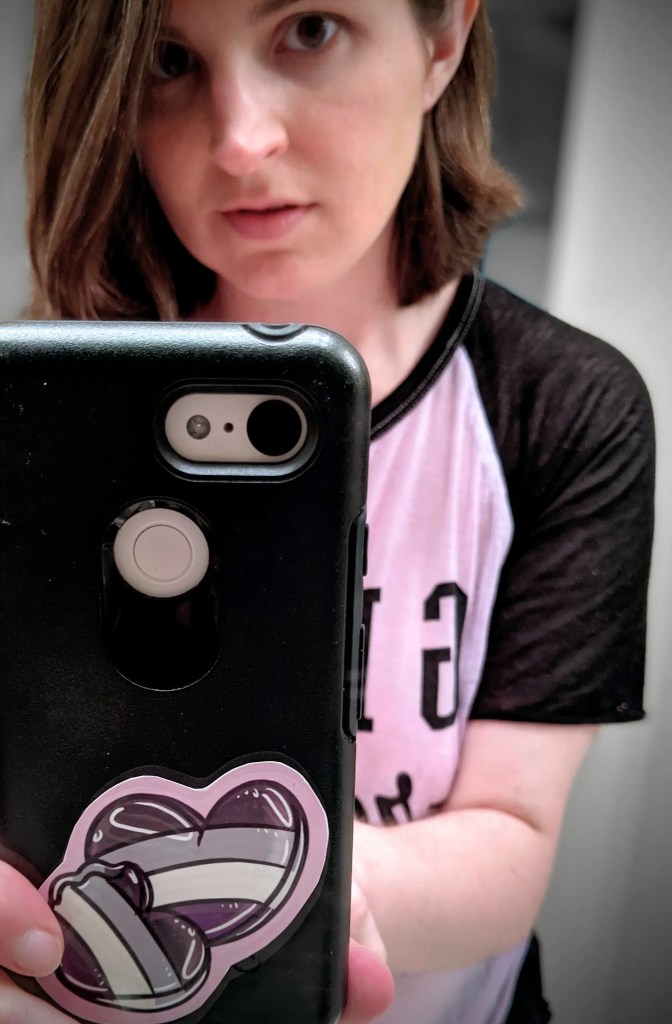
Selfie of a girl with an asexual heart sticker on a phone case
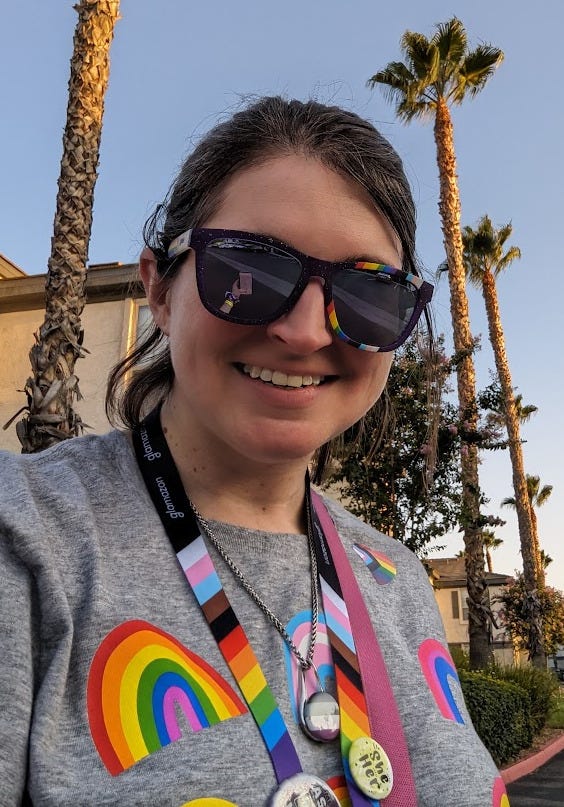
More subtle Pride selfie

For example, as an asexual girl, I wore black shorts and sandals, a purple and black shirt with a vague feminist Girls Rule the World (ironically from Victoria’s Secret haha), and a white undershirt. You CAN be as bold and bright as you want, but you can also be subtle too. Go at your own pace and comfort level. If you’re up for sloppy buzzed at drag brunch on mimosas and PDA with your visibly queer partner, go for it! If you’re just stopping by anonymously on your way to the store because you “love local culture” and “celebrate community in your city,” hear me when I say that is okay!

The scariest part is the conservative protestors. Stay away from them your first time. Don’t get into Bible battles or argue theology. Ignore, walk around, cross the street, pick a spot far from them where the music drowns out their hate, strike up conversations with people standing around unoccupied near you, especially if they have kids or are new to this too or look like they know what they are doing and are just chilling. This may require some small talk, so if that’s emotionally draining for you, don’t stress about it. Just know if you need to to feel safe or if you have a question, everyone NOT shouting is pretty friendly.

If a parade is too much, look at the schedule and just attend the markets and shows so you can leave at any time. Mind the temperature and dress accordingly (including sunscreen and WATER water water). But don’t be afraid to go. It’s just rainbow Fourth of July (or insert local parade holiday here) in small and mid-size cities.

A girl in Pride gear
Me after Pride now haha

Even better is asking your affirming organization/hobby group/small business/sports team/school committee/club/church to host a booth (get connected to the festival organizers and then pass along what they say to your own leaders to have a finance/planning/outreach/service committee meeting about it NOW and don’t wait until the week before in May or June). You can use the booth to hand out water, stickers, magnets, flyers with your clear affirming stance and info to get connected, etc. Or you can join the Human Rights Campaign, Free Mom/Dad Hugs, PFLAG, or another similar organization always looking for volunteers. Leave time to walk around and enjoy Pride yourself too.

But even if you are an introvert’s introvert, or a socially anxious neurodivergent of any energy personality type, at least once when geographically possible, go be with our people in all your rainbow glory. It may take more than once to feel comfortable there. That’s okay. Just go and be in the same physical space and feel less isolated and despairing as you marinate in the joy and community and connection. Even if you don’t make a new friend or join a new group or sing karaoke or have a party bone in your body. Bring home a sticker or ribbon or locally crafted item or something, just to remind yourself every day that you were there and it is real still, in every queer and allied heart around you.

allyship, aromanticism, asexuality, queer, resources

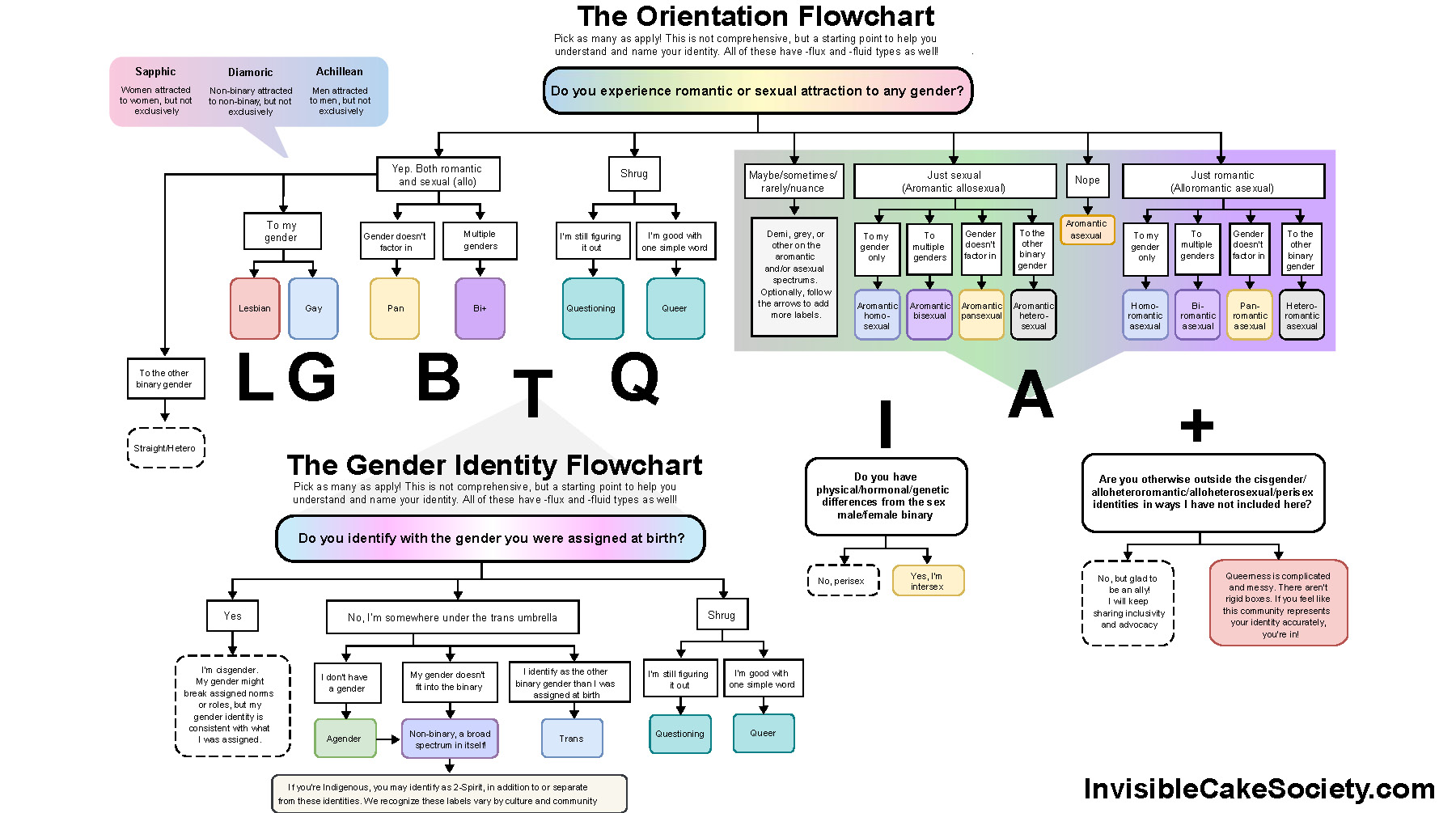
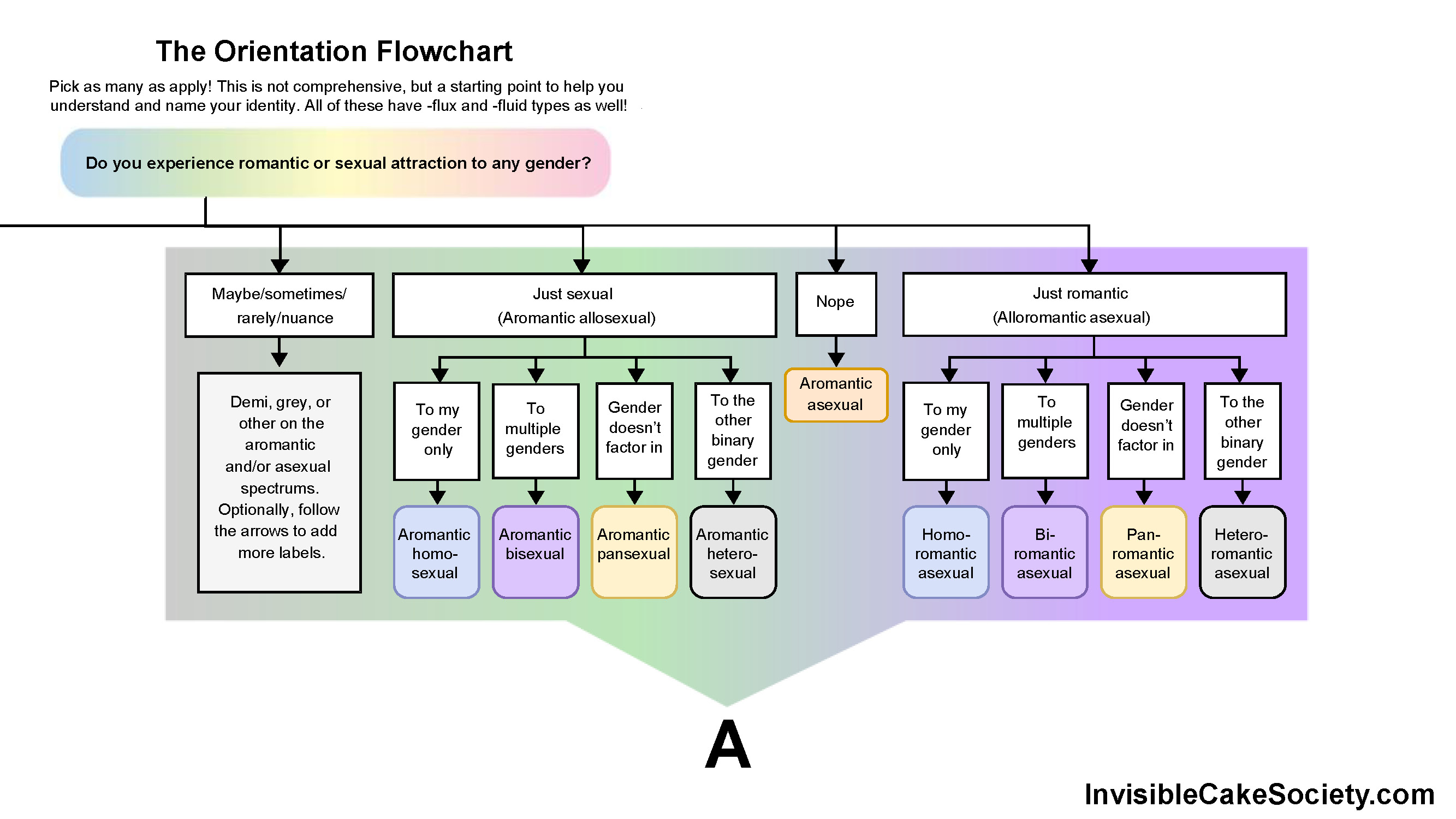
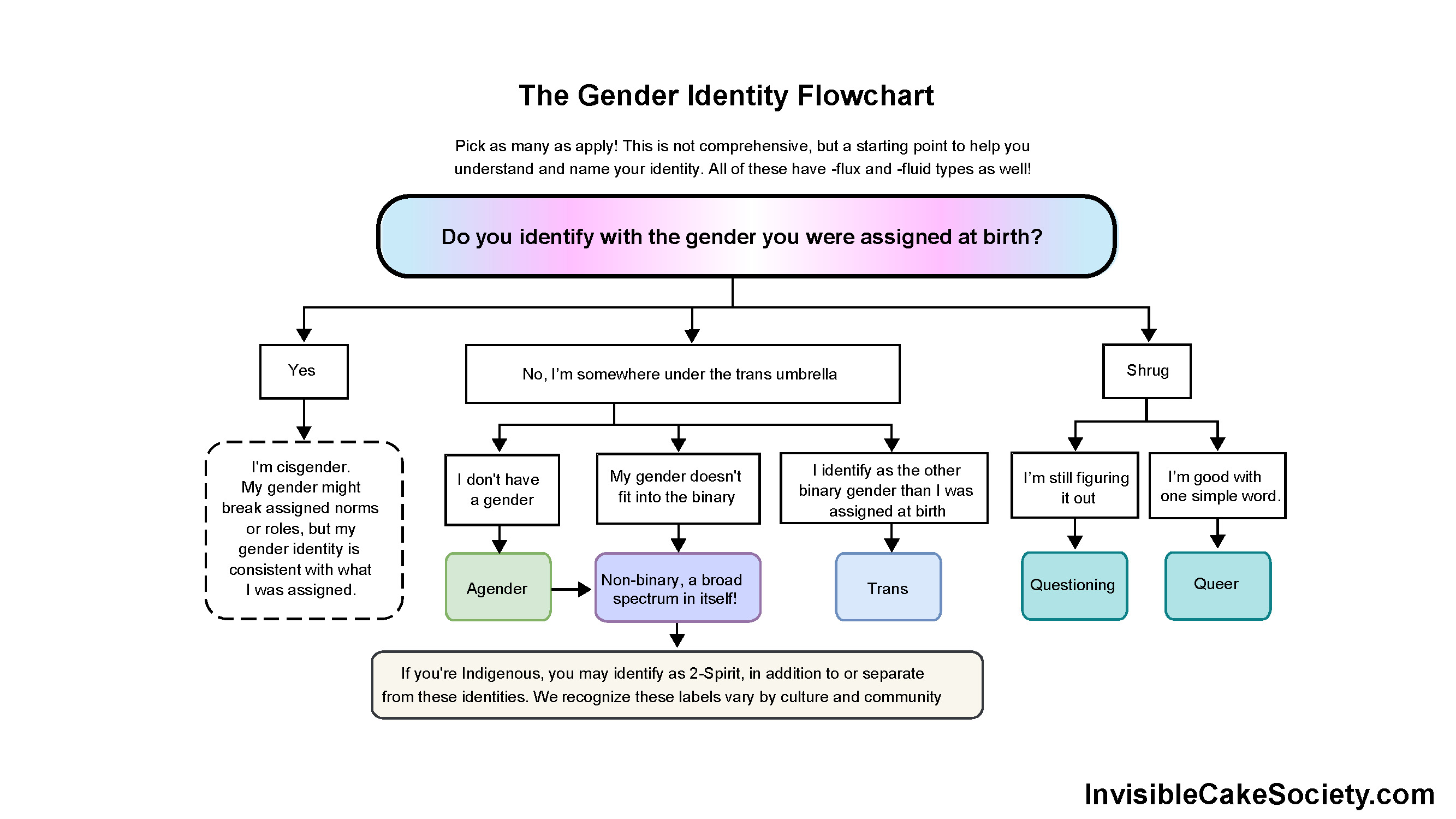
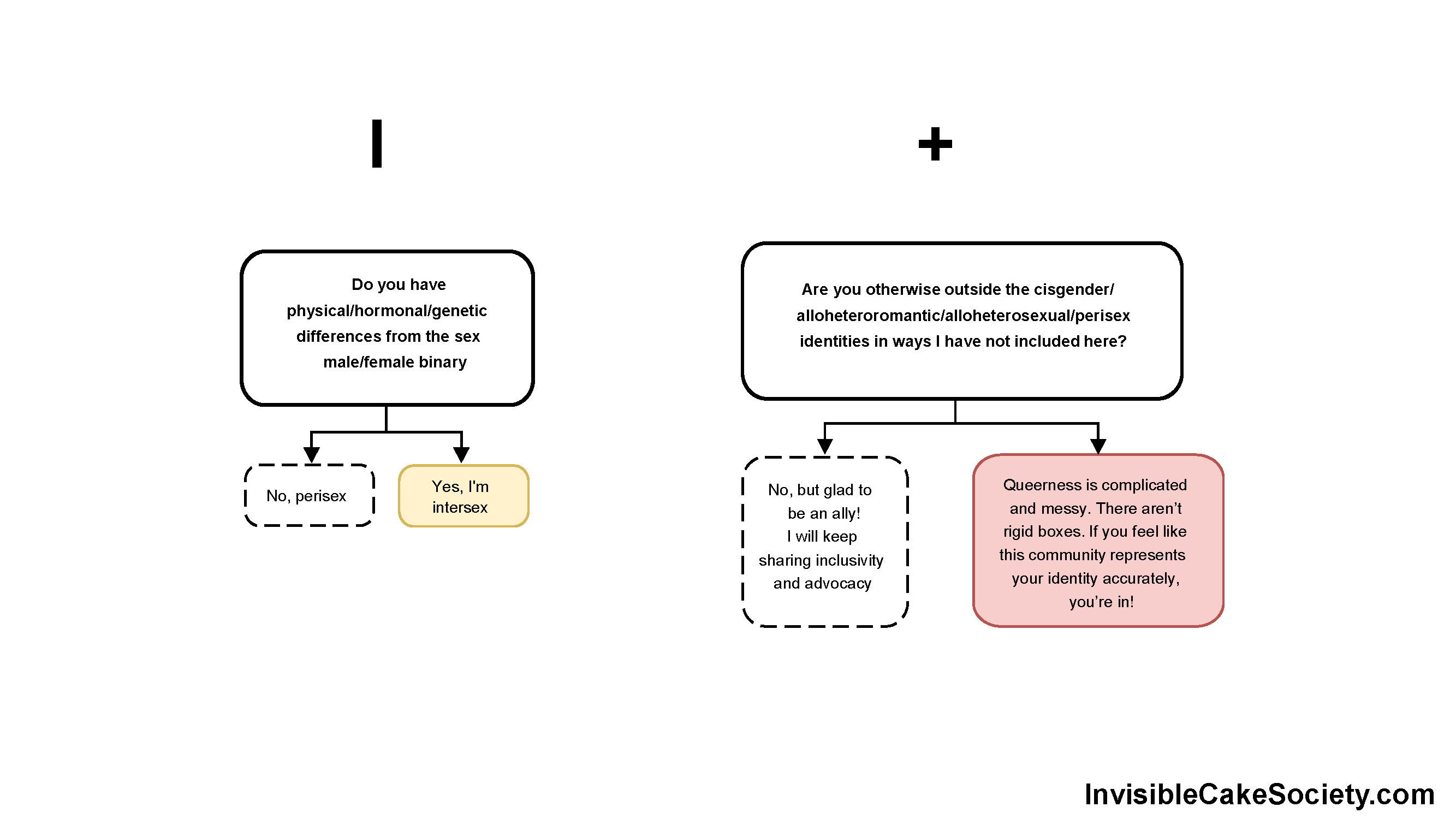
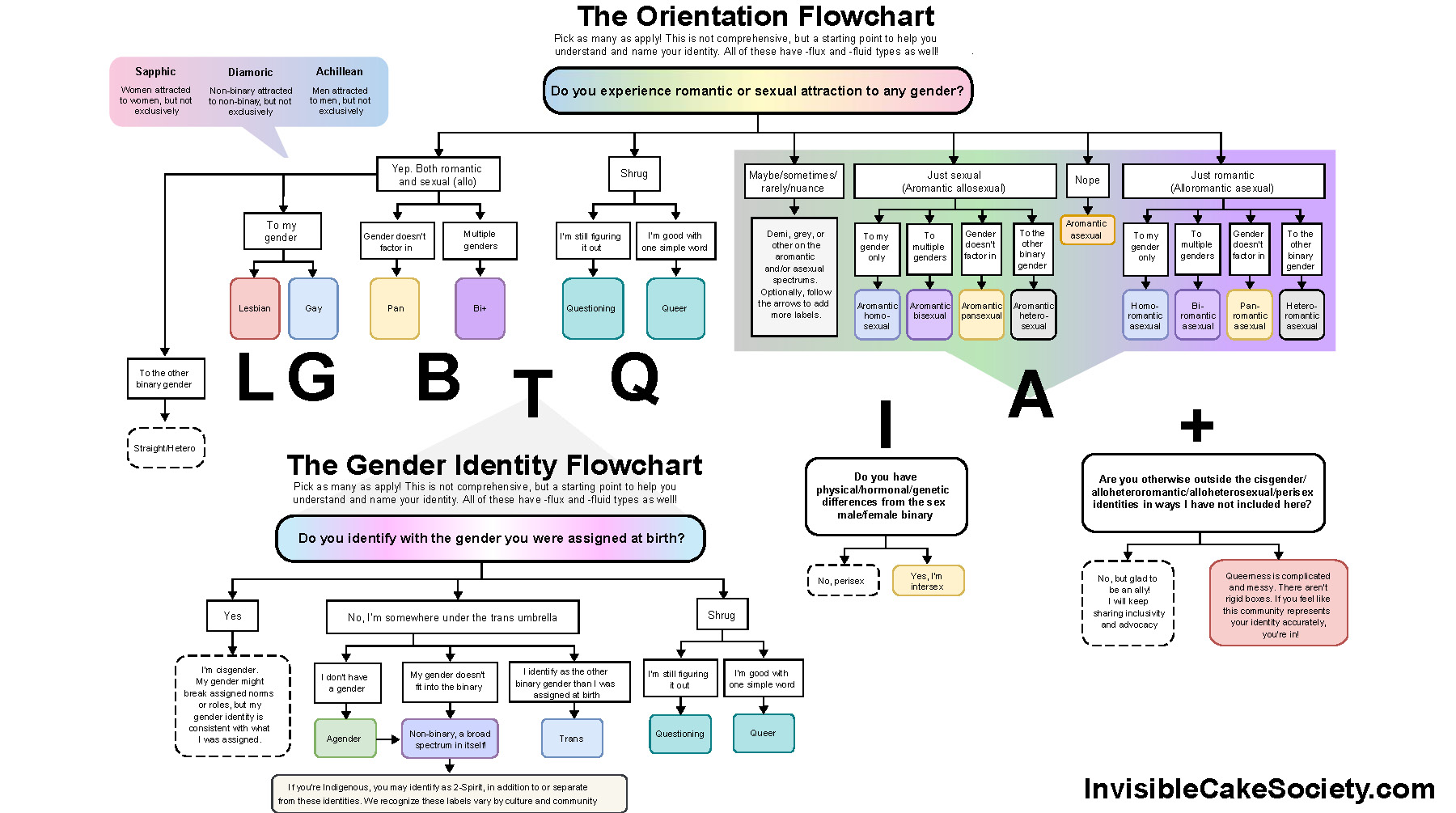
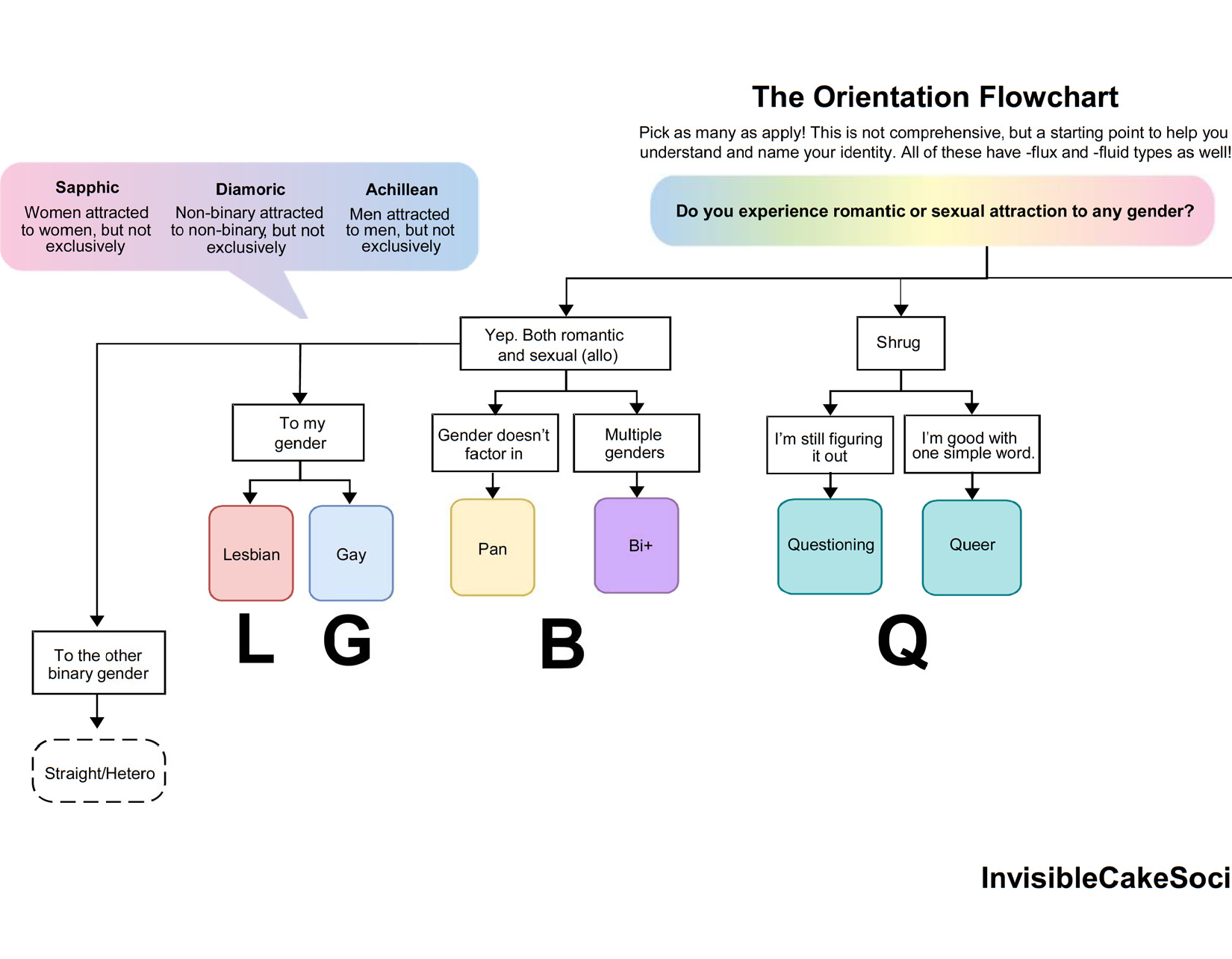
The Queer Identities Flowchart

  • LGBTQIA overview
  • L G B and Q
  • A spectrum
  • Gender spectrum
  • Intersex and plus

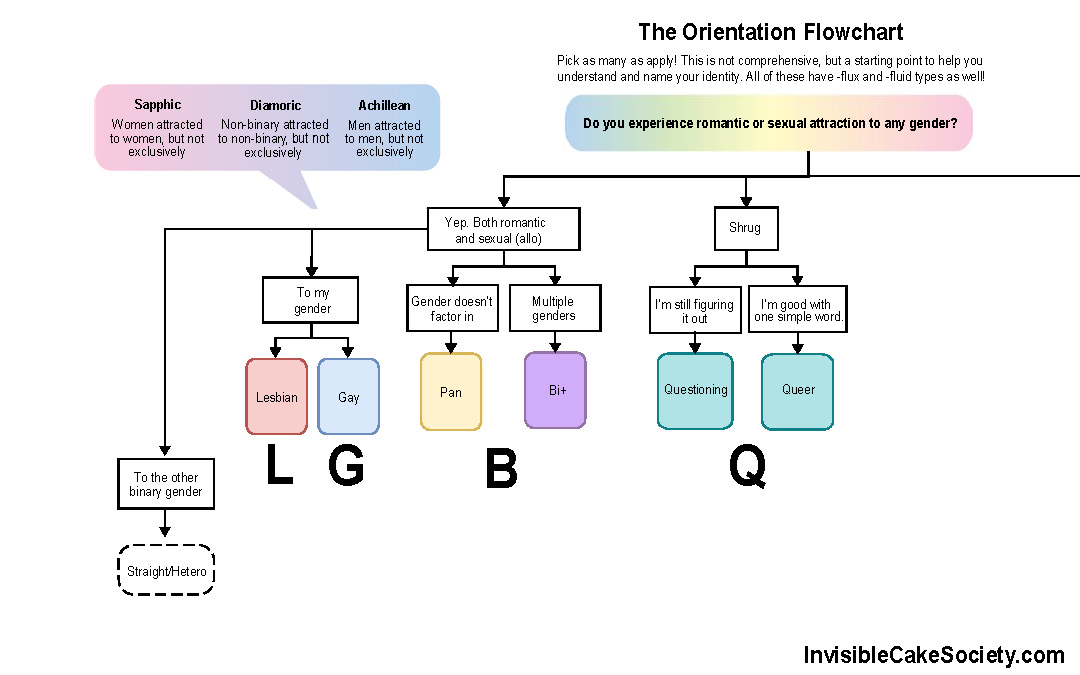
I’m hoping this flowchart can help everyone understand that the letters aren’t just a jumble of alphabet soup, but there is an organized system behind each one. It’s easier to see if you click the arrows to navigate through each slide, focusing on a specific section. These concepts are pretty much a multiple-choice test.

Orientation options include:

  • Attracted to the other binary gender
  • Attracted to my gender
  • Gender isn’t a factor
  • Attracted to multiple genders
  • Don’t know/don’t need to specify
  • Rarely or in certain situations
  • Just sexual
  • Just romantic
  • None of the above

Gender options include:

  • Same as the one everyone expected when I was born (“assigned at birth”)
  • No gender
  • Fluid or more than one gender or a gender not in the binary
  • The other binary gender of the one everyone expected when I was born

Intersex identities and other variations of queerness are also included.

Open these in a new tab or zoom in to explore!

LGBTQIA overview
A spectrum
Gender spectrum
Intersex and plus

Hope these are helpful! This is meant to be the start of the conversation, not the end point. Explore more in-depth and specific identities here: https://lgbtqia.wiki/wiki/LGBTQIA%2B_Wiki:FAQ

Christmas, pop culture, queer

LGBTQIA+ Holiday Romance/Family Movies

Merry Queersmas and happy holigays! While Hallmark, Lifetime, Netflix, Max, Prime, Hulu, and more are certainly known for their abundant straight/cis holiday romances and family comedies, queer holiday romance and family movies do exist! We have more Christmas, Thanksgiving, holiday, seasonal, and new year movies and miniseries than you might think. Representation can be so important for queer people, and these films normalize queer relationships, gender expressions, and identities for everyone. Joy is revolutionary, hope is our fuel, peace is our dream, and love wins in every form: romantic, platonic, familial, and more.

Fair warning that while some of these are produced by major studios like the streamers and networks above, some of these are very indie, and they vary in quality of writing, acting, and cinematography. Also read the linked description for content, rating, and where to watch.

Save this list and check off the ones you’ve seen as you go!

I’ve seen all of them currently available for streaming as of 2024. While I didn’t love them all, I will refrain from commenting because what didn’t resonate with me might be exactly what you need!

I’ll update with more as more are released each year. Let me know if you have more to suggest! The only criteria are that an LGBTQIA+ person is a major character (not necessarily the main one, though), it is overall a positive/affirming message in regards to queer rights and dignity, and that it is a holiday-centered romance that takes place primarily around November, December, or early January.

disability, neurodivergence, Poetry, queer

Every time I get a little freer

Every time I get a little freer
I grieve who I could have been all along
It could have been this easy
I didn't know that I was wrong

I know it takes a journey
I know I needed time
But part of joy is aching
For the me I left behind

She'll never get to be this me
At 17 or 23
What I wouldn't give to give her
A life always this free

I grieve for my own body
My heart and brain got hurt a lot
So many years to get here
I did what I was taught

I grieve for the gift
I didn't know I could take,
that I could take it slow
All the friends I'd make

I needed longing met with kindness
And not just affirmation of ambition
I needed empathy and wisdom
Not expectations or a mission

I wish I could go back there
To tell her spread her wings
But she'd just say That's pretty
And buy butterfly earrings

I wish I had listened
When they sang I hope you dance
Because dancing isn't fun when
You fear every judging glance

Today I heard that solitude
Is just the liberty
From others' loud opinions
And rest starts with loving me

I know that in the future
I will look back to the me here
Mourning that I didn't know
Liberation from my fear

allyship, faith, queer, resources

Worship resources for affirming churches

Explore the links on this page for liturgies, devotionals, worship services, naming rites, marriage ceremonies, prayers, songs, Bible commentaries, and more.

A Sanctified Art

Word Made Queer

Our Bible

Enfleshed

A Place in God’s Heart, A Place at Christ’s Table published by the National Gay & Lesbian Task Force

Illustrated Ministry graphics

Many Voices

Common Word

Sam Lundquist

Out in Scripture reflections on the HRC

Creating Sanctuary UK – Prayers and reflections guide

Parity

Music

Worship resources created by denominational LGBTQIA+ advocacy organizations but open to all churches:

See the Queer Christian resources list for more!

aromanticism, asexuality, essays, queer

You Are Not Bad Representation: A list of things you don’t have to do

1. You don’t have to be perfect as a queer person to prove that queerness is good. For the Christians, this might show up as pressure to individually always display fruit of the spirit to prove we are morally okay. While queer-affirming theology does lead to fruit of the spirit at a population level, you individually don’t have to be perfect to prove queerness as a whole is okay.

2. You don’t have to be content or fulfilled as a single aromantic and/or asexual person. There’s a lot of pressure on us to prove we aren’t missing out or scared of commitment or broken. But it’s okay to feel lonely because honestly life is lonely sometimes, and being a-spec in an amatonormative world is hard.

3. You don’t have to want to date or have sex even if you are allo and queer. Liberation isn’t about checking off a list of formerly forbidden behaviors. It just makes what you DO want possible because you have the freedom to choose.

4. You don’t have to want poly, open, or otherwise ethical nonmonogamous relationships in order to be supportive of others’ choices and desires. It’s okay to say this isn’t for you while advocating for others to have the same freedom of choice in the opposite direction.

5. You can decide your labels were wrong and change them, add more, or stay questioning forever. There’s no deadline to join a faction or house or cabin. This is not a fictional school or dystopian society. Even if it means detransitioning or deciding you aren’t attracted to your gender or realizing you aren’t on the a-spectrum after all. You’re always welcome as long as it’s helpful, and you’re welcome back if you change your mind or find better language. Keep fighting for your former community and be a well-informed ally.

6. You don’t have to date or have sex with someone of your same gender. You don’t have to dress androgynous as a nonbinary person or pass as cis if you’re transitioning. You don’t have to change your appearance or music or media tastes or hobbies to fit in. It’s about identity, not behavior.

7. You don’t have to renounce everyone you’ve been with or every term you previously identified with. You don’t have to have been born this way or have known as a kid. There’s no “must have exhibited symptoms before age ___” diagnostic criteria. Your whole story is your story, whether you’ve always known or just realized at age 80. Fluidity, self-awareness, and learning new terms are all valid reasons to identify differently than you did when you were younger.

8. You do not have to drink alcohol.

9. You don’t have to be feminine to be a gay man or masculine to be a lesbian. You don’t have to hate Valentine’s and rom-coms to be aro or hate sexual humor or erotica to be asexual. You don’t have to be hyperfeminine to be a trans woman or hypermasculine to be a trans man. Or feel completely androgynous to be nonbinary or agender. You can have as many genders as you want or any self-experience or expression.

10. Relatedly, you don’t have to stick to gender roles. The point is that we’re breaking free of heteronormativity, not recreating it in a more inclusive way. Stop expecting trans men or butch lesbians or bear gay men to fill patriarchal “man of the house ” “wears the pants” roles, and stop treating trans women and femme lesbians and twink gay men to be the delicate or incapable or weak one. What choices work for you is between you and your partner, not the “shoulds” of rebranded patriarchy.