It occurs to me tonight to put my rainbow grocery bag in the trunk. Not just because that’s where it belongs, but to not give anyone an excuse to take out their religion on my car window.
It occurs to me that if I were in a redder county, I would never have left it visible to begin with.
It occurs to me on a Walmart run after work that I should have taken off my company staff badge with the Pride flag on the back while walking alone in the dark.
It occurs to me that in other places, I would never have been allowed to put that sticker on my identification to begin with.
It occurs to me to move my black ace ring to my left ring finger in a protective lie, signaling to the men of the crowd that I am another man’s property. If they don’t respect my humanity, they may respect the rights of possession—or at least the fear of violating them.
It occurs to me that I have the privilege of safety in being gender conforming, able to chameleon my way into invisibility.
It occurs to me that I have to constantly remind people I know what I’m talking about, that my experiences are erased, that I am here too, that we are not new or a trend or a bonus feature.
It occurs to me that I do not require documents to be changed, or medicine to be seen as myself, or a search for my literal voice with the help of lessons.
It occurs to me that I am likely the only one you know. That when I speak, I must point to many others like me but not like me, so you have a broader view.
It occurs to me that I occupy a space of assumed privilege as others explain marginalization that I live every day myself. Amusing at times, but mostly frustrating.
It occurs to me that my intersections give me advantages to steward so others will be heard.
It occurs to me that most people don’t have to wonder if their friends, family, church, or job will disown them over basic identity facts. If they confess who they are, will they receive a birthday card this year, will they have any references for their job applications, will they be welcomed home at Christmas, will they still have an emergency contact?
It occurs to me that others have faced far worse: Will they still have a home, food, a functional body, their lives?
It occurs to me that there is safety in numbers, and my numbers are small, often just me and my carabiner and my rainbow T-shirt.
It occurs to me that an ally up the mountain was murdered for less.
It occurs to me that I can change my shirt, but others can’t change their voice, their government, their bones.
It occurs to me that some allies will only care to the point that it is comfortable to be with us. Our humanity is an issue on which they agree to disagree with friends and colleagues and those who can help their careers.
It occurs to me I must have patience for the indoctrinated.
It occurs to me that I don’t have the tolerance to wait.
It occurs to me, too, that even the wait is privilege. Others, our youngest, are running out of time.
Aphobia is often rooted in intentional ignorance but contains actual legitimate questions non-hateful people have, but are now afraid to ask after seeing the responses to the aphobic person, which defeats the goal of educating. It’s time to address some of these questions in a safe and open place: here in the Invisible Cake Society!
First: We can generally tell the difference between questions asked respectfully and humbly and questions asked to bully, sea lion, and troll. We’re not perfect, and tone on the Internet is hard, especially when emotionally activated, but be encouraged that educators/activists want you to learn!
Now, let’s get going:
I’m into girls, but I’m also on the aromantic spectrum and asexual. What does that even mean? How can I be all of those!? Well, queerness is a big wibbly wobbly blob of grey areas, not neat boxes. Getting free of boxes is the point. Labels help us connect and communicate. They help us feel less alone, find resources, and form community to work on shared goals and experience belonging in a world that seeks to erase us.
We hear about sexual orientation, but there are others, usually but not always aligned. Romance, platonic, aesthetic, etc.
Also frequency: never, rare, average, or only in specific circumstances.
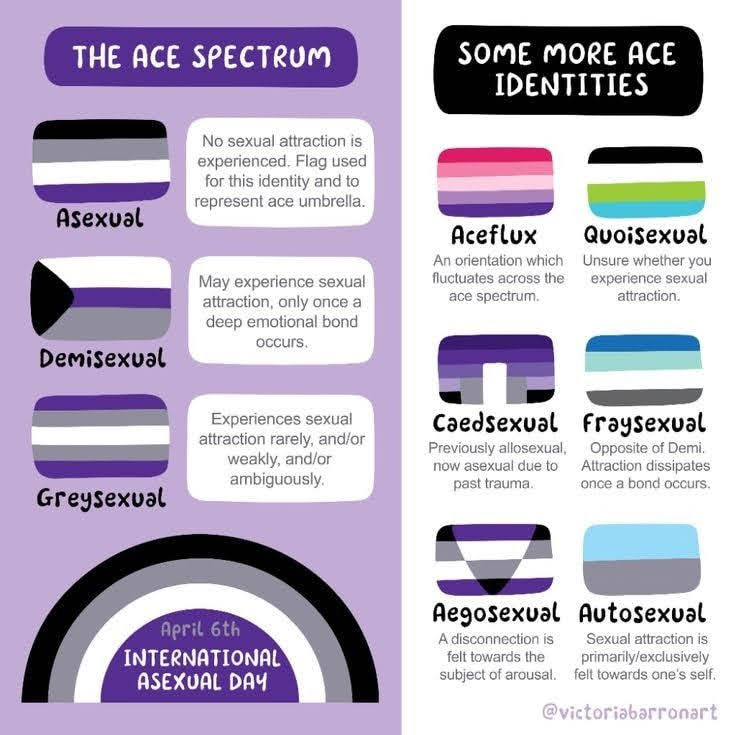
List of ace spectrum identities
So if you rarely experience attraction to girls not boys, and that attraction is mostly nonsexual…
You may be sapphic asexual or ace lesbian, and possibly somewhere on the aromantic spectrum as well.
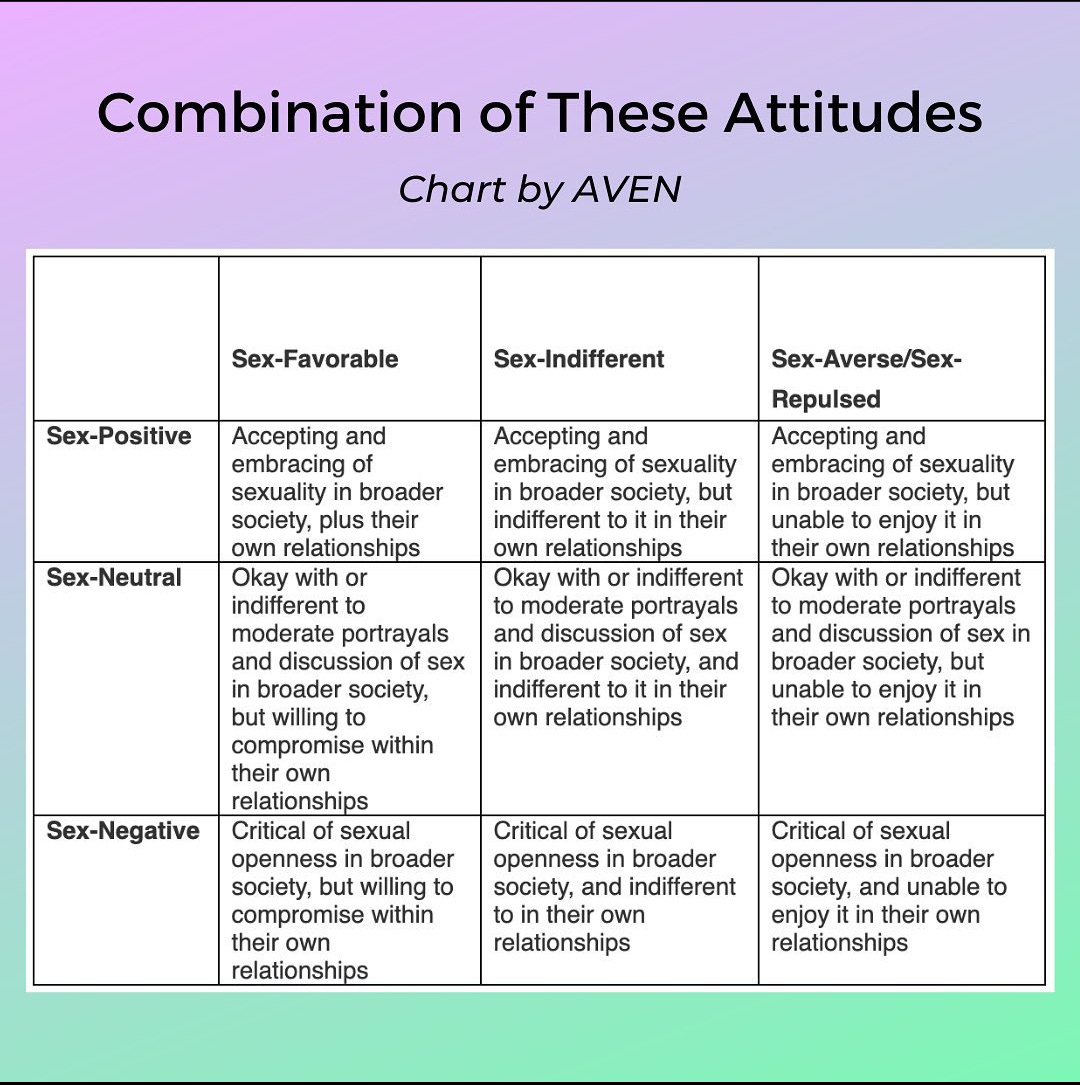
We then have favorability, indifference, aversion, and repulsion to specific behaviors.
This is different than sex positivity, neutrality, and negativity that are about attitudes toward sex in society.
Chart comparing various attitudes and preferences
Also generalized desire: you may want to experience kissing but not have a specific person or gender you’re particularly drawn to.
And biological libido/hormones.
All different independent but related things.
Attraction is a word we use with magnets. A fridge door is magnetic even when empty, but if you hold a magnet close, it will react with attraction. Aka, a gay person is still gay even when single or “not getting laid.” Same for straight or bi or pan, etc.
And vice versa, an asexual person is still ace even if they have a sexual partner. That person could be the rare exception of sexual attraction, or someone they love in other ways, or just a fun partner to have a good time with. That’s their business, not yours. Regardless, they are still ace.
We know people can still be straight (and we not only assume it but strictly enforce it as normal) even if they haven’t had sex or dated. But there’s a pressure to prove we aren’t broken or defective so we conform to the norm of romance and sex.
This is broadly called amatonormativity (amato, as in amorous, + normative). Amatonormativity means: the assumption that all people aspire to or have a romantic and sexual relationship at the center of their lives. It is the measure of not only whether you’re similar to others, but your desirability and attractiveness aesthetically and platonically, your success and maturity as an adult, and your character to be a good employee or leader.
“Virginity” is a conservative purity culture term that both honors the purity of a young person (let’s be real, teen girls) and is used as a barb to insult anyone past that “expiration date.”
This is true regardless of your thoughts on abstinence, which is waiting for marriage to have sex. Conservatives and self-proclaimed radical feminists and mainstream culture agree that people without a romantic and sexual relationship by an arbitrary age are societal rejects, undesirable, or sick.
The only part that differs is whether that relationship must be a marriage. Whether it is a hookup buddy or a covenant life partner in the eyes of God, society generally agrees not having one is enough to get you pity and “just get laid” or “needs a girlfriend/boyfriend” comments.
Say you have never or, worse, don’t want, such a relationship, and they lose their minds. How!? Isn’t a romantic and sexual partner a requirement for maturity, health, success, and personal survival??? No, it isn’t.
That’s why while everyone should have the legal right to have romance and sex with any gender, sex and romance are not a “right” you can demand from others. The gender of your partner(s) should not be constrained by law AND ALSO you are not entitled to that relationship from another gender or individual.
This is the consistency of consent. It goes both ways: There is no sexual or romantic liberation without the choice to refuse romance and/or sex. If we’re only fighting for the right to choose the gender of our partner but otherwise chained to the same stigma and shame, that’s not liberation.
If we’re only fighting for the right to choose the gender of our partner but otherwise chained to the same stigma and shame, that’s not liberation.
And yes, I don’t just mean stigma and shame over having had sex or romance but also over NOT having had it or not desiring it.
This liberation benefits not only aro and ace people who are less likely to have partners but EVERYONE who is single, whether by choice or not, divorced or widowed, etc.
In case you haven’t read stats on that lately, that’s roughly half the population. And many of those singles aren’t actively looking for a partner, whether they were partnered before or not.
So are asexual people “just straight”? No. Some may have hetero attractions, some have gay or bi or pan to describe their attractions, and some are just aro ace with no attractions. And some are a combination. Remember, people are a wibbly wobbly mush.
Is orientation about how much, or the type, or the quality of sex we’ve had or not had? Nope. Attraction and behavior are independent topics. Related, yes. Entirely the same? Not at all.
Like magnets, you can change the shortcut terms you use to describe yourself at any time. Maybe in your 20s you were positive that you were a straight, female, sporty, extroverted premed student. Maybe in your 40s now, you are a bi, nonbinary, bookish, ambivert therapist. Labels change! Growth!
It makes sense why queer Christian theology is often heavily sexually centered, given our history, but the best queer theologians balance it with ace inclusion. Not just as a footnote, but as a core goal. The point is ending amatonormativity and gaining collective liberation, which takes all of us—of every gender, orientation, relationship style, race, ability, culture, and more. Rightfully practiced, Christianity—with the words of Jesus at the center—drives us forward to this goal.
Jesus is as clear of an aromantic asexual Christian role model as we could ever ask for! Embracing found family and breaking gender and class binaries are foundational to his life. There’s just no way to read the gospels and come away with a factual interpretation that centers amatonormativity. That doesn’t stop the global church (now or historically), of course, because institutions and patriarchal power structures are best served by amatonormativity and all that comes with it.
When women are free to earn their own money, when singles are equal to married people, when everyone has the same rights and respect regardless of gender or orientation or relationship status or race or disability, we can liberate ourselves from the oppression that power structures are built on. That’s gospel, as Christlike as it gets, but it’s the exact opposite of what those in power want because it would require true humility, servant leadership, the Beatitudes, sacrifice, and loving others as themselves. It would be for the benefit of all, including themselves, but there’s nothing that scares them more than the risk and exposure of vulnerability.
I truly believe the only way forward is shame resilience, tolerance of vulnerability, finding belonging within, and developing healthy, boundaried empathy that leads to freedom beyond anything gatekeeping or virtue signals or scarcity can achieve. That’s work each of us can do, whether by reading books by Brene Brown, Aundi Kolber, and Matthias Roberts; or doing therapy one on one or as a part of a couple or in a group; or listening to podcasts, lectures, or wise friends and leaders who can guide us there.
When we liberate our minds and hearts, we are free to see others who are unimaginably different than us as a gift to the Body of Christ. We aren’t threatened or defensive because we honor what other identities and perspectives can bring that we can’t.
With the fruit of the Spirit as our guide, we lead from a common goal that all will be free: asexual and allosexual, aromantic and alloromantic, queer and allocishet, and more. Single or partnered, parents and childfree, living alone or with others, sexually celibate or abstinent or solo or partnered or open or any combination. Everyone.
But we can’t get there while asexuality (and aromanticism and our respective spectrums) remain erased and invisible in the church. We are vital to the liberation of Christ. We queer queer theology. We challenge norms in ways that rewriting gender rules alone can’t. We defy expectations and push beyond affirming marriage or ordination or any one label or issue in our unique ways, as all letters do if given proper consideration. But for asexuality, it isn’t as simple as churches might think. We are going to ask more than a flag at Pride or a language change, but a mentality shift that will require surrender of structures and norms and old visions and false realities.
But don’t fear. It’s the surrender of flight, falling into the ways of Jesus and finding ourselves held by the wings of love the whole time. That is, if only we have the courage to listen to asexuals, end amatonormativity, and become something so much better: the family of God.
Ornament on a Christmas tree that says Be Proud of Who You Are
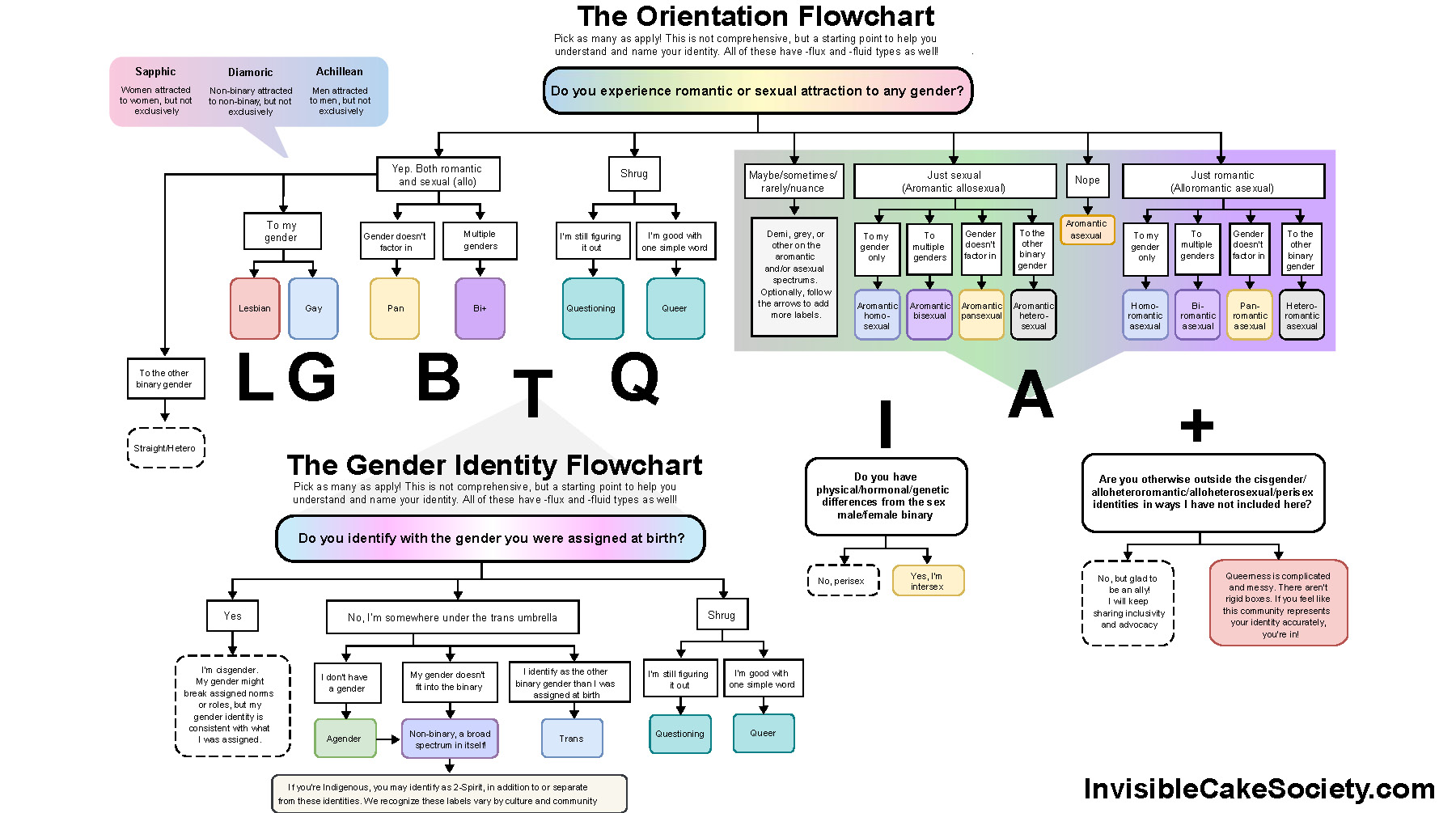
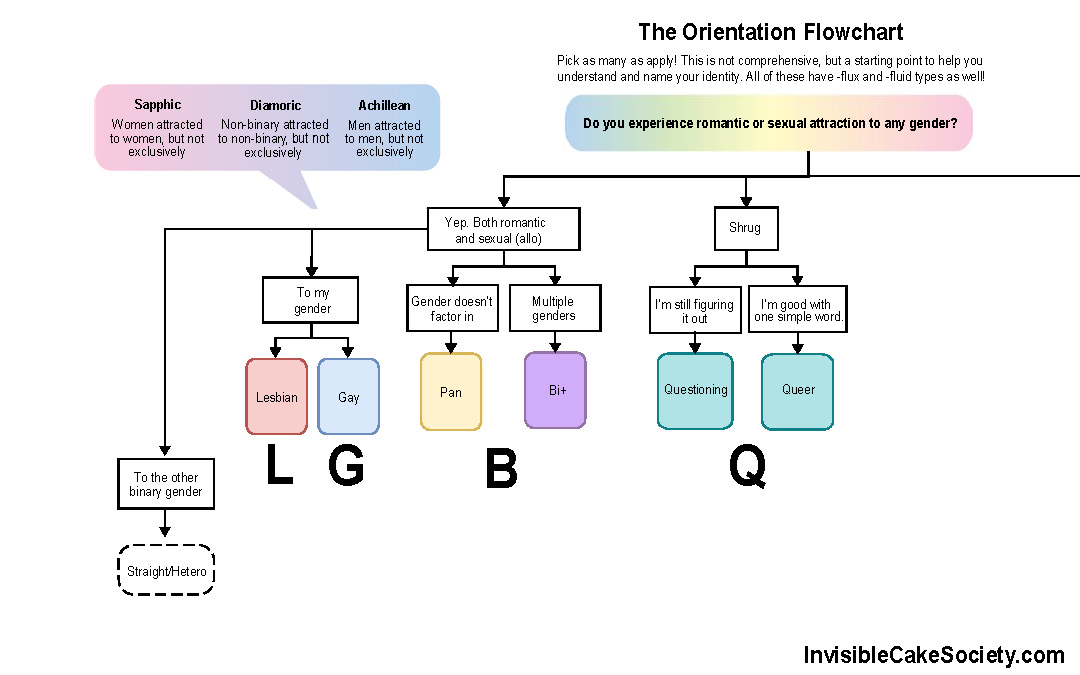
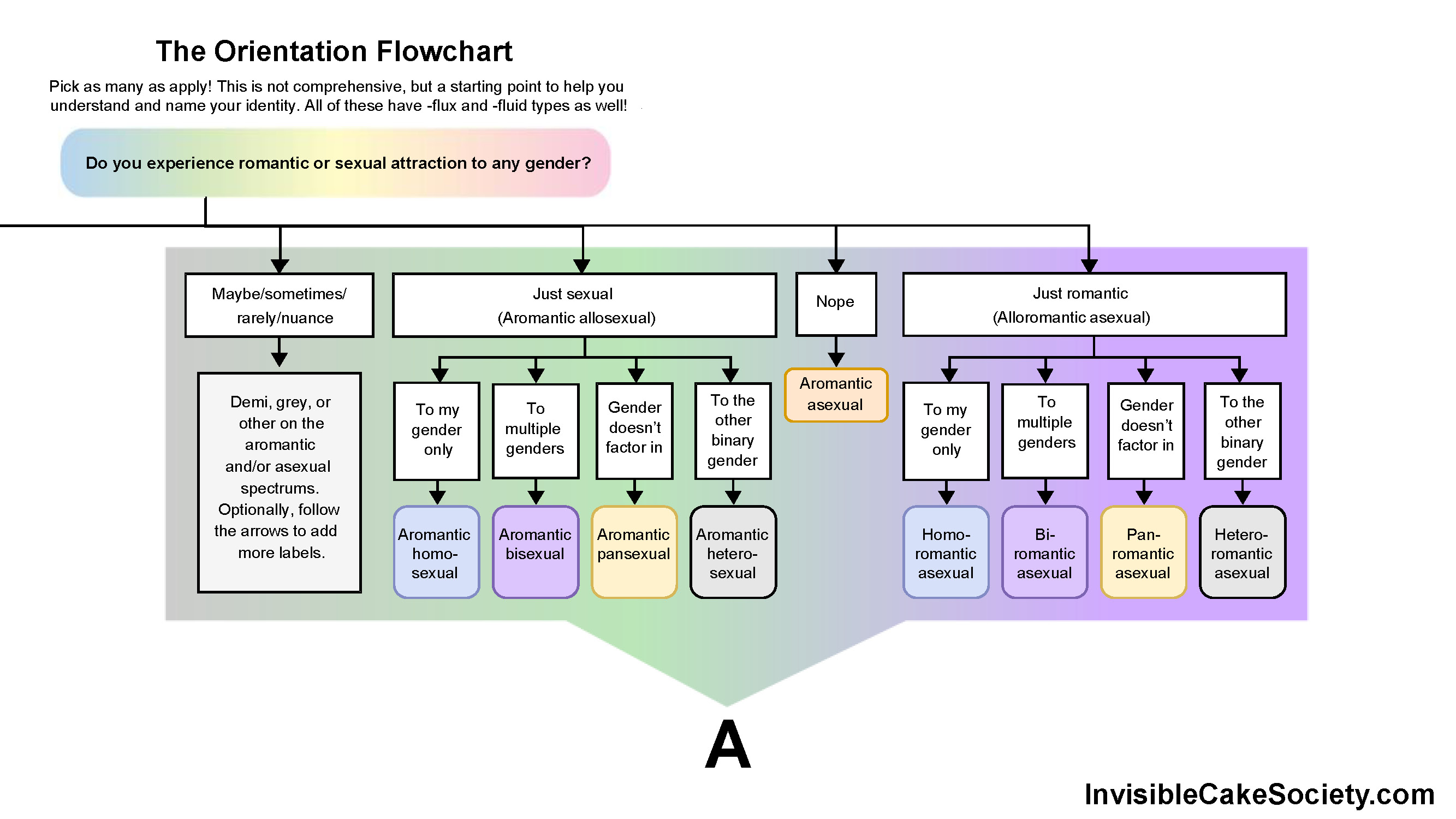
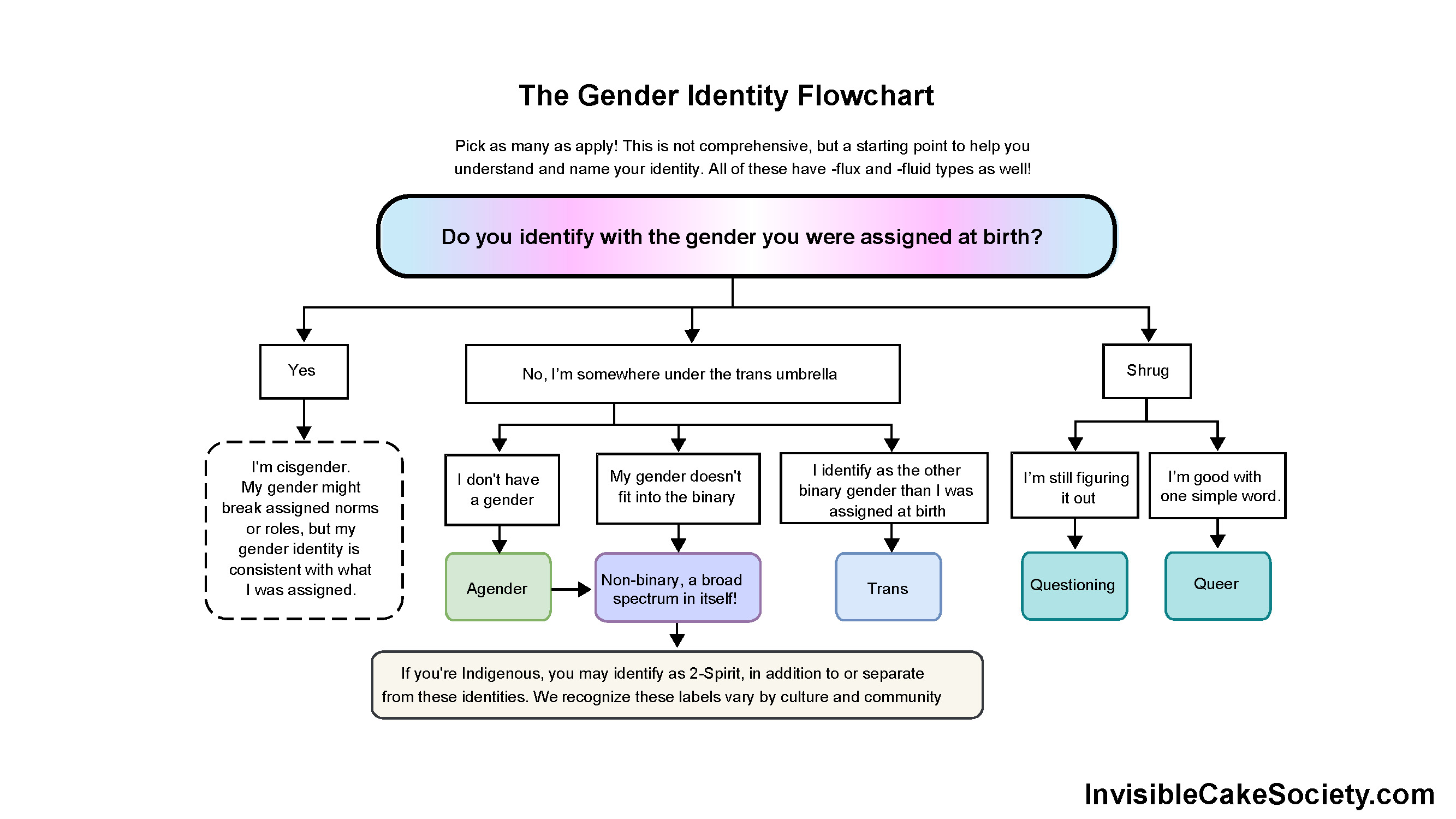
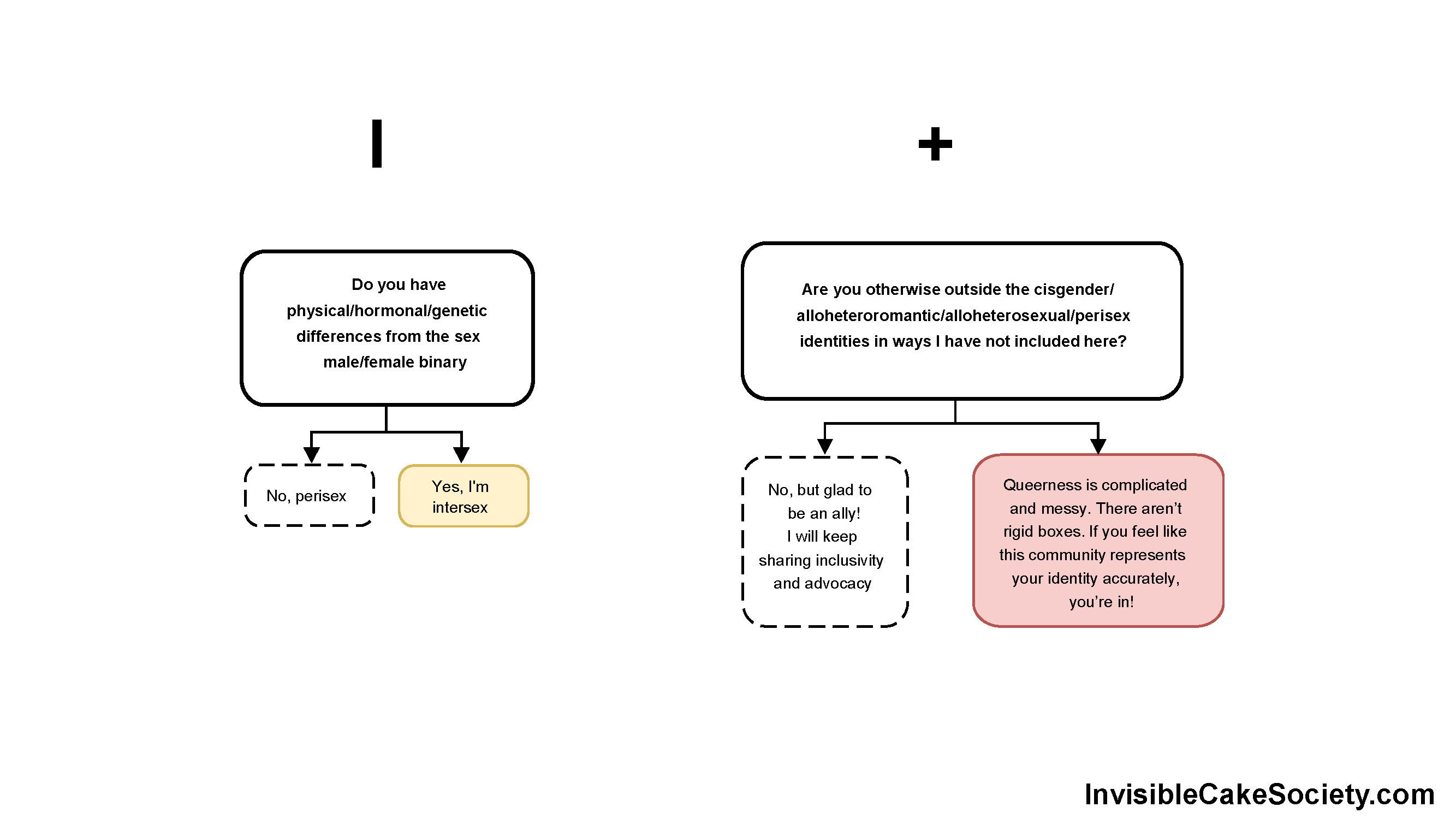
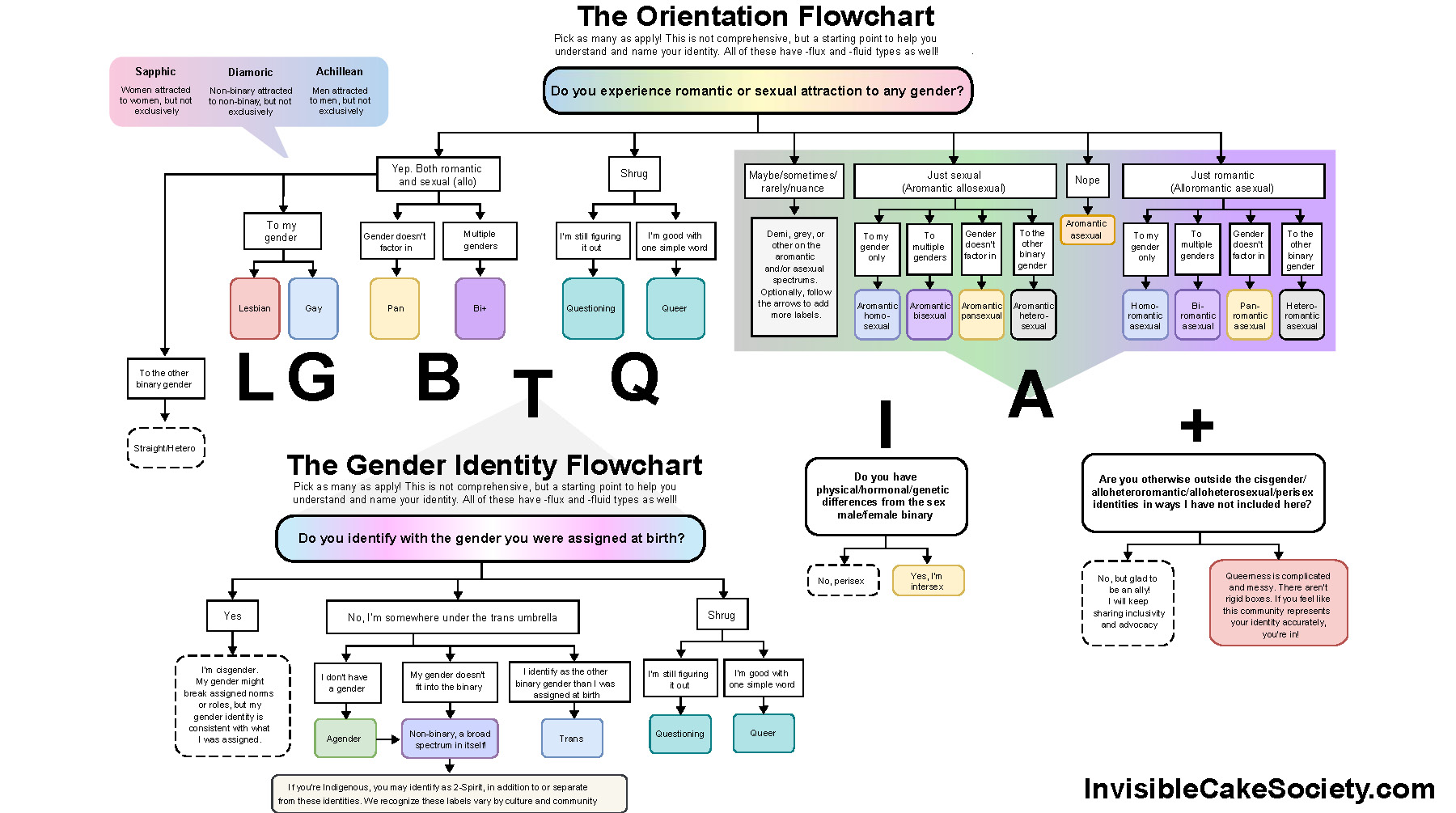
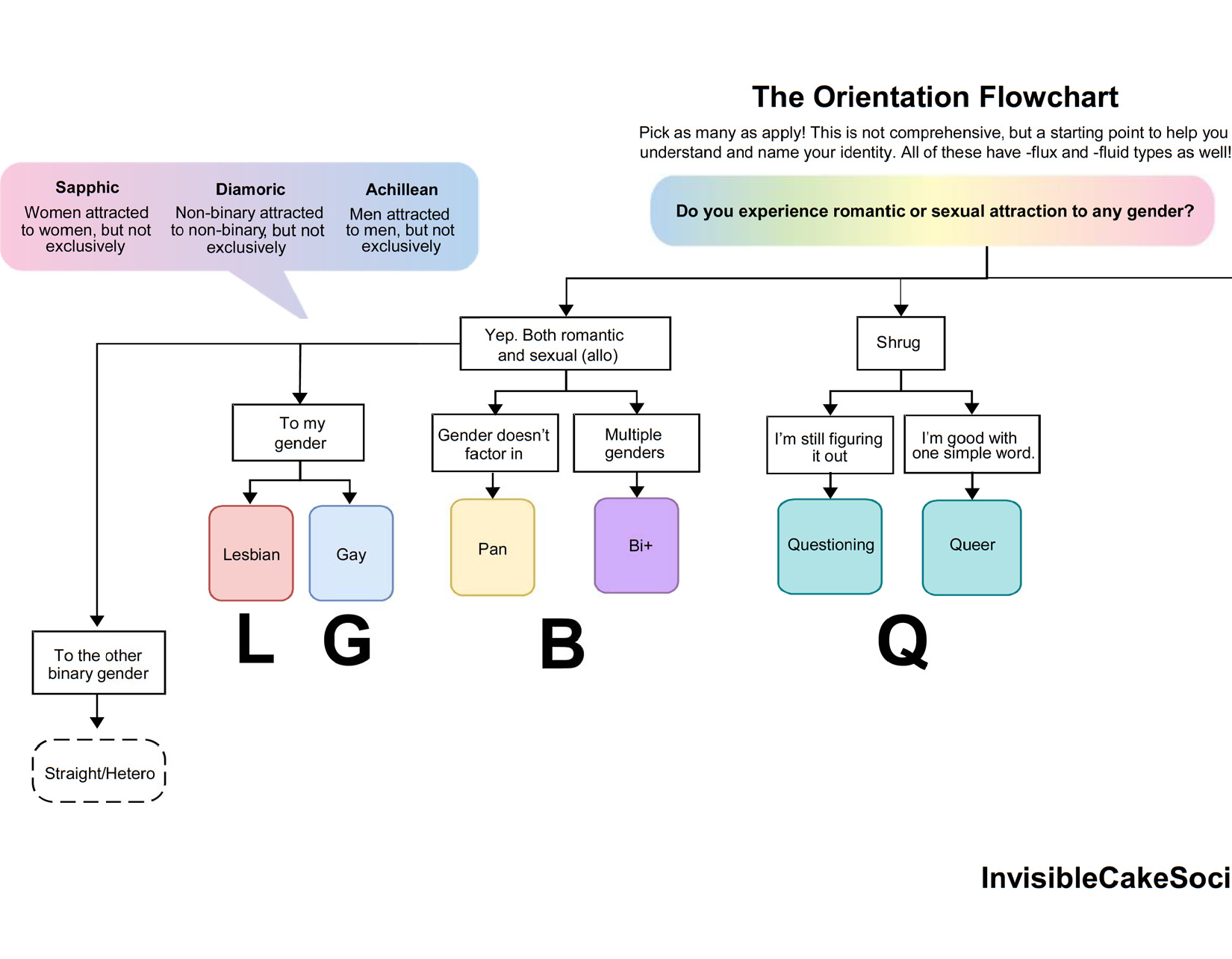
I’m hoping this flowchart can help everyone understand that the letters aren’t just a jumble of alphabet soup, but there is an organized system behind each one. It’s easier to see if you click the arrows to navigate through each slide, focusing on a specific section. These concepts are pretty much a multiple-choice test.
Orientation options include:
Attracted to the other binary gender
Attracted to my gender
Gender isn’t a factor
Attracted to multiple genders
Don’t know/don’t need to specify
Rarely or in certain situations
Just sexual
Just romantic
None of the above
Gender options include:
Same as the one everyone expected when I was born (“assigned at birth”)
No gender
Fluid or more than one gender or a gender not in the binary
The other binary gender of the one everyone expected when I was born
Intersex identities and other variations of queerness are also included.
Open these in a new tab or zoom in to explore!
Hope these are helpful! This is meant to be the start of the conversation, not the end point. Explore more in-depth and specific identities here: https://lgbtqia.wiki/wiki/LGBTQIA%2B_Wiki:FAQ
April 6 is International Asexuality Day, highlighting asexual organizations and people all over the world. Asexuality is not unique to North America or the UK. We are everywhere in every culture and country and time zone. Here are organizations highlighting not only asexuality but also aromanticism and both spectrums.
When we say aros can date or aces can have sex, we aren’t appealing to normativity; we’re speaking about liberation and against gold-star gatekeeping. There is no vow of singleness or celibacy in being a-spec. You can do what you want. It’s about identity not behavior.
The context for these discussions is when allos and gatekeeping a-specs say we aren’t really ___ because they think it’s about choices. If you understand that and don’t have anyone telling you, “But you can’t be a-spec because you….” then these discussions are not for you. And that’s great!
It means we are making progress if a-spec people don’t know why it’s important and educational to separate behavior and identity. If you aren’t constantly conscious if you’re acting aro or ace enough “to count.” If you accept without question that there are many ways to be a-spec, that’s amazing because it’s proof that the last decade of activism worked!
But if you know your own community history, you understand why these phrases like “can still date” or “some aces have sex” are vital to liberation frameworks. Not long ago, this was MIND-BLOWING. And controversial.
So congrats if you don’t get it because you had elders who came before you to pave the groundwork so you don’t have to fight the need to police your behavior to prove you belong or have earned your labels.
This is not purity culture. You don’t have to repent or reform your life choices or pledge your virginity or stay single or be accountable to a leader who will determine if you are living in asexual or aromantic righteousness. THAT’S what we mean when we say you can date as an aro person or have sex while being asexual. For some people, that’s the missing piece they need to hear and is not at all as obvious to them as it is to you.
1. You don’t have to be perfect as a queer person to prove that queerness is good. For the Christians, this might show up as pressure to individually always display fruit of the spirit to prove we are morally okay. While queer-affirming theology does lead to fruit of the spirit at a population level, you individually don’t have to be perfect to prove queerness as a whole is okay.
2. You don’t have to be content or fulfilled as a single aromantic and/or asexual person. There’s a lot of pressure on us to prove we aren’t missing out or scared of commitment or broken. But it’s okay to feel lonely because honestly life is lonely sometimes, and being a-spec in an amatonormative world is hard.
3. You don’t have to want to date or have sex even if you are allo and queer. Liberation isn’t about checking off a list of formerly forbidden behaviors. It just makes what you DO want possible because you have the freedom to choose.
4. You don’t have to want poly, open, or otherwise ethical nonmonogamous relationships in order to be supportive of others’ choices and desires. It’s okay to say this isn’t for you while advocating for others to have the same freedom of choice in the opposite direction.
5. You can decide your labels were wrong and change them, add more, or stay questioning forever. There’s no deadline to join a faction or house or cabin. This is not a fictional school or dystopian society. Even if it means detransitioning or deciding you aren’t attracted to your gender or realizing you aren’t on the a-spectrum after all. You’re always welcome as long as it’s helpful, and you’re welcome back if you change your mind or find better language. Keep fighting for your former community and be a well-informed ally.
6. You don’t have to date or have sex with someone of your same gender. You don’t have to dress androgynous as a nonbinary person or pass as cis if you’re transitioning. You don’t have to change your appearance or music or media tastes or hobbies to fit in. It’s about identity, not behavior.
7. You don’t have to renounce everyone you’ve been with or every term you previously identified with. You don’t have to have been born this way or have known as a kid. There’s no “must have exhibited symptoms before age ___” diagnostic criteria. Your whole story is your story, whether you’ve always known or just realized at age 80. Fluidity, self-awareness, and learning new terms are all valid reasons to identify differently than you did when you were younger.
8. You do not have to drink alcohol.
9. You don’t have to be feminine to be a gay man or masculine to be a lesbian. You don’t have to hate Valentine’s and rom-coms to be aro or hate sexual humor or erotica to be asexual. You don’t have to be hyperfeminine to be a trans woman or hypermasculine to be a trans man. Or feel completely androgynous to be nonbinary or agender. You can have as many genders as you want or any self-experience or expression.
10. Relatedly, you don’t have to stick to gender roles. The point is that we’re breaking free of heteronormativity, not recreating it in a more inclusive way. Stop expecting trans men or butch lesbians or bear gay men to fill patriarchal “man of the house ” “wears the pants” roles, and stop treating trans women and femme lesbians and twink gay men to be the delicate or incapable or weak one. What choices work for you is between you and your partner, not the “shoulds” of rebranded patriarchy.
I started this year with a specific Word of the Year, a tradition in Christian women’s circles dating back to the heyday of the “blogsphere.” I usually don’t remember mine by April, but this year was different. This year the word that came to me, or that I picked (depending on what you believe about such things), was “complicated.”
As in, letting myself be.
I refused to simplify myself any longer. I would not pretend to be straight for others’ comfort. I would not pretend to be the perfect gold-star aromantic asexual person while denying the reality of my vague sapphic attractions, while accepting that I would never be fully accepted in the lesbian community either. Aromantic and yet a romantic. A cis woman and yet deeply, intrinsically, queerly, asexually so.
I would not hide that I have nontraditionally presenting ADHD in addition to my variety pack of mental illnesses. I would give up trying to screen and test myself over and over for autism, which I probably don’t actually have but also don’t not have entirely. I would be hyperactive and exhausted, both wrapped in brain fog and begging for someone quick enough to catch up with my twice-exceptional brain that has already put the pieces together. I would live into the reality of my disabilities despite feeling unqualified to use that term. I would respect my body’s needs and differences as my own and not the object of others’ expectations.
As you might assume from my content on this site, I carry a lot of labels. Some are less well-known than others, and some carry inaccurate connotations. Some I am constantly working for greater awareness of, and others I keep quieter about. These labels have been immensely helpful for me, whether they are as specific as a microlabel on the spectrum of aromantic and asexual identity or as broad as the unifying and nebulous umbrella terms that I’m not sure where all I fit within.
Naming is important to self-concept and acceptance of our identity, but there are equally important stages that we move through before and after we first say, “Hi, my name is ____ and I’m ____.” These aren’t strictly linear, but they are numbered for the sake of organization:
I’m primarily focusing my work on progressive Christianity and the queer church because that’s where I’m most needed and fit best, but others have blazed a trail before I got here and I’m not alone now.




 Invisible Cake Society