I want to be absolutely clear: The end goal is no more nonaffirming churches. Not a “diversity of thought” that’s just rewriting purity codes. Not a “range of opinions” with a variety of ways to exclude and dehumanize and tolerate “separate but equal.” Not a bare minimum. Not an “I love you but.”
Whether these churches accept correct, just, God-honoring theology or simply fade into history as factories of shame and harm and fake-nice, the collective liberation vision does not include nonaffirming theologies. Affirming theology *is* correct theology. We have beat around the bush long enough.
The mainline squandered opportunity after opportunity to draw that line, and we’re seeing the fruit of that, but we’re also seeing the fruit of the risk, the courage, the willingness to say NO to fence-riding and big-tent and “inclusive of all, the marginalized and the powers behind marginalization.”
In Christ, gender is not a factor for whether a marriage is holy, for whether sex is sinful, for whether someone is qualified to lead, serve, parent, teach, adopt, or write, for when passion is lust or love is healthy. That doesn’t mean we abandon discernment, but that gender isn’t relevant to it.
We are uncompromising in that. Lesbian, gay, bi/pan/+, trans/nonbinary/genderqueer, intersex, asexual/aromantic/agender, and all other kinds of queerness are not just permitted but *required* for the full reflection of the image of God and the accurate representation of the Kingdom come on earth.
Churches that factor in gender to who is permitted to do what are not only harmful, even deadly, for a small subset of the population. That is too minimizing. They are lacking in faithfulness. They are missing out on our gifts and our presence, but they are also missing out on the real, true God.
Conviction isn’t the enemy. Just like how becoming affirming isn’t “throwing out sexual ethics” or “there are no rules” or “rewriting history/the Bible,” it also isn’t an accommodation we’re asking for, a way to boost your Good Person points, or a secondary issue. It’s accurate, correct, right.
Have the courage to say so. Have the willingness to exclude the intolerant beliefs and opinions while honoring the need to listen, learn, grow, influence, and teach. It’s not about excluding individuals; it’s about setting our doctrinal truth, our policies, our reason for being.
Conservatives will panic: “See, the crazy liberals want to erase us! They want to eradicate us! They discriminate against us! The intolerant left!” Yes. I do. I want to erase the possibility that any queer kid grows up thinking God hates, Jesus is ashamed, or the Spirit would take away their joy.
I want to eradicate queer death, suffering, rejection, and homelessness. I do discriminate against bigotry and hate and fear-peddling propaganda lies. I want the world to stop tolerating violence, inequality, and terror in the name of “religious freedom,” “thought diversity,” and “broad umbrellas.”
We refuse anything less as the destination. The future is one where every church is practicing and preaching the truth, the life, the freedom, and the blessing that is only reflected with full queer welcome, inclusion, affirmation, belonging, and leadership at every level.
I had two big goals for the year: I wanted to watch all of Star Trek, and I wanted to bake my own bread. Neither of which I had any experience in.
With the exception of the 3D animated show Star Trek: Prodigy, I have accomplished the first through a year of binge watching. But the second is not one of those things you just do once and check off the list.
It started out rough, as I was warned it might. The dough overwhelmed the pan and dripped all over the oven because I didn’t know to put a baking sheet underneath. The dough was messy and sticky, and so much got on my hands that I wondered if it would affect the size of the loaf. I didn’t have a stand mixer, and this was far beyond the capabilities of my hand mixer, so I tried using a wooden spoon to knead instead, which was much harder and not very effective.
We have a long, complicated history as a queer Christian community. It’s crucial that we preserve, learn, and grow from that history with each generation that follows so we know who we are, that we are not a new trend, and that “tradition” is in the eye of the historian. We are proud to have a deep, rich history of faithful love and justice work, standing strong in our God-given identities. LGBTQIA+ Christians have always been here. Our stories were just erased. Make the invisible visible again in remembering them:
The LGBTQ Religious Archives Network (LGBTQ-RAN) is an innovative venture in preserving history and encouraging scholarly study of lesbian, gay, bisexual, transgender and queer (LGBTQ) religious movements around the world. LGBTQ-RAN has a two-fold basic purpose.
Second, LGBTQ-RAN provides an electronic information clearinghouse for these archival collections and other historical data about LGBTQ religious history for the use of historians, researchers and other interested persons.
First, it assists LGBTQ religious leaders and groups in determining how best to preserve their records and papers in appropriate repositories.
The Center for LGBTQ and Gender Studies in Religion (CLGS) was established at Pacific School of Religion in Berkeley, California and opened its doors in the fall of 2000.
Since 1996, Whosoever has existed to publish resources, primarily in the form of curated content, for those who seek a deeper understanding of the truly loving God, whose unconditional love is experienced as boundless grace.
The Queer Saints Project began as a collaboration between the artist, Jason Tseng, and Judson Memorial Church, a historic church located in New York City’s West Village neighborhood. In 2018, Judson commissioned Tseng to create icons of LGBTQIA+ ancestors, to celebrate their inherent divinity, honor their contributions, and reclaim them as queer saints. The goal is to raise awareness and funds for the LGBTQIA+ community using these transcendent images that glorify and celebrate the miracle that is queerness.
Kittredge Cherry provides profiles and a saints day calendar that ask “What if” in queering the Bible and Christian history, as well as recognizing modern-day and historical queer people of faith in ways the church has largely ignored. Dare to imagine, explore, question, and enjoy beyond the normative and cisheteropatriarchical-assumed stories we’ve been taught.
Growing up in the segregated South, Rev. Carolyn Mobley-Bowie knew the challenge of finding an accepting place in the world—a challenge that only grew when her attraction to women came into conflict with her devotion to God. The predominantly gay Metropolitan Community Church offered refuge.
An essay by historian John D’Emilio “On Teaching Religion and Homosexuality in the U.S.,” and six chronologies on religion and homosexuality in the United States. First published on OutHistory in 2014.
This timeline highlights key milestones and flashpoints within the UMC, Presbyterian Church (U.S.A.), Episcopal Church, Evangelical Lutheran Church in America, United Church of Christ, as well as in civic life.
By affirming denomination
Your experience may vary, but overall, these denominations have come to a broadly LGBTQIA+ affirming stance and hold socially progressive theology.
When We All Get to Heaven is a documentary project that tells the story of one of the first gay-positive churches, the Metropolitan Community Church of San Francisco, and how it faced the personal, social, and political trials of the AIDS epidemic, including the deaths of 500 of its members.
Dr. Lynne Gerber (she/her/hers) is an independent scholar. She is the author of Seeking the Straight and Narrow: Weight Loss and Sexual-Reorientation in Evangelical America (Chicago, 2011). She is currently working on a history of religion and HIV/AIDS in San Francisco.
He’s preaching revolution! In this episode, Reverend Troy Perry, founder of the Metropolitan Community Church, joins us to chart his unlikely journey from Southern Baptist roots to gay‐affirming ministry and queer liberation. He recalls founding MCC in his living room in 1968, officiating groundbreaking same-sex marriages, and fighting for dignity when society told him faith and queerness could never co-exist.
There were fires—literal and metaphorical—that threatened his church, courtroom battles, and protests in the street. Through it all, he held onto something radical: that God loves us all, fully and without apology. Tune in to witness faith as resistance and prophecy as sanctuary.
Affirmation was founded in 1972 and went on to establish Reconciling Ministries. Affirmation was the first group to include Transgender people and was the first to provide direct support to LGBTQ+ people in Uganda and Kenya.
As the Church embraces a more inclusive and hopeful future, the Center exists to intentionally collect, preserve, and share the stories of Queer individuals whose voices, ministries, and faith have long been marginalized. Through this work, the LGBTQ+ UMC Heritage Board is tasked with ensuring LGBTQ+ people and their legacy in the Church can move forward unapologetically to be seen, celebrated, and empowered in the fullness of who they are.
TransEpiscopal – TransEpiscopal is a group of transgender, nonbinary, and allied Episcopalians dedicated to fostering the full embrace of trans and nonbinary people, and our loved ones within the Episcopal Church and to inspiring faith-based advocacy for trans and nonbinary justice in the wider world.
LGBTQIA+ Episcopal History – Faithful Episcopalians have been working toward a greater understanding and radical inclusion of all of God’s children for nearly a half-century.
United Church of Christ LGBTQIA+ History
Open and Affirming Coalition– Beginning in 1969, the United Church of Christ has advocated for the LGBT community. From the campaign to decriminalize same-sex relationships to support for marriage equality, the UCC has made a difference in the lives of LGBT citizens and their families. The issues have changed over the decades, but the basic commitment to full inclusion and human rights remains the same.
Presbyterian Church USA LGBTQIA+ History
Timeline of LGBTQIA+ History – The Presbyterian Historical Society has created a timeline of LGBTQIA+ related history in the Presbyterian Church (U.S.A.). The stories included show how church members’ perspectives as well as the language used to speak about sexuality shifted throughout decades of advocacy work by LGBTQIA+ Presbyterians and allies.
Oral history project at the Center for Queer Studies – Amy Short, in her work on the BMC Elder History Project, has been busy collecting stories, primarily from older BMC individuals, but also from some younger ones as well. Currently she has over 40 hours of taped interviews that will be preserved for their archives, with some utilized for trainings or simply shared as a celebration of their strength and variety as a community.
Many more to come! If you have more queer Christian history/archival sites to suggest, please submit them via DMs on Bsky, Threads, Instagram, Substack, Discord, or Facebook (all under @ jennadewitt), or send me an email at jennadewitt (at) gmail (dot) com.
“Everything within me wants [romantic and sexual] love, but as queer Christians, we have to trust that if God is denying us what we desire and making us suffer, then it’s for the best!”
OR perhaps you can trust that not only does God create you with good and holy desires but you weren’t meant to reject them. God is not interested in crafting tests for you so that you can prove you’re worthy. Trust God enough to see the evidence around you that you can call goodness good and not wait around for a secret mystical reveal that you can earn more holiness, prosperity, heavenly treasure, or a bigger payoff through a morality obstacle course divinely designed to trip you up.
The mythology of gods who make games of people’s lives out of boredom or demand tests to prove loyalty and worthiness are not our stories. That’s not Christianity rightly practiced, even if that’s Christianity traditionally practiced. We can stop doing this. The world has enough loneliness and suffering as it is. God has bigger stuff going on than toying with you or creating hero trials.
Collective liberation theology is the antidote to this. You do not have to manufacture pain for yourself. If you are denying healthy, natural, freeing love in favor of imposed suffering, there is nothing of God in that. We have too much to do here to be distracted by “how far is too far” rules.
God does not create you with an orientation or gender you are supposed to spend all your time, energy, resources, etc. changing or suppressing or creating elaborate rules for. Our time, energy, resources, and more are so precious and limited. Just be who you are and get to work for justice and good. The needs and crises around us are too great.
We have far too much pain in the world already that we are the God-given answer to. We are the solution, not burdened with creating more fake problems. When we’re busy over here debating whose romantic and sexual relationships are valid or who gets to be their gender, we can’t fulfill our calling.
I don’t understand those seeing hunger, loneliness, homelessness, fear, addiction, despair, prejudice, injustice, and more and then going, “You know what we need? MORE of this! God must have a plan to redeem it if we just trust and obey gender roles! That’s where our money and energy and time should go! More sex rules, exclusion, and rigid gender boxes!”
Collective liberation means affirming theology isn’t about “selfishness,” etc. It’s about getting all of this legalistic shit out of the way so we can be free to focus on the real work. Let people live, love, transition, marry, and be how they were made. The real stuff is too urgent.
If your “values” and “beliefs” are about creating gender-based rules and sexual morality codes and labeling it a “calling” to suffer through for the sake of holiness than creating more peace, hope, joy, and love in the world, change your values and reset your priorities. We have too many actual, practical problems we must act on. We can’t waste our lives policing our thoughts and behaviors and relationships to keep them from trying to align in integrity with our God-given identities. Not to mention other people’s relationships and bodies that don’t affect us! Every minute spent on trying to adhere to a norm we can never fit and creating more suffering to be one day rewarded for our heroic self-denial is a minute that could have been spent on alleviating the actual suffering in the world, including our own very real problems and the fallout of others’ queerphobia.
Biblical celibacy is part of biblical sexuality: It isn’t about which genders get married or have sex. Biblical celibacy and biblical sexuality are when you aren’t distracted from the real calling of loving others by rule-following, drama, angst, self-imposed or church-imposed misery, loneliness, temptation-resisting tests, and all the other manufactured fears and obstacles. These keep us focused on ourselves and our own purity so that we never get to the part where we get free, where we dismantle injustice, where we oppose and defeat patriarchy, White supremacy, queerphobia, ableism, systemic poverty, xenophobia, and all other evils.
You have to do what is more effective and efficient for the real work of bringing justice and flourishing, on earth as it is in heaven. Be celibate if that’s what is freeing you to do the work in authenticity, in wholeness, without distraction (like it is for me!). Have sex if that’s what frees you to do the work in authenticity, in wholeness, without distraction. Living your values should empower you to do justice and love mercy, not burden you with morality hand-wringing and pearl-clutching. Follow the fruit of the Spirit in your life toward liberation for all. That will have you focused more on bringing love, hope, and flourishing to the world than looking at your own behaviors and purity performance to pass a vague and cruel divine test.
Our God is not abusive or cruel or bored or dangling a carrot while hitting us with a stick. God is not a drill sergeant or a prosperity promiser or a manipulator or a lab rat maze designer or a puppet master. God doesn’t work like a capitalist or a merit badge system or a game show host or a trickster con man.
God IS Love. That love is demonstrated, unashamed, and unearned. It is not deception or a hustle or a scheme. It doesn’t create problems for the sake of a trust exercise or set contradictory expectations to raise life’s difficulty level. Love doesn’t hide at the finish line after a lifetime of gold stars and perfect grades and queerness-control performance reviews. Ours is the God of vibrant life, of integrity and of constancy, a God of Creation and joy, of overflowing goodness and hope and peace, a God of gentleness and patience, of faithfulness and kindness, of the self-control that comes with empathy and generosity. The truth sets us free, and with that freedom, we can tear down obstacles like holy hustle tests, purity culture, gender roles, unnecessary distractions, and systems of oppression. With collective liberation, we can focus on spreading love and flourishing throughout all the world.
I often see people saying “Look for the helpers is for kids, you’re the adult, YOU’RE the helper!” a lot, but Mr. Rogers wouldn’t have said kids can’t help, and he definitely wouldn’t have said adults should “just do it” instead of looking around for people who are already doing the work, learning from them and following their lead, and then joining in with where their abilities meet the actual needs and requests of those they are helping. The work is already being done, and we can’t just “be the helper” without understanding it and our place in it.
You are not too young to be a helper. And you are not too old to need help, to defeat despair with hope, and to join in the work already in motion. Remember it’s about when we are shocked by tragedy and overwhelmed by suffering. It’s about what you do when you’re staring down images of death and disaster, and then it’s about where to look next. You see the debris on TV. You see the virus totals. You see the crying kids. But then… you see the firefighters, doctors, nurses, volunteers, etc. Ah. There.
It’s still Giving Tuesday as I’m writing this, and maybe you can be a helper in a recurring or one-time donation. Maybe you don’t have money but you have a few hours to spare, if you bring the kids along with you. Maybe you don’t have time or money, but you have a social media following to inform others, a place of influence in policy, an organization you lead, a church or club you can rally, a professional skill you can use pro bono, a boat or a car or a business to run aid and relief efforts from.
Whether you’re defending human rights by filing suits and explaining contracts, or book-keeping for a nonprofit, or paying a construction crew out of your own pocket to rebuild the community center after a big storm, there’s a way to help. You can be an 8-year-old shopping for an Angel Tree gift or a 90-year-old knitting blankets for foster babies or a 60-year-old making phone calls and grocery runs for a disabled neighbor. You can look, LEARN from the helpers, and go do it too.
But please, I say this delicately, do not jump in like a missionary, hero-complex White savior and try to just “help” without looking to the helpers first. No one needs the worn-out-snow-coats sent to Haiti after the earthquake incident ever again. No one wants your broken appliance as a “donation” they have to be grateful for. Nonprofits can’t spend all their time making you feel needed. No finding youth pastors a house in a Latin American country for teens to paint over and over each summer as a mission trip or service project. Remember when the hospitals asked us to stop hand-making masks and dropping them off at the start of COVID because they aren’t adequate medical PPE and weren’t safe/sterile/tested, and well-intentioned crafters bringing them in might be carrying the virus?
Looking to the helpers was Mr. Rogers’ way of redirecting attention from despair to hope, from overwhelm and panic into action and progress. But it’s also just exactly what a wise, veteran minister or leader would say after seeing so much suffering to shepherd people through. Who’s already doing the work? Who already has systems and strategies and coalitions and networks? Who is asking and what are they asking for? How can I help and serve, not how can I make myself feel like a hero? Look and ask and follow before leaping into “helping.”
Fred Rogers was a Presbyterian, but in a moment of ecumenism he might have appreciated, I’ll add an Extremely Methodist Take for you.
You’ll often hear me say “Stop trying to ~manifest~ a miracle to save the world. You are the miracle!” I’m a social gospel Methodist always asking people to get up from begging for supernatural shows of power and divine interventions to BE the body of Christ in the world. It’s us! We’re the answer God has provided to the problem of pain! We are the divine intervention. But know that it is always with this context: root yourself in the Wesleyan quadrilateral first. “Tradition” aka, learn from the past and from those around you who’ve been doing it. Reason, aka, does it make sense in facts and data, is it actually what anyone needs or wants or is asking for? And the experience of the Spirit within you will remind you how far you’ve come and what’s been impossible made possible before you, and They will lead you forward, even when the odds seem against you and hope is scarce and the problem is too big for you or your group alone. We trust the Spirit of Love, higher than us, to work to bring us all together so each person or group’s contribution matters in a bigger picture we can’t see from here.
Look to the helpers in humility when you need help, in example when you need an education, and in leadership when you are ready to serve and join in to be a helper yourself, in any age, ability, skills, gift, contribution, or capacity you can bring to the work of collective liberation.
Justin, Ell, and I hosted a gathering for neurodivergent progressive Christians for Disability Pride Month 2025. Though this year’s event was not specifically for asexual and aromantic people, there is significant overlap with these communities, which was reflected in this discussion. (See our previous conversations about the a-spec Christian intersection here.)
Discussion questions:
How has your neurodivergence affected your experience of Christianity?
How has your faith affected your experience of being neurodivergent?
How have you been supported by your community?
What challenges have you encountered in your communities?
How can the Christian community as a whole better support and uplift neurodivergent people? What can Christianity learn from neurodivergent people and their lived experience?
What encouragement/words of affirmation can you share with other neurodivergent Christians?
What spiritual practices, resources or supports have helped you with your neurodivergence and faith?
It makes sense why queer Christian theology is often heavily sexually centered, given our history, but the best queer theologians balance it with ace inclusion. Not just as a footnote, but as a core goal. The point is ending amatonormativity and gaining collective liberation, which takes all of us—of every gender, orientation, relationship style, race, ability, culture, and more. Rightfully practiced, Christianity—with the words of Jesus at the center—drives us forward to this goal.
Jesus is as clear of an aromantic asexual Christian role model as we could ever ask for! Embracing found family and breaking gender and class binaries are foundational to his life. There’s just no way to read the gospels and come away with a factual interpretation that centers amatonormativity. That doesn’t stop the global church (now or historically), of course, because institutions and patriarchal power structures are best served by amatonormativity and all that comes with it.
When women are free to earn their own money, when singles are equal to married people, when everyone has the same rights and respect regardless of gender or orientation or relationship status or race or disability, we can liberate ourselves from the oppression that power structures are built on. That’s gospel, as Christlike as it gets, but it’s the exact opposite of what those in power want because it would require true humility, servant leadership, the Beatitudes, sacrifice, and loving others as themselves. It would be for the benefit of all, including themselves, but there’s nothing that scares them more than the risk and exposure of vulnerability.
I truly believe the only way forward is shame resilience, tolerance of vulnerability, finding belonging within, and developing healthy, boundaried empathy that leads to freedom beyond anything gatekeeping or virtue signals or scarcity can achieve. That’s work each of us can do, whether by reading books by Brene Brown, Aundi Kolber, and Matthias Roberts; or doing therapy one on one or as a part of a couple or in a group; or listening to podcasts, lectures, or wise friends and leaders who can guide us there.
When we liberate our minds and hearts, we are free to see others who are unimaginably different than us as a gift to the Body of Christ. We aren’t threatened or defensive because we honor what other identities and perspectives can bring that we can’t.
With the fruit of the Spirit as our guide, we lead from a common goal that all will be free: asexual and allosexual, aromantic and alloromantic, queer and allocishet, and more. Single or partnered, parents and childfree, living alone or with others, sexually celibate or abstinent or solo or partnered or open or any combination. Everyone.
But we can’t get there while asexuality (and aromanticism and our respective spectrums) remain erased and invisible in the church. We are vital to the liberation of Christ. We queer queer theology. We challenge norms in ways that rewriting gender rules alone can’t. We defy expectations and push beyond affirming marriage or ordination or any one label or issue in our unique ways, as all letters do if given proper consideration. But for asexuality, it isn’t as simple as churches might think. We are going to ask more than a flag at Pride or a language change, but a mentality shift that will require surrender of structures and norms and old visions and false realities.
But don’t fear. It’s the surrender of flight, falling into the ways of Jesus and finding ourselves held by the wings of love the whole time. That is, if only we have the courage to listen to asexuals, end amatonormativity, and become something so much better: the family of God.
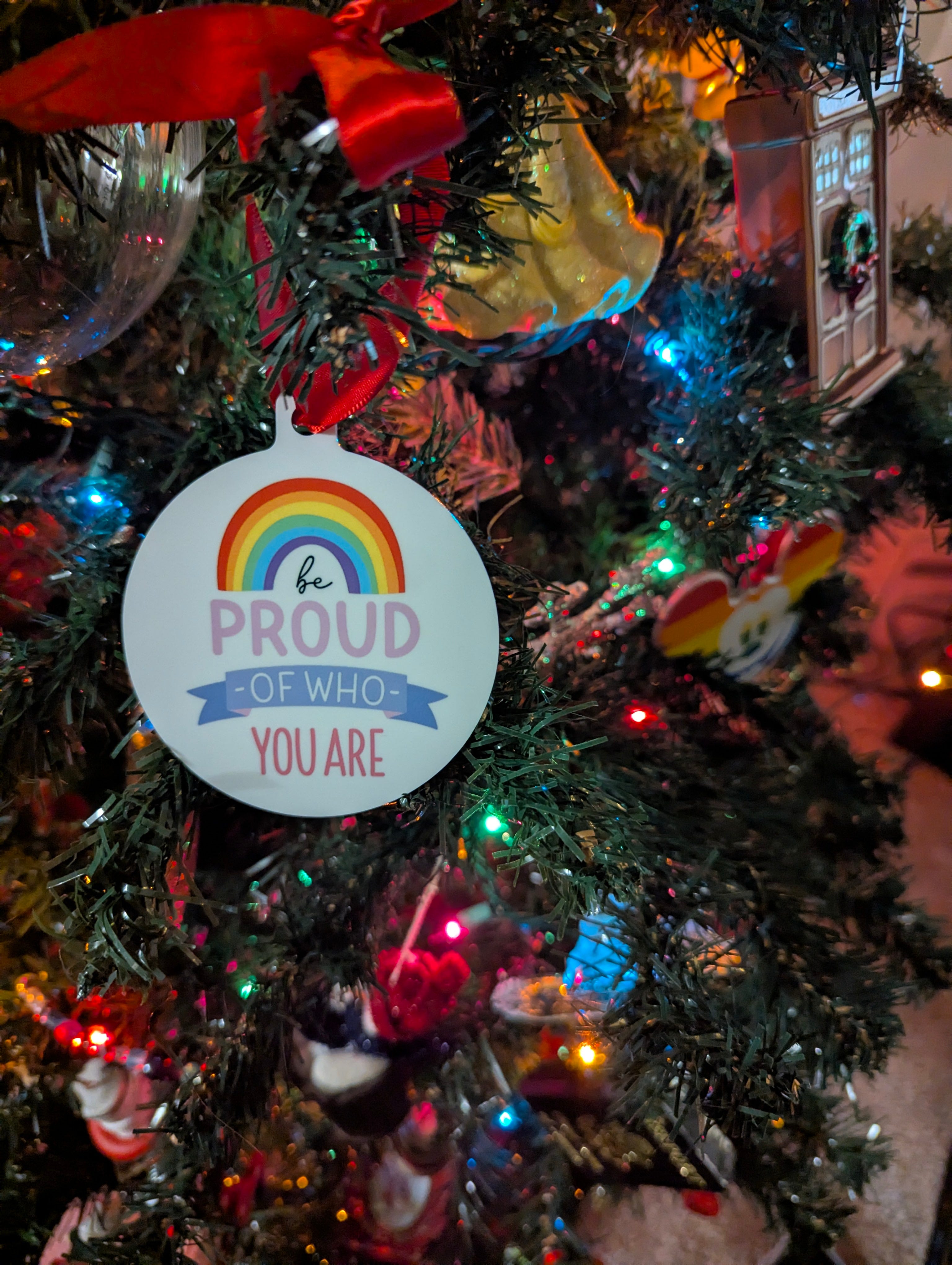
Ornament on a Christmas tree that says Be Proud of Who You Are
This Enneagram 3 has been wrestling with “But is it enough to the world? Should I be doing more? Am I doing enough?” for many years.
Sarah Bessey asked these questions in a Substack post last week, and I wrote much of the following as an essay-length comment in response. At her encouragement, I am not being self-deprecating about my hyperverbal tendencies and am instead turning it into an actual essay here. 😊
Enoughness and too-muchness haunt me as I bounce between ADHD and anxiety, between disabilities and giftedness, between work-for-your-worthiness hustle culture and the fine line of comfort that tips necessary recovery-mode rest into self-indulgence and privilege. Am I achieving enough to have earned my belonging, my right to be treated with respect, my credibility when I speak on my own story, my rest? And then there are the less me-focused questions: Am I doing enough to steward my gifts for the needs of the world? Am I loving my neighbor or just talking about it online? Am I missing opportunities when I could have made a difference but didn’t see the need right in front of me, which I am uniquely gifted and called to fill?
For one example, there is work to be done around building the field of asexual theology as a subset of queer theology, and I know I could and maybe even “should” do it, but here at this point in time, I spend so much time managing my disorders and disabilities and general adulting that even reading and remembering a book feels like a daunting task, much less trying to be one of few pioneers in a niche and controversial subgenre of a subgenre. Maybe that will change! My containers and limits today might only be for a season. I can’t know.
And still the ambition is there: Maybe I will feel like I am making a difference if I just wrote a book or got a significant speaking gig or finally went to seminary, just as the leaders and mentors in my life have suspected I someday will. The Enneagram 3 in me knows I could be Someone Special, if I just tried harder, had the right master’s degree from the right school, started a podcast, networked with all the right people, had an impressive title, never said “no” ever, flew to all the conferences and namedropped and threw my resume and story around like currency. If tried to be everything shiny and powerful and impressive to everyone all of the time, maybe enoughness would find me.
Alas for the darn bounds of time and space that I have to live linearly, constrained to physics, for lack of a TARDIS.
But being Someone Special is not a magic solution for the enoughness. This is part of my twice-exceptional ADHD, anxiety, perfectionist, compulsive overachiever recovery plan: to live contained to what I can do and not what I should do. I know it sounds simple, like the first-day-of-therapy kind of basic. But I realized in 2024 that I wasn’t getting to bed late because of Revenge Bedtime Procrastination, in which one stays up late to extend their fun free time. I simply had too many things on my plate for a normal human to get done in a day, and I am not a “normal” human. I am an invisibly disabled one, just in small ways that add up, and not always obviously, even to myself. My brain and body are different than other people’s, in need of different and sometimes more time-consuming care or problem-solving. (In 2023, my Word of the Year was “Complicated, as in letting myself be.” And that was a huge theme. Very accurate for that year. Goodness.)
I know all the hustle culture currency, which we have been taught will buy love or respect, is just another lie of capitalism. So, as Kendra Adachi says, naming what matters to ME (and not to everyone’s expectations to live up to) is vital for survival.
Back to the good I could do in the world, which genuinely does need what I am uniquely gifted to share: My skills as an editor and former journalist can teach my friends and followers media literacy; my specific theology and knowledge as a queer asexual Methodist provides a rare perspective on de/reconstruction and advocacy training; my White middle-class privilege to boost a cause or raise awareness or speak until my voice is hoarse allows others to get what they need. But at what point do my gifts/abilities/skills and the world’s needs surpass my capacity, regardless of my fit-ness for the task and call to stewardship of all I’ve been given?
My local leaders of United Women in Faith, the UMC women’s organization, said their theme this year, is “No one can do everything, but we can all do something. Let’s see what we can do together.” It is essentially the same “my drop in the bucket” concept I’ve held like a lifeline: I can’t fill the whole bucket of the solution, but I can be one droplet that makes the bucket overflow with compassion and care for all.
So I know I can’t do everything, but am I doing enough, what’s expected of me, what I should be doing, what the world needs from me, what is my duty and responsibility to step up and do? One body, many parts, means I can’t be the whole body by myself, but as a body part, am I contributing my function to justify the gifts I’ve been given and meet the needs of those who need me to give them?
I tried so hard in 2024. I did what I could. And in some ways, it was never going to be enough, and learning that the hard way allowed me to discern “the difference” of the infamous prayer, between what is mine to change and what is mine to accept I cannot change. People like to edit this to “no longer accepting what I cannot change, but changing what I cannot accept” as if it makes any sense. With apologies to Angela Davis, often cited as the source of this quote, it doesn’t add up. The lesson of the container is learned in cracking it to pieces and the necessary repair work that follows. I cannot save the whole world and convert them to be Justice Warriors with my leftover Evangelical Hero Complex (vintage Sarah Bessey blog post throwback!). I can’t change the election outcome or my body’s neediness or hateful people who don’t want to do better and refuse to learn anything. But I can accept what is out of my control and still commit to live my values regardless of the circumstances. For another metaphor, if a brick wall is blocking my path, the only way forward is to start by accepting that the wall is immovable, but I am not. I can’t change the wall, but I can change direction in response to it. This is “the wisdom to know the difference.”
As Sarah wrote about, we must make peace with being contained, constrained, being CONtent/conTENT of a boundaried physics-abiding linear timestream with over a third of my 24 hours a day being paid work and another third being necessary sleep. We must trust it’s enough, we’re doing enough, we’re enough, or that we’ve equipped others enough that they can pick up the baton and start running for themselves. And maybe we build that community we want, not through earning admirers from hustling, impressing, or fulfilling obligations and duties with our own skills, but in encouraging, equipping, opening doors, and giving away our seat at the table to those who need to be heard and seen. And then, when we are refreshed and discerning wisely, we can jump back in with what IS ours to do.
Sarah also wrote of others demanding moremoremore, which can turn from an honor into a storm of expectations and duty and stewardship and performance and responsibility so fast. As Taylor Swift sings, “the crowd was chanting MORE” as she was falling apart and pretending to be on top of the world (“I Can Do It With a Broken Heart”). It is often a mistimed, misplaced, or misworded expression of gratitude.
I say this to all of you from hard-won experience: you are already enough. And you have the wisdom to determine your own course of action and capacity to give. Comparison and competition will not measure accurately, ever. Your worthiness and enoughness lie unshaken within you by any outside force or others’ assessment. You’re wanted and not forgotten, you’re important and belong, you’re respected and trusted, you’re so very deeply loved and appreciated, you’re effective and outstanding in your work. And often that work does hit exactly where your neighbors and loved ones have their own needs. And I sit with you all in that grief of discernment, priorities and values alignments, and adding and subtracting to your schedule, knowing that some of the “moremoremore!” cheeping baby birds will have to learn to fly and seek their need-meeting elsewhere because you cannot be everything to everyone all of the time, even if you’d be better at it than others or have been given unique gifts to do it. Sometimes that opens the door for someone else to be the one who steps up to help, and sometimes that learn-to-fly moment will be the realization the baby birds need to lead themselves. The “moremoremore” might be a chance for the crowd to grow into “I can too” and blossom into a community of support so you aren’t the lone pioneer in your area of expertise and giftings, just one necessary and interdependent part of a larger body.
Being involuntarily boundaried by our limitations is a grief. Don’t skip over that part. We must learn to lament.
And also. Healthy containers and constraints can lead to more diverse ecosystems and stronger, lasting growth. They will also help us get quiet and still enough to hear the whisper of the Spirit or nudge in a direction to go and love in ways we are uniquely called to, equipped for, gifted in, and given to delight in.
If I must live bounded in a container of energy, time, space, and ability, then let me be a garden, flourishing and resting and bearing fruit and contributing to the growth of others, each in its season.
You’re going to hear me say a phrase a lot: “Sexual liberation includes the choice not to have sex.” What do I mean?
Sex-negative purity culture and celibacy-shaming culture are part of the same harmful system with moving goalposts. Both force sex on us.
The fight is not purity culture vs. hookup culture. The fight is true sexual liberation and self-agency against mandates controlling our bodies. No one can tell you you have to have sex in order to be good, normal, healthy, or mature. Not in marriage, not in singleness.
If sex positivity ends when “no” is said too often, expressed too confidently, or extends to a certain age before it’s “not normal! Humans NEED sex!”, that’s not sex positivity. It’s still a form of purity culture with a different set of rules you’re forced to play by. Other people’s standards.
Purity culture isn’t about abstaining from sex. It’s about putting strict rules on when you *must* have it. Secular culture simply removes the marriage element. There’s something “wrong” with you if you’re a “sad virgin” at 21, they say. “He just needs to get laid.” “What a frigid bitch.” etc.
If you don’t have sex, whether in marriage or out of it, you’re a freak. Doctors want to find out why you’re sick. Therapists worry about you and think if you just tried dating or hooking up, you’d find healing. Friends don’t trust you because surely you have to have something wrong with you.
No, maybe family doesn’t kick you out, but they sure as hell pity you and look down on you and shame you. You’re a joke. You’re a political jab. You’re a concern. The GOP wants to make you an example of all the things wrong with this country. “Your body, my choice” they scream now.
trigger warning: SA
You have to worry about getting pregnant even if you don’t want to have sex ever because telling men that leads to them thinking it’s a challenge. We call it corrective rape. Correcting what’s wrong with us.
Meanwhile conversion therapy plays out for us every day because we’re considered mentally or physically ill if we don’t have sex by (16? 18? 22? 30? 45?). No one has to make a “Side X” or “nonaffirming” camp for asexuality because it’s the air we breathe. It’s everyone around us.
Even those who consider themselves affirming of us think of it as a niche, for “those people.” Good for them, but for NORMAL people, you know, real humans need sex. Real adults mature into wanting sex. Real liberated people say “yes.” The consent is for us to feel morally, culturally pure about it, not for you to actually refuse over and over. And certainly not forever. Eventually, you’re “supposed to” want it.
But maybe you don’t. Whether by orientation or interest or opinion or lack of suitable options.
I’m not at risk of being excommunicated for staying celibate and single by church policy. I’m at risk of being excommunicated from society by refusing to let men use my body for things I don’t want just so I can meet some developmental norm or perceived biological need (of theirs, of course) or hit a milestone or rite of passage to prove I’m not “weird” or “broken” or making others uncomfortable.
Is it better than being kicked out of a home as a teen? Sure. Am I still fighting every day to get people to see the harm of amatonormativity and allonormativity? Now and always.
Liberation and bodily autonomy.
If that’s what you’re for, you are united with us in the same fight against purity culture. If this feels like a threat to you, consider liberating yourself and those around you from the shame boxes altogether. Both the purity culture box and the not-sexual-enough shame box.
Collective liberation is for all of us to have the freedom to determine our own choices, about our bodies and identities and lives. It’s shaping the kind of society we want to live in. We have to think bigger than judging people for the sex they have or haven’t had. That’s not enough. Liberation respects, trusts, and honors each of us living as our whole selves authentically true to our needs and what is freedom to us.
Explore the links on this page for liturgies, devotionals, worship services, naming rites, marriage ceremonies, prayers, songs, Bible commentaries, and more.






 Invisible Cake Society