It is an invitation with an expectation: No dehumanization allowed. It does ask something of us, a dress code of sorts, that we bring love, real love, to the party. We come with the understanding and shared value that no one is an acceptable casualty of liberation.
Sometimes we must remember the long road. We must take the closest imperfect bus to our destination when it doesn’t go all the way and march our way down the road, generation after generation. Passing along what we have gained and refusing to go back.
Collective liberation doesn’t see my freedom as your continued harm. If you are freed, I cannot be your new target to get the acceptance of oppressors. Exclusion is the thing we exclude. Vitally, we do have one thing we must agree on, that we are tyrants for: No more tyrants.
From Cone to Kendi, from Stonewall to Sherronda J. Brown and Judith Butler and my friends on social media, from the earliest church to the women of modern books, Substacks, podcasts still resisting a patriarchal faith, we learn the only liberation worth having is collective.
If our gospel leads to death for some, it isn’t the Words of Life for any. If our work is only legitimized by those we leave out of it, it isn’t the work of Christ. We start imperfectly and evolve continually to be better. If we uphold the harm, we cannot liberate from it.
Every minute of every day That a person goes hungry That a hospital is bombed That slavery is and has been
That the planet is burning With hate and fear and pride But mostly as a sacrifice To the ravenous god Mammon Who demands a child die For each dollar it grants the wicked
You’re totally right. We should be unable to breathe To sleep, to have peace Until each war is ended forever
Until violence is mutinied And bullets no longer rain on the schools and churches And cities and countries
Until all are free from the demons In the legislature and in their minds In the pulpit and in their homes
You’re right. We are complicit. You’re right.
We live in abundance while others starve And freeze and lie ill or scream of anguish On our very streets
We pass by and we scroll on We can’t take another headline We ask in despair if anything matters And wonder that anyone has survived this long
This cruel planet, and its stupid inhabitants Destroying it as fast as possible In our worship to our golden god
You’re right. It should make us boil in rage. You’re right. We have no excuse to stay silent.
And our bodies are also right. We cannot take constant grief and rage. We are not built for this 24/7 world. We need rest and hope and humor
We need to hold so much in our hearts Not just the anger fire But the still waters Not just the injustice But praise of the good
The birds of the air And the palm trees that line my street Know something I don’t And they don’t know what I know
So I learn from their wisdom And ground myself to the earth That will be here long after we die Welcoming us back to the dirt
I can feel and do and be And speak from My full self Unashamed
Unwavering in righteous anger Rooted in peace within Committed to what is mine to do Rejoicing with those who rejoice Taking pleasure in the ephemeral and savoring transcendence
Holding in tension Multidimensional Loving and raging and fighting and calming Hosting and giving And resting and creating
So that my body, mind and heart Survive long enough to turn my grief Into a legacy.
There has yet to be peace on the Earth But don’t stop seeking Until it’s born.
Aphobia is often rooted in intentional ignorance but contains actual legitimate questions non-hateful people have, but are now afraid to ask after seeing the responses to the aphobic person, which defeats the goal of educating. It’s time to address some of these questions in a safe and open place: here in the Invisible Cake Society!
First: We can generally tell the difference between questions asked respectfully and humbly and questions asked to bully, sea lion, and troll. We’re not perfect, and tone on the Internet is hard, especially when emotionally activated, but be encouraged that educators/activists want you to learn!
Now, let’s get going:
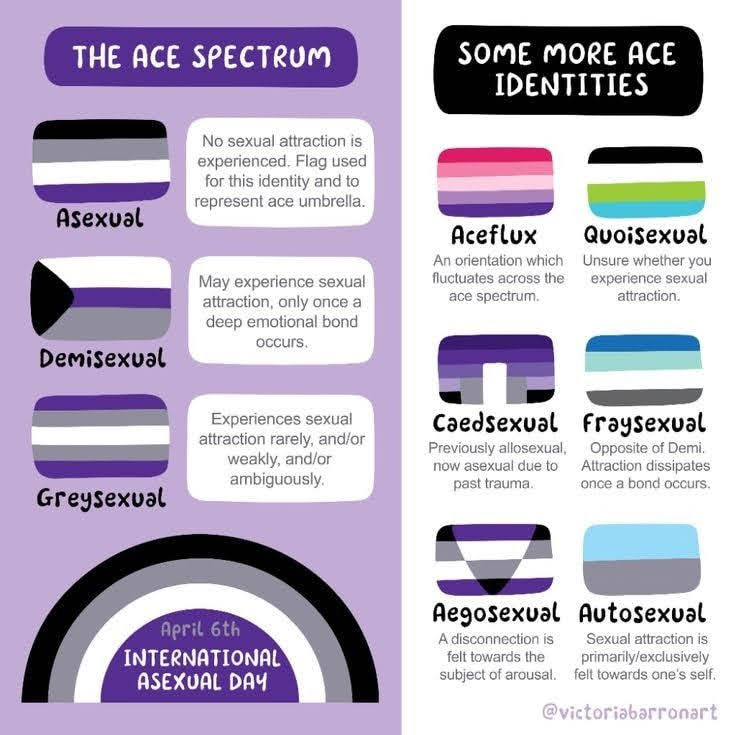
I’m into girls, but I’m also on the aromantic spectrum and asexual. What does that even mean? How can I be all of those!? Well, queerness is a big wibbly wobbly blob of grey areas, not neat boxes. Getting free of boxes is the point. Labels help us connect and communicate. They help us feel less alone, find resources, and form community to work on shared goals and experience belonging in a world that seeks to erase us.
We hear about sexual orientation, but there are others, usually but not always aligned. Romance, platonic, aesthetic, etc.
Also frequency: never, rare, average, or only in specific circumstances.
List of ace spectrum identities
So if you rarely experience attraction to girls not boys, and that attraction is mostly nonsexual…
You may be sapphic asexual or ace lesbian, and possibly somewhere on the aromantic spectrum as well.
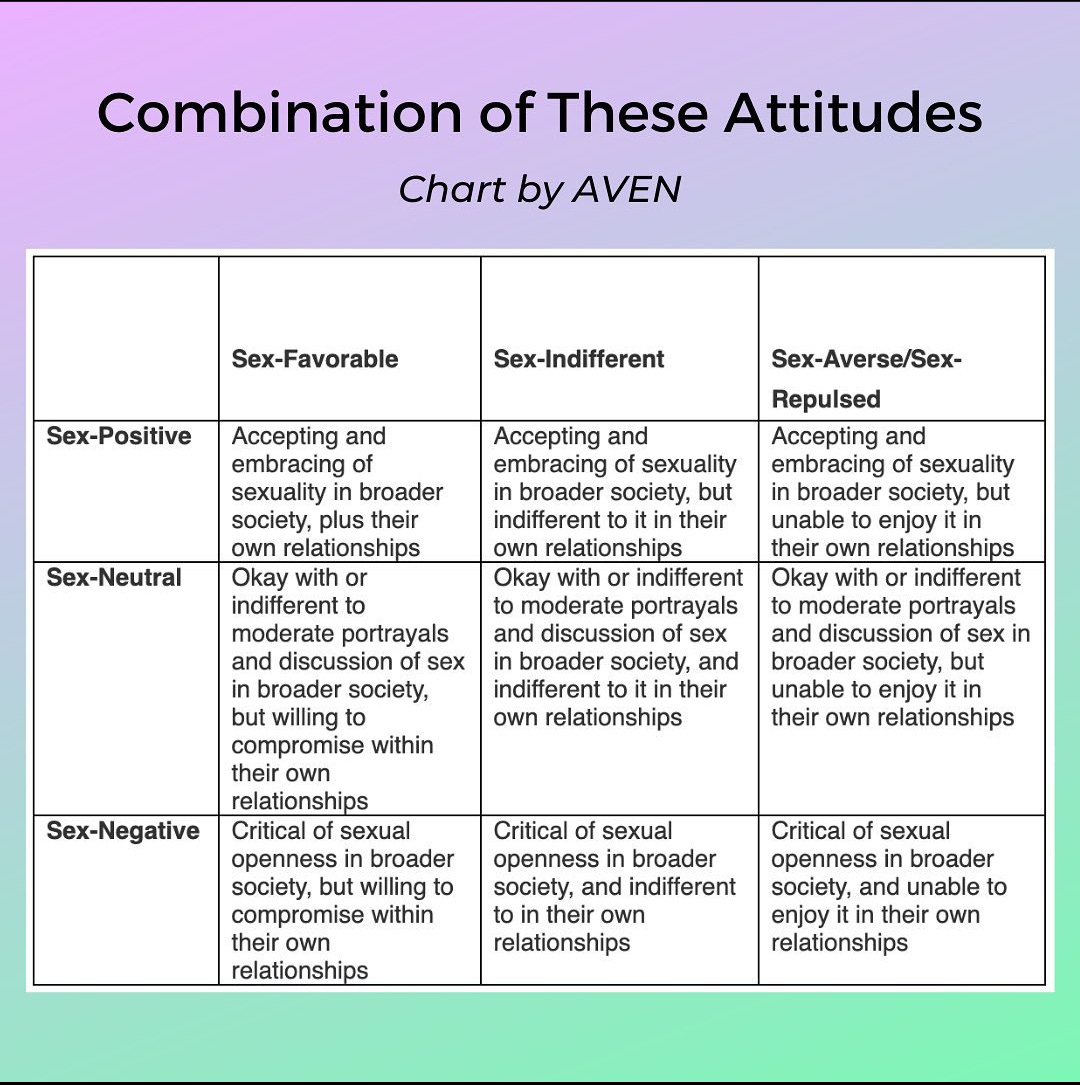
We then have favorability, indifference, aversion, and repulsion to specific behaviors.
This is different than sex positivity, neutrality, and negativity that are about attitudes toward sex in society.
Chart comparing various attitudes and preferences
Also generalized desire: you may want to experience kissing but not have a specific person or gender you’re particularly drawn to.
And biological libido/hormones.
All different independent but related things.
Attraction is a word we use with magnets. A fridge door is magnetic even when empty, but if you hold a magnet close, it will react with attraction. Aka, a gay person is still gay even when single or “not getting laid.” Same for straight or bi or pan, etc.
And vice versa, an asexual person is still ace even if they have a sexual partner. That person could be the rare exception of sexual attraction, or someone they love in other ways, or just a fun partner to have a good time with. That’s their business, not yours. Regardless, they are still ace.
We know people can still be straight (and we not only assume it but strictly enforce it as normal) even if they haven’t had sex or dated. But there’s a pressure to prove we aren’t broken or defective so we conform to the norm of romance and sex.
This is broadly called amatonormativity (amato, as in amorous, + normative). Amatonormativity means: the assumption that all people aspire to or have a romantic and sexual relationship at the center of their lives. It is the measure of not only whether you’re similar to others, but your desirability and attractiveness aesthetically and platonically, your success and maturity as an adult, and your character to be a good employee or leader.
“Virginity” is a conservative purity culture term that both honors the purity of a young person (let’s be real, teen girls) and is used as a barb to insult anyone past that “expiration date.”
This is true regardless of your thoughts on abstinence, which is waiting for marriage to have sex. Conservatives and self-proclaimed radical feminists and mainstream culture agree that people without a romantic and sexual relationship by an arbitrary age are societal rejects, undesirable, or sick.
The only part that differs is whether that relationship must be a marriage. Whether it is a hookup buddy or a covenant life partner in the eyes of God, society generally agrees not having one is enough to get you pity and “just get laid” or “needs a girlfriend/boyfriend” comments.
Say you have never or, worse, don’t want, such a relationship, and they lose their minds. How!? Isn’t a romantic and sexual partner a requirement for maturity, health, success, and personal survival??? No, it isn’t.
That’s why while everyone should have the legal right to have romance and sex with any gender, sex and romance are not a “right” you can demand from others. The gender of your partner(s) should not be constrained by law AND ALSO you are not entitled to that relationship from another gender or individual.
This is the consistency of consent. It goes both ways: There is no sexual or romantic liberation without the choice to refuse romance and/or sex. If we’re only fighting for the right to choose the gender of our partner but otherwise chained to the same stigma and shame, that’s not liberation.
If we’re only fighting for the right to choose the gender of our partner but otherwise chained to the same stigma and shame, that’s not liberation.
And yes, I don’t just mean stigma and shame over having had sex or romance but also over NOT having had it or not desiring it.
This liberation benefits not only aro and ace people who are less likely to have partners but EVERYONE who is single, whether by choice or not, divorced or widowed, etc.
In case you haven’t read stats on that lately, that’s roughly half the population. And many of those singles aren’t actively looking for a partner, whether they were partnered before or not.
So are asexual people “just straight”? No. Some may have hetero attractions, some have gay or bi or pan to describe their attractions, and some are just aro ace with no attractions. And some are a combination. Remember, people are a wibbly wobbly mush.
Is orientation about how much, or the type, or the quality of sex we’ve had or not had? Nope. Attraction and behavior are independent topics. Related, yes. Entirely the same? Not at all.
Like magnets, you can change the shortcut terms you use to describe yourself at any time. Maybe in your 20s you were positive that you were a straight, female, sporty, extroverted premed student. Maybe in your 40s now, you are a bi, nonbinary, bookish, ambivert therapist. Labels change! Growth!
It makes sense why queer Christian theology is often heavily sexually centered, given our history, but the best queer theologians balance it with ace inclusion. Not just as a footnote, but as a core goal. The point is ending amatonormativity and gaining collective liberation, which takes all of us—of every gender, orientation, relationship style, race, ability, culture, and more. Rightfully practiced, Christianity—with the words of Jesus at the center—drives us forward to this goal.
Jesus is as clear of an aromantic asexual Christian role model as we could ever ask for! Embracing found family and breaking gender and class binaries are foundational to his life. There’s just no way to read the gospels and come away with a factual interpretation that centers amatonormativity. That doesn’t stop the global church (now or historically), of course, because institutions and patriarchal power structures are best served by amatonormativity and all that comes with it.
When women are free to earn their own money, when singles are equal to married people, when everyone has the same rights and respect regardless of gender or orientation or relationship status or race or disability, we can liberate ourselves from the oppression that power structures are built on. That’s gospel, as Christlike as it gets, but it’s the exact opposite of what those in power want because it would require true humility, servant leadership, the Beatitudes, sacrifice, and loving others as themselves. It would be for the benefit of all, including themselves, but there’s nothing that scares them more than the risk and exposure of vulnerability.
I truly believe the only way forward is shame resilience, tolerance of vulnerability, finding belonging within, and developing healthy, boundaried empathy that leads to freedom beyond anything gatekeeping or virtue signals or scarcity can achieve. That’s work each of us can do, whether by reading books by Brene Brown, Aundi Kolber, and Matthias Roberts; or doing therapy one on one or as a part of a couple or in a group; or listening to podcasts, lectures, or wise friends and leaders who can guide us there.
When we liberate our minds and hearts, we are free to see others who are unimaginably different than us as a gift to the Body of Christ. We aren’t threatened or defensive because we honor what other identities and perspectives can bring that we can’t.
With the fruit of the Spirit as our guide, we lead from a common goal that all will be free: asexual and allosexual, aromantic and alloromantic, queer and allocishet, and more. Single or partnered, parents and childfree, living alone or with others, sexually celibate or abstinent or solo or partnered or open or any combination. Everyone.
But we can’t get there while asexuality (and aromanticism and our respective spectrums) remain erased and invisible in the church. We are vital to the liberation of Christ. We queer queer theology. We challenge norms in ways that rewriting gender rules alone can’t. We defy expectations and push beyond affirming marriage or ordination or any one label or issue in our unique ways, as all letters do if given proper consideration. But for asexuality, it isn’t as simple as churches might think. We are going to ask more than a flag at Pride or a language change, but a mentality shift that will require surrender of structures and norms and old visions and false realities.
But don’t fear. It’s the surrender of flight, falling into the ways of Jesus and finding ourselves held by the wings of love the whole time. That is, if only we have the courage to listen to asexuals, end amatonormativity, and become something so much better: the family of God.
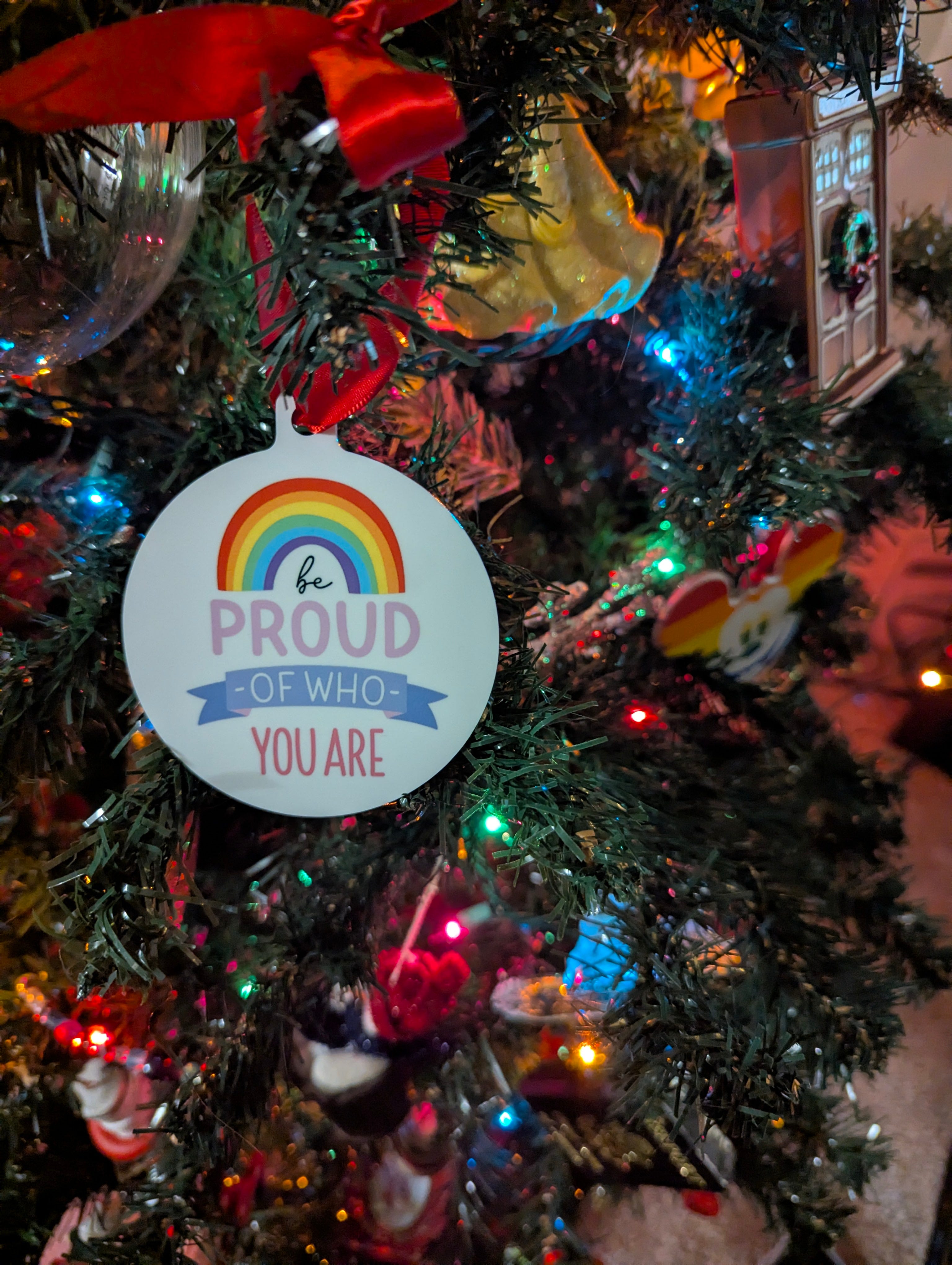
Ornament on a Christmas tree that says Be Proud of Who You Are
Perhaps cliche, perhaps meaning more from someone with social anxiety:
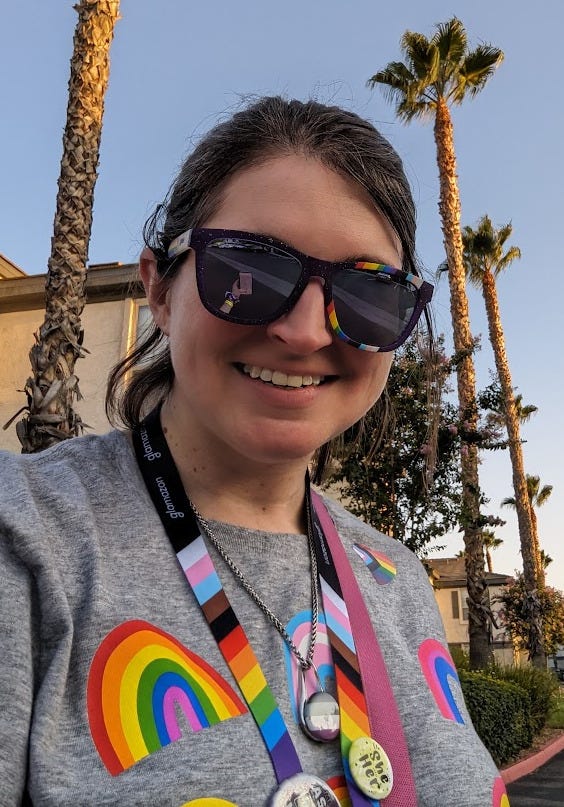
Please, at least once, attend a Pride festival. Find one that’s in a mid-size town (mine was Aurora, Illinois, for example!) and bring a friend or acquaintance if you’re nervous. You don’t have to use your legal name to go, you don’t have to be IN the parade, you don’t have to understand or know all the trivia first, you don’t have to drink alcohol or have sex, you don’t even have to know your labels or if you’re queer at all. Go observe, play some street fair games, buy from a local artisan, wear bright colors or rainbows or things that look like your flag if you know what it is.
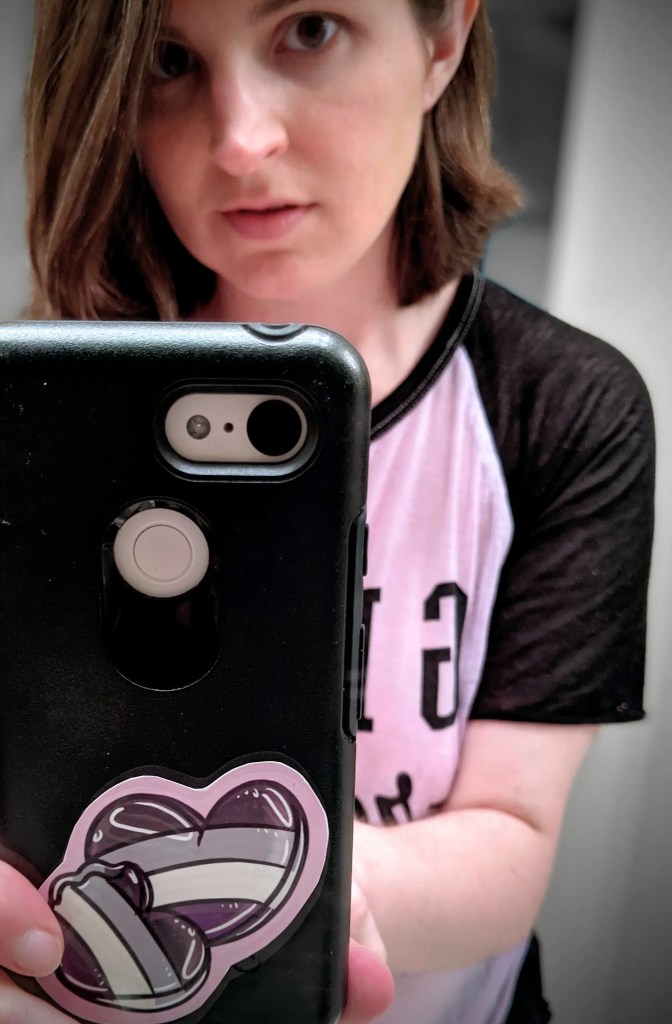
More subtle Pride selfie
For example, as an asexual girl, I wore black shorts and sandals, a purple and black shirt with a vague feminist Girls Rule the World (ironically from Victoria’s Secret haha), and a white undershirt. You CAN be as bold and bright as you want, but you can also be subtle too. Go at your own pace and comfort level. If you’re up for sloppy buzzed at drag brunch on mimosas and PDA with your visibly queer partner, go for it! If you’re just stopping by anonymously on your way to the store because you “love local culture” and “celebrate community in your city,” hear me when I say that is okay!
The scariest part is the conservative protestors. Stay away from them your first time. Don’t get into Bible battles or argue theology. Ignore, walk around, cross the street, pick a spot far from them where the music drowns out their hate, strike up conversations with people standing around unoccupied near you, especially if they have kids or are new to this too or look like they know what they are doing and are just chilling. This may require some small talk, so if that’s emotionally draining for you, don’t stress about it. Just know if you need to to feel safe or if you have a question, everyone NOT shouting is pretty friendly.
If a parade is too much, look at the schedule and just attend the markets and shows so you can leave at any time. Mind the temperature and dress accordingly (including sunscreen and WATER water water). But don’t be afraid to go. It’s just rainbow Fourth of July (or insert local parade holiday here) in small and mid-size cities.
Me after Pride now haha
Even better is asking your affirming organization/hobby group/small business/sports team/school committee/club/church to host a booth (get connected to the festival organizers and then pass along what they say to your own leaders to have a finance/planning/outreach/service committee meeting about it NOW and don’t wait until the week before in May or June). You can use the booth to hand out water, stickers, magnets, flyers with your clear affirming stance and info to get connected, etc. Or you can join the Human Rights Campaign, Free Mom/Dad Hugs, PFLAG, or another similar organization always looking for volunteers. Leave time to walk around and enjoy Pride yourself too.
But even if you are an introvert’s introvert, or a socially anxious neurodivergent of any energy personality type, at least once when geographically possible, go be with our people in all your rainbow glory. It may take more than once to feel comfortable there. That’s okay. Just go and be in the same physical space and feel less isolated and despairing as you marinate in the joy and community and connection. Even if you don’t make a new friend or join a new group or sing karaoke or have a party bone in your body. Bring home a sticker or ribbon or locally crafted item or something, just to remind yourself every day that you were there and it is real still, in every queer and allied heart around you.
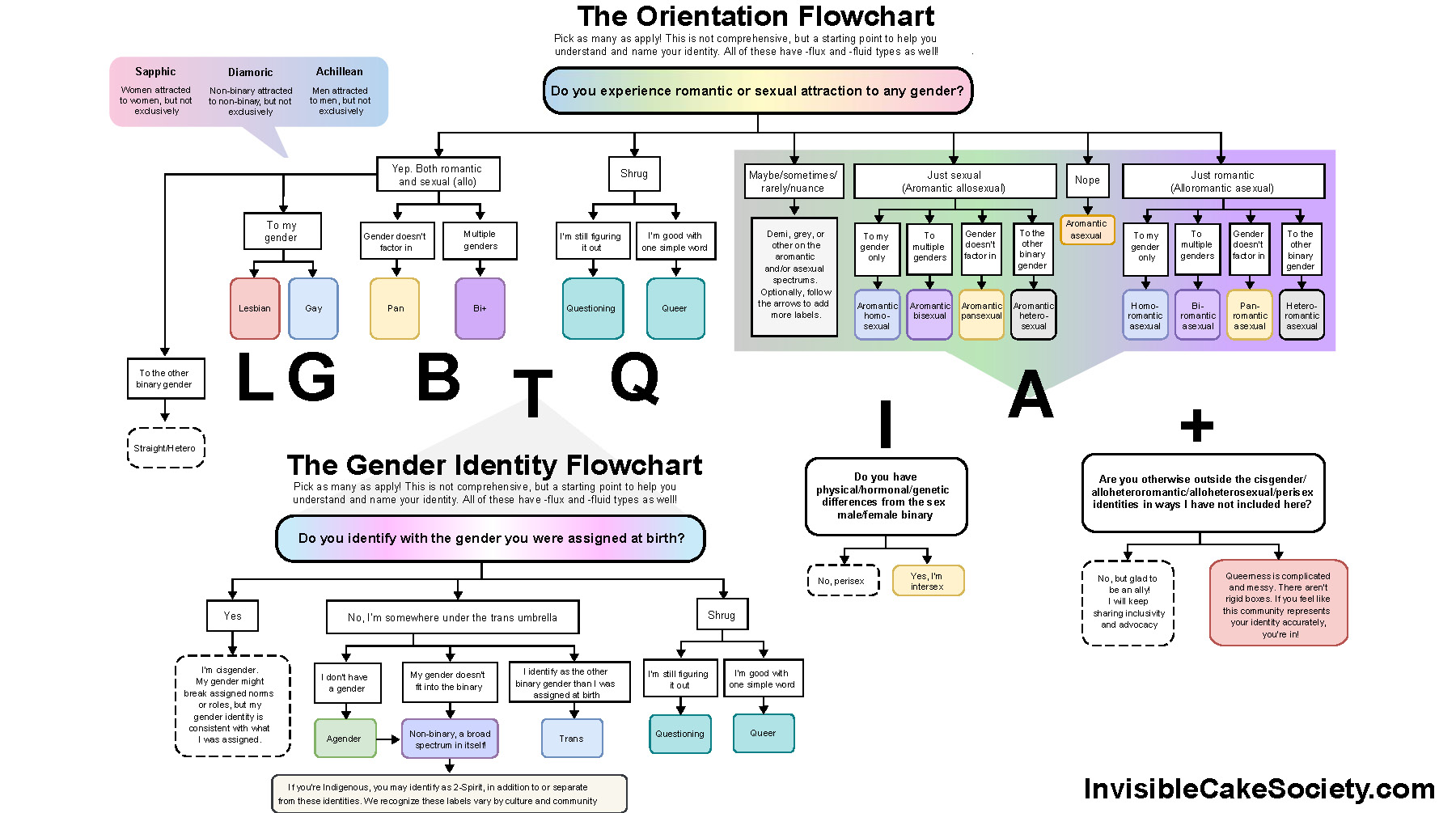
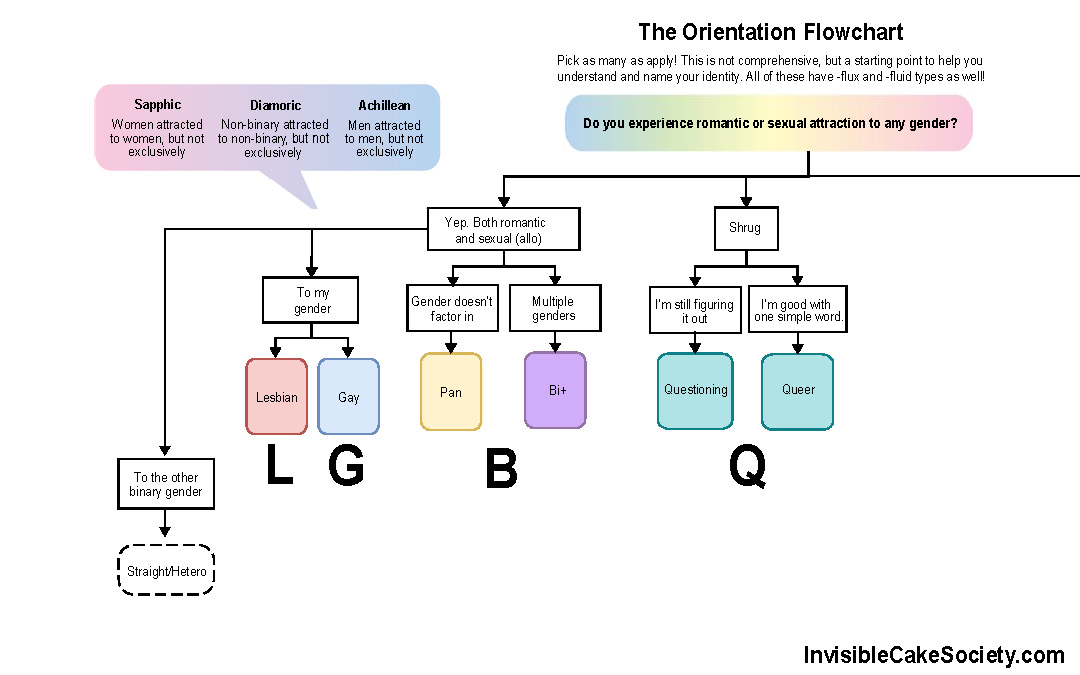
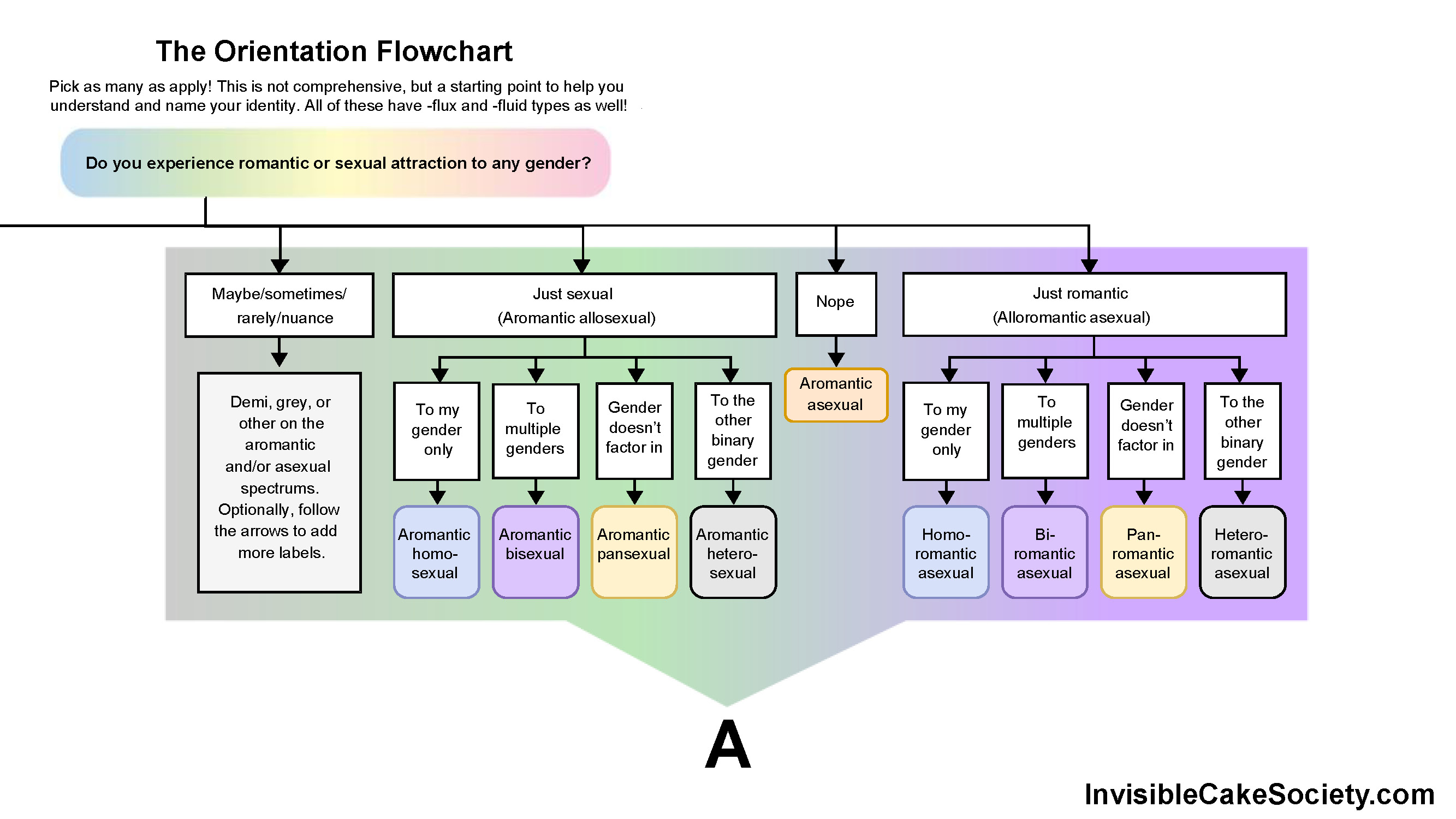
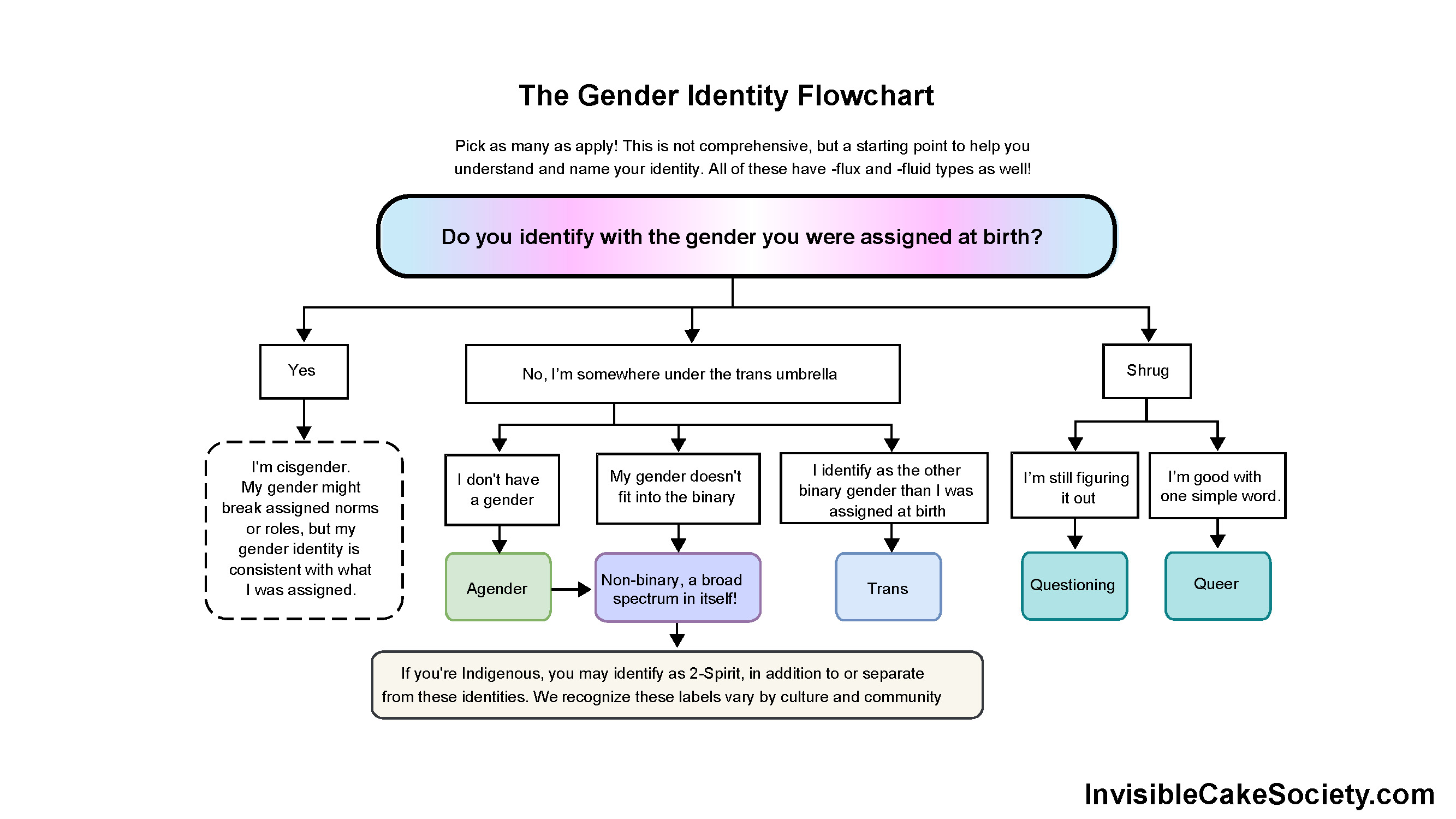
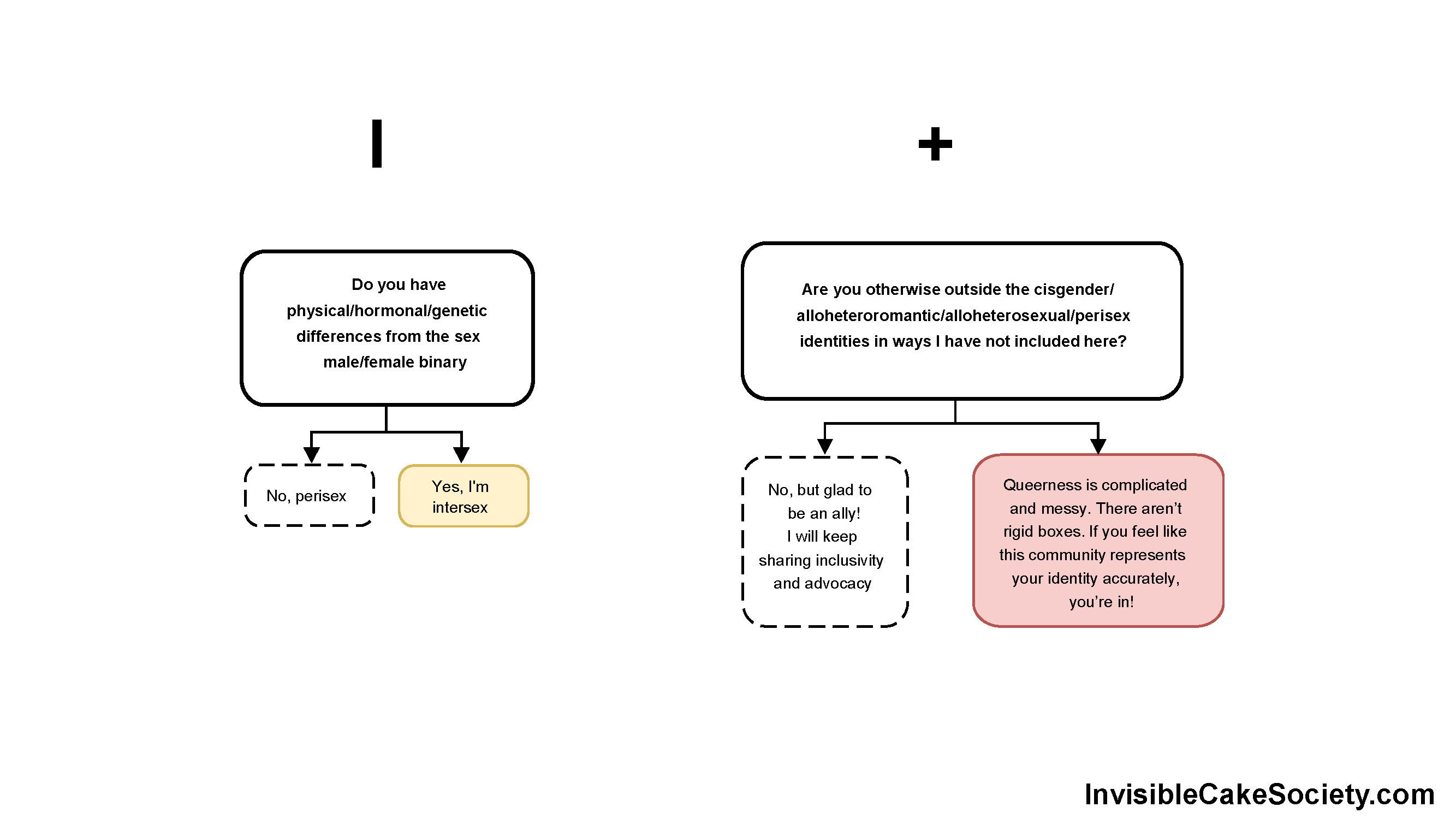
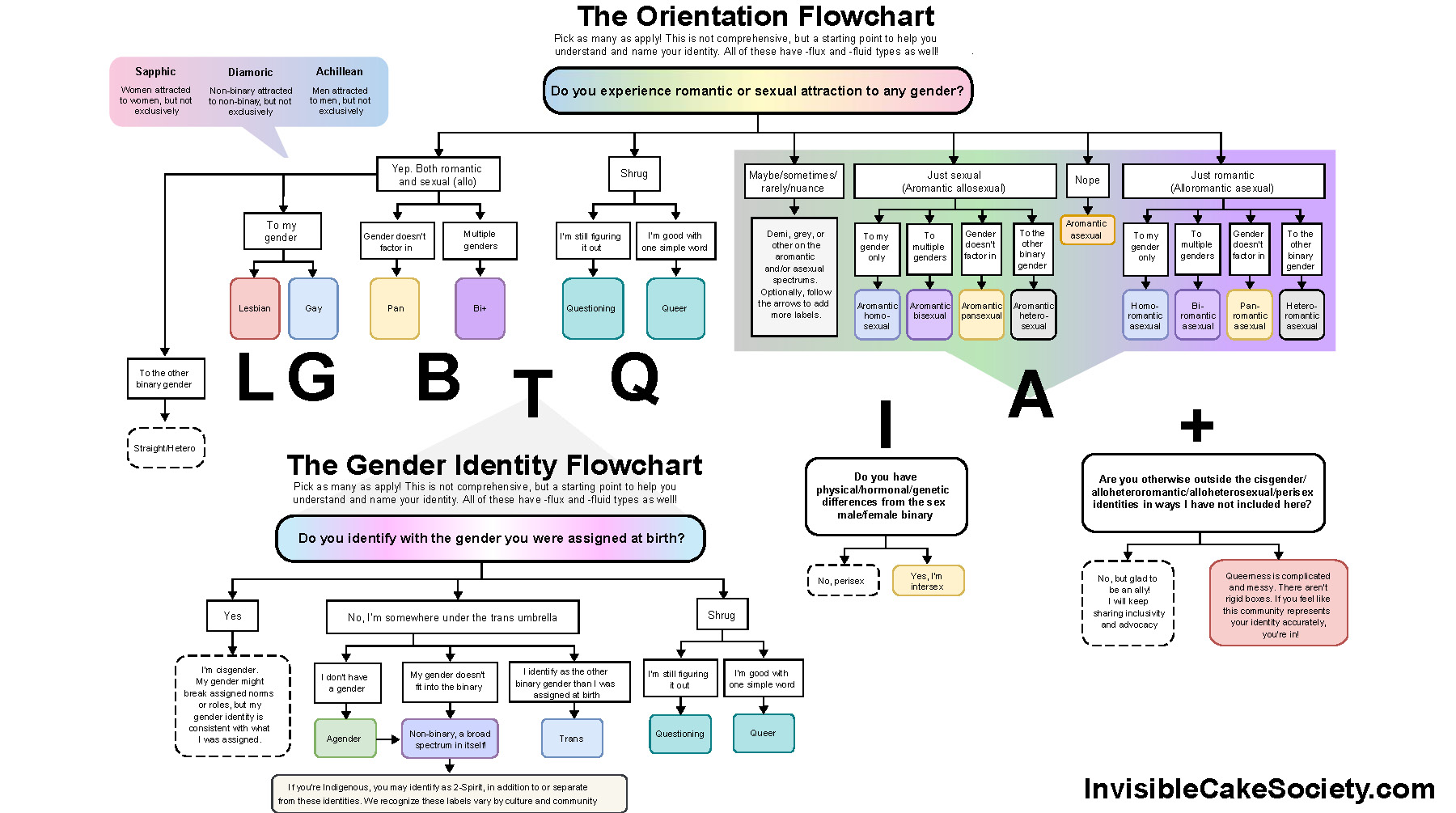
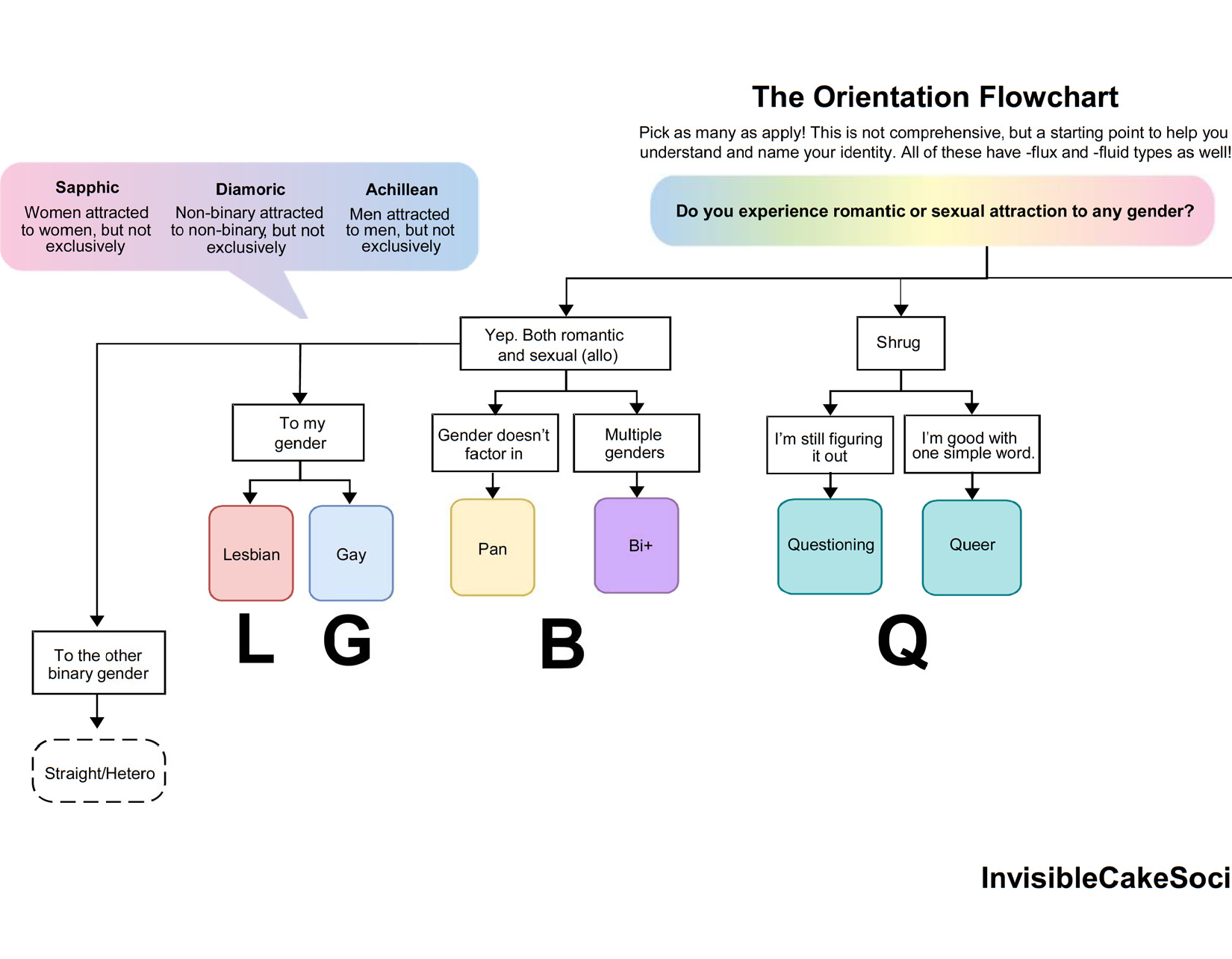
I’m hoping this flowchart can help everyone understand that the letters aren’t just a jumble of alphabet soup, but there is an organized system behind each one. It’s easier to see if you click the arrows to navigate through each slide, focusing on a specific section. These concepts are pretty much a multiple-choice test.
Orientation options include:
Attracted to the other binary gender
Attracted to my gender
Gender isn’t a factor
Attracted to multiple genders
Don’t know/don’t need to specify
Rarely or in certain situations
Just sexual
Just romantic
None of the above
Gender options include:
Same as the one everyone expected when I was born (“assigned at birth”)
No gender
Fluid or more than one gender or a gender not in the binary
The other binary gender of the one everyone expected when I was born
Intersex identities and other variations of queerness are also included.
Open these in a new tab or zoom in to explore!
Hope these are helpful! This is meant to be the start of the conversation, not the end point. Explore more in-depth and specific identities here: https://lgbtqia.wiki/wiki/LGBTQIA%2B_Wiki:FAQ
Many of us represented here in the Invisible Cake Society—a feminist, queer/ally, often asexual/aromantic, progressive Christian, neurodivergence, mental illness, and disability site—have found ourselves curious about BlueSky. Whether you’re migrating from Twitter (“X”) or a Meta platform (FB, Insta, Threads), or simply want to see what the hype is about, this guide can walk you through the basics.
BlueSky’s culture, purpose, and design combine an older model of social media and the forefront of a new liberated era: It actually shows you what you signed up to see. Imagine that. Groundbreaking.No ads, no gaming the algorithm, no being spoon-fed whatever the app wants you to see while posts from friends are suppressed, and no disappointment when you see a post about an “upcoming” event show up on your feed for the first time, only to discover that the event happened several days ago. It’s real time here and you have much more control over seeing what you want to than on any other app. More on that later.
BlueSky works on something called the fediverse. All you need to know right now about that is user handles are longer here and vary, but most end in .social. It’s like .com or .org, sort of. If you want to know more, there are plenty of good explainers out there, but you’re reading my simple start guide so you probably don’t need to care at the moment. Let’s go!
Before we begin, open the homepage, Bsky.app on a desktop browser. Most of this is easier on a desktop browser. A desktop browser is required for step 4’s browser extension. At this time, no app version or mobile browser version of this extension exists.
Also: If any of this changes or is wrong, please let me know and I will edit this guide!
Create an account and personalize your profile
Pick a username (handle), upload a photo and banner, write a bio/description in the text box of how people might know you and what you post about, etc etc… you know the drill.
I’d highly recommend, if you need to be recognizable, whether as an activist, leader, internet educator, a brand, or business (including writer or freelancer), go professional: real name or brand name, good portrait photo of your face or good-quality logo, website link, and a description that matches other social media and your website and clearly states what you do that might help people recognize you from elsewhere or find you for the first time and want to follow.
If you have an established internet pen name and want to continue to post under that, use that as your username and try to keep your photo, banner, and/or description similar to the platforms you’ve been using already, at least at first.
If you want to stay anonymous and create a new name/personal brand here, this is a great time to do it, but stay aware that everything on BlueSky (at least at this time) is public. There are no private accounts (yet?).
Explore the settings for each part of the site.
The gear button on the left sidebar on desktop only takes you to some of the settings (https://bsky.app/settings), but you can change your profile appearance, who can send you direct messages, how and which of your feeds (the tabs on the top of the home page) display, etc. by clicking each respective icons in that left side bar and then a button at the top right.
Don’t get distracted by each empty section of the site so far or terms you don’t know yet. We’ll come back to this.
First, take some time to open each section of the Settings and set the things you know you want/need, like privacy, nsfw settings, muted words, font size, default language, etc.
You can also read the official BlueSky FAQs to get a quick overview of what terms mean, who can see what, and links to download the mobile app. Again, if you don’t know what something is yet, don’t worry about it. There’s a broad range of users on this app, from complete beginners to the expert internet-coding pioneers shaping the future, so treat it like a group exercise class and go at your own pace while letting the elite Pilates/yogi/Zumba athletes go at theirs.
Post and find posts
Before you follow anyone, post something so people know it’s the real you. Link to your site, do an intro post with facts about you, copy and paste your most timeless and relevant post from elsewhere, or simply start posting you usual content here instead of/in addition to other social media apps. Post whatever first impression you want to give so people know immediately who you are and what vibe you’re going for here.
Now, add some feeds (tabs on the top of the home screen) besides the default. Feeds are automated tools, not hand-curated lists (those are up next). They might be automatically customized for your account specifically or populate based on a hashtag, emoji, keyword, or other trigger. Some allow anyone to add a post by using the hashtag or emoji, while some require being added by the creator as a contributor. Look through the following linked post for any that appeal to you (the Mutuals one is my favorite—only posts from people I’m following who are also following me). Once you’re on the feed’s page, pin it to the Home page so you don’t have to save the URL somewhere. (Though you could! You do you.) https://bsky.app/profile/erinbiba.bsky.social/post/3lbxbqv65722h
Find more! https://bsky.app/feeds, accessed by clicking the # button on the left side bar, not only allows you to view feeds (and lists saved as feeds) you have pinned but also search for more and see popular suggestions.
Next, create some lists of accounts you will want to see.
You can save these as if they are feeds (tabs on the top of the home screen). This allows you to organize accounts into topics or to keep your default feed to just the people you follow, who you really want to see first thing when you open the app. Using lists, you don’t have to follow accounts that you don’t want in your default feed but do still want to have readily accessible. This allows you intentional organization and sanity-preserving separation from, for example, news and politics. And vice versa, if you need a break, you can create a list of accounts that make you happy or calm and only scroll through that without having to see everything else. How to create a list:
In the left sidebar, click the Lists button (looks like a bullet list). In the top right corner, click + New. Add a photo, name, and description so people know what it’s a list of. Reminder that almost everything on BlueSky is public, so anyone will be able to see this, not just you or people you add. Add members by searching. Pin to Home. Share by clicking the options (…)button.
The obvious advantage of using other people’s lists is that you do not have to do any work. The downside is you cannot edit them, no matter how much you want to add someone to or remove someone from showing up there. If you think you’ll want to add others not already on the list, or if someone on the list is going to make BlueSky a negative place for you, create your own list for that thing.
Now, you need to follow some people for your home feed. You could search for them one by one, or click friends’ links as they post them on other sites, but the best way to get started is to run the Sky Follower Bridge extension: https://bsky.app/profile/did:plc:l3nkrpivwuvwuqduk3illkvf .
Make sure you are using the official one and do not get duped by a scam site. The real one is free. (Though thank-you donations to the one developer maintaining it in his free time are appreciated, it will not require anything like that to use it).
I’ve had the best luck using the Chrome browser extension. Firefox (and my dozens of other extensions there) did not play well with it at the time. Your experience may vary, but I recommend Chrome first and then if that doesn’t work, try another browser you have the least number of other extensions installed on.
Use it on Twitter, Threads, Instagram, and TikTok by opening your Following page on each. Do not run it on multiple sites at a time.
Follow the instructions at the Sky Follower Bridge site: https://www.sky-follower-bridge.dev . Give it plenty of time to run. This part of the process is not quick but well worth it. You may also need to re-run it if it’s been stuck on the same number for a long while (in my experience, it tends to hit the other social media site’s rate limit as it gets into the 200s). Maybe walk away from the computer while it’s running so it can have the computer’s full attention for an hour or so. I follow several hundred people on most platforms, so yours may work the first time or you may not need to wait long at all. Some of us have been collecting social media users like Pokémon for nearly 20 years.
Now that that’s done, click the button to review the results. Do not use the Follow All button. I’d recommend looking through them one by one to make sure the match is right. Not everyone has followed step 1’s substeps, so you may get false matches (especially for very common names. The JSmith123 on the BlueSky may not be same person as your friend who was JSmith123 on your previous social media app.) It also often matches a celebrity’s real account on Twitter/Instagram/Threads with a fan account on BlueSky because the fans are faster to adopt new platforms and claim their usernames than celebrities or brands are.
(On the other hand, there were some incorrect matches on mine, with just coincidentally the same name/handle as someone I followed elsewhere, who actually also sounded like very cool people so I ended up following them as well, despite knowing that they weren’t the person Sky Follower Bridge intended to match. 😊 )
The next step is to either:
Click the button in Sky Follower Bridge to follow them.
Right-click and open the BlueSky profile in a new tab to check it out first or to add it to one of the lists you’ve created.
Another way to mass follow a lot of people at once is to search for Starter Packs:
For example, if you want a list of a bunch of news outlets and political opinions, but don’t want to get caught in the doomscrolling, you can use this starter pack and then make it a list with the tool above. https://bsky.app/starter-pack-short/U9juDW4
A chronological default means posting is different here.
Not only should you carefully decide who you’re following (aka spending your time with and setting the tone as soon as you open the app) but also keep this in mind about reposting your own content that you want people in various time zones and life schedules to see. Someone who only gets on during their morning commute may miss your posts in the evening if you’re not reposting it the next morning too.
Don’t judge a lack of engagement here with failing the algorithm or disinterest. You just need to remember the old-school rules: shameless “self-promo” is necessary to hit that window when the majority of your mutuals (people who follow you and you follow them) are scrolling through the app. It’s not really “promo” to repost once or twice at different times; it’s just giving people what they followed you to see.
You can automate this (and crosspost to multiple platforms while you’re at it) through tools like Buffer if this sounds like too much work.
Or you can just post when you feel like it and your people who are meant to find you can find you, whether through other users sharing your posts or recommending you, from you following them, from a list you’re on, from hashtags or search terms you’ve used, or on their Discover tab. Yes, there IS an algorithm so you can still find new content and be discovered by others, but it’s an optional function, not the core of the app.
Don’t be spammy: adding unrelated hashtags or @ mentioning people, only posting your own work and not interacting with others’, selling things, private (direct) messaging someone unsolicited without stating why you’re saying hello to them specifically, posting links with no other text or content, etc. Again, it’s about who you know here, not gaming a computer algorithm. Be human, for humans.
Use alt text for visual content: Accessibility, in particular alt text, is a big part of the culture here. Use this setting to make sure you are always posting alt text descriptions. Whether for vision-impaired users, when the internet is not loading images, or anything else, alt text is a good way to make sure everyone can understand the visual elements of your post, like photos, GIFs, and videos. https://bsky.app/settings/accessibility
Labels can help you find what you like more quickly or hide certain posts or accounts. Or just have fun! Try some here: https://www.bluesky-labelers.io/
Blocking is more meaningful here than elsewhere as far as interaction goes, and they won’t be able to see your posts while logged into that account, but remember there are no private accounts here. Blocked accounts cannot see your profile while in the app, reply in your threads, mention you, or otherwise interact with you. And vice versa.
It seems counterintuitive but one way to mass block a bunch of accounts is by “subscribing” to a list.
This is one example: https://bsky.app/profile/skywatch.blue/lists/3l53cjwlt4o2s. The problem of course is false positives, which mean they may blocking anyone with the keywords in their username, description, and/or handle, so an account that is anti-Trump, for example, might be accidentally picked up by it if they are using the keywords like “Trump” in their main profile identity. Or an account that regularly critiques an organization might be accidentally added to a list of that organization’s fans. As an account yourself, this is why it’s smart not to define yourself by what you’re against, but also as a follower, this is why it’s smart to be picky about which blocklists you subscribe to (which will mass block everyone on them at once).
Find out which lists you’re on: If you would like to find out which lists you’d been added to (for better or worse), type your handle into https://clearsky.app/.
Major caution here: On ClearSky, you can see not only who you’ve blocked but also who has blocked you, and sometimes the lists are not very nice (or accurate). No need to be offended at the results here, should you choose to view them. Just be amused and let people be wrong about you—or right about you and just not their cup of tea. You can’t please everyone. I’m grateful for those who have blocked me instead of trying to fight me on things that are often fundamental disagreements, simply who I am as person, or just a difference of opinion or preference. And someone’s choice to add you to a list might tell you something about them that leads you to block them first. Don’t use this knowledge to start drama, but besides that, it’s up to you if or how you handle this information.
On the plus side, once you get reconnect with all of your friends from everywhere else online, you’ll probably feel warm fuzzy feelings from being on their lists. ❤
ClearSky doesn’t ask for a password, so you can also see all of this information for other people too. Reminder that BlueSky is very public. The names of your lists, who is on them, who you’ve blocked, who has blocked you, your posts and replies activity history… everything is on display here for anyone who wants to see it.
Moving forward, you can subscribe to either Listifications or Listifications Without Blocks to get a DM when someone adds you to a list, feed, or starter pack, and, optionally, when someone blocks you. For the reasons stated above, I’d recommend using self-awareness and discernment before using either of these, but especially the been-blocked-notifying one.
Bookmarking: This is odd, not gonna lie. Bookmarking isn’t a built-in feature, so users have created workarounds:
Copy a link to your profile: On your profile page, click the button that looks like an up arrow in a box. You can add yourself to one of your own lists or copy a link to your profile to share easily with others. Paste this link on your website or on other social media, wherever you have friends who want to find and follow your BlueSky account.
Turn the Twitter share button on other websites into a BlueSky button, functionally: https://share.notx.blue/
RSS, HTML, SMS, oh my! More tools featured on BlueSky’s official documentation page to help you, including tools to connect to GitHub, post via text message, crosspost to other apps, and import all your old tweets or Instagram posts: https://docs.bsky.app/showcase?tags=bridge
Go further! Okay so you’re set up and now you are ready to really see what else you can do. Here are plentiful toy boxes on ways to have fun, customize your experience, track metrics, convert a starter pack to a list, find more people to follow, discover what’s trending, draft and schedule posts, use a different (third-party) interface if you’re not vibing with the built-in one, and much more:
Why am I not getting the interaction I am used to? You are likely to get more engagement if you:
Had a following on Twitter (and your followers used Sky Follower Bridge to just port who they were following over automatically).
Know people who are active here.
Interact with other people’s posts regularly and consistently.
Use hashtags and request to be on lists and starter packs in your area of expertise.
Link to your profile here on other platforms.
Post at various times.
Be the change! Make lists, search for and post about research and resources that are helpful, learn the tips and tricks that other people need to know (whether about this app or anything in life).
Similarly, you must share things you like in order for others to see them. “Liking” something doesn’t inject it into others’ Following feed the way it does on other platforms.
Things that we are hoping to see and BlueSky has confirmed they are working on: group DMs, post editing, more sign-in options, and limiting post audience.
This Enneagram 3 has been wrestling with “But is it enough to the world? Should I be doing more? Am I doing enough?” for many years.
Sarah Bessey asked these questions in a Substack post last week, and I wrote much of the following as an essay-length comment in response. At her encouragement, I am not being self-deprecating about my hyperverbal tendencies and am instead turning it into an actual essay here. 😊
Enoughness and too-muchness haunt me as I bounce between ADHD and anxiety, between disabilities and giftedness, between work-for-your-worthiness hustle culture and the fine line of comfort that tips necessary recovery-mode rest into self-indulgence and privilege. Am I achieving enough to have earned my belonging, my right to be treated with respect, my credibility when I speak on my own story, my rest? And then there are the less me-focused questions: Am I doing enough to steward my gifts for the needs of the world? Am I loving my neighbor or just talking about it online? Am I missing opportunities when I could have made a difference but didn’t see the need right in front of me, which I am uniquely gifted and called to fill?
For one example, there is work to be done around building the field of asexual theology as a subset of queer theology, and I know I could and maybe even “should” do it, but here at this point in time, I spend so much time managing my disorders and disabilities and general adulting that even reading and remembering a book feels like a daunting task, much less trying to be one of few pioneers in a niche and controversial subgenre of a subgenre. Maybe that will change! My containers and limits today might only be for a season. I can’t know.
And still the ambition is there: Maybe I will feel like I am making a difference if I just wrote a book or got a significant speaking gig or finally went to seminary, just as the leaders and mentors in my life have suspected I someday will. The Enneagram 3 in me knows I could be Someone Special, if I just tried harder, had the right master’s degree from the right school, started a podcast, networked with all the right people, had an impressive title, never said “no” ever, flew to all the conferences and namedropped and threw my resume and story around like currency. If tried to be everything shiny and powerful and impressive to everyone all of the time, maybe enoughness would find me.
Alas for the darn bounds of time and space that I have to live linearly, constrained to physics, for lack of a TARDIS.
But being Someone Special is not a magic solution for the enoughness. This is part of my twice-exceptional ADHD, anxiety, perfectionist, compulsive overachiever recovery plan: to live contained to what I can do and not what I should do. I know it sounds simple, like the first-day-of-therapy kind of basic. But I realized in 2024 that I wasn’t getting to bed late because of Revenge Bedtime Procrastination, in which one stays up late to extend their fun free time. I simply had too many things on my plate for a normal human to get done in a day, and I am not a “normal” human. I am an invisibly disabled one, just in small ways that add up, and not always obviously, even to myself. My brain and body are different than other people’s, in need of different and sometimes more time-consuming care or problem-solving. (In 2023, my Word of the Year was “Complicated, as in letting myself be.” And that was a huge theme. Very accurate for that year. Goodness.)
I know all the hustle culture currency, which we have been taught will buy love or respect, is just another lie of capitalism. So, as Kendra Adachi says, naming what matters to ME (and not to everyone’s expectations to live up to) is vital for survival.
Back to the good I could do in the world, which genuinely does need what I am uniquely gifted to share: My skills as an editor and former journalist can teach my friends and followers media literacy; my specific theology and knowledge as a queer asexual Methodist provides a rare perspective on de/reconstruction and advocacy training; my White middle-class privilege to boost a cause or raise awareness or speak until my voice is hoarse allows others to get what they need. But at what point do my gifts/abilities/skills and the world’s needs surpass my capacity, regardless of my fit-ness for the task and call to stewardship of all I’ve been given?
My local leaders of United Women in Faith, the UMC women’s organization, said their theme this year, is “No one can do everything, but we can all do something. Let’s see what we can do together.” It is essentially the same “my drop in the bucket” concept I’ve held like a lifeline: I can’t fill the whole bucket of the solution, but I can be one droplet that makes the bucket overflow with compassion and care for all.
So I know I can’t do everything, but am I doing enough, what’s expected of me, what I should be doing, what the world needs from me, what is my duty and responsibility to step up and do? One body, many parts, means I can’t be the whole body by myself, but as a body part, am I contributing my function to justify the gifts I’ve been given and meet the needs of those who need me to give them?
I tried so hard in 2024. I did what I could. And in some ways, it was never going to be enough, and learning that the hard way allowed me to discern “the difference” of the infamous prayer, between what is mine to change and what is mine to accept I cannot change. People like to edit this to “no longer accepting what I cannot change, but changing what I cannot accept” as if it makes any sense. With apologies to Angela Davis, often cited as the source of this quote, it doesn’t add up. The lesson of the container is learned in cracking it to pieces and the necessary repair work that follows. I cannot save the whole world and convert them to be Justice Warriors with my leftover Evangelical Hero Complex (vintage Sarah Bessey blog post throwback!). I can’t change the election outcome or my body’s neediness or hateful people who don’t want to do better and refuse to learn anything. But I can accept what is out of my control and still commit to live my values regardless of the circumstances. For another metaphor, if a brick wall is blocking my path, the only way forward is to start by accepting that the wall is immovable, but I am not. I can’t change the wall, but I can change direction in response to it. This is “the wisdom to know the difference.”
As Sarah wrote about, we must make peace with being contained, constrained, being CONtent/conTENT of a boundaried physics-abiding linear timestream with over a third of my 24 hours a day being paid work and another third being necessary sleep. We must trust it’s enough, we’re doing enough, we’re enough, or that we’ve equipped others enough that they can pick up the baton and start running for themselves. And maybe we build that community we want, not through earning admirers from hustling, impressing, or fulfilling obligations and duties with our own skills, but in encouraging, equipping, opening doors, and giving away our seat at the table to those who need to be heard and seen. And then, when we are refreshed and discerning wisely, we can jump back in with what IS ours to do.
Sarah also wrote of others demanding moremoremore, which can turn from an honor into a storm of expectations and duty and stewardship and performance and responsibility so fast. As Taylor Swift sings, “the crowd was chanting MORE” as she was falling apart and pretending to be on top of the world (“I Can Do It With a Broken Heart”). It is often a mistimed, misplaced, or misworded expression of gratitude.
I say this to all of you from hard-won experience: you are already enough. And you have the wisdom to determine your own course of action and capacity to give. Comparison and competition will not measure accurately, ever. Your worthiness and enoughness lie unshaken within you by any outside force or others’ assessment. You’re wanted and not forgotten, you’re important and belong, you’re respected and trusted, you’re so very deeply loved and appreciated, you’re effective and outstanding in your work. And often that work does hit exactly where your neighbors and loved ones have their own needs. And I sit with you all in that grief of discernment, priorities and values alignments, and adding and subtracting to your schedule, knowing that some of the “moremoremore!” cheeping baby birds will have to learn to fly and seek their need-meeting elsewhere because you cannot be everything to everyone all of the time, even if you’d be better at it than others or have been given unique gifts to do it. Sometimes that opens the door for someone else to be the one who steps up to help, and sometimes that learn-to-fly moment will be the realization the baby birds need to lead themselves. The “moremoremore” might be a chance for the crowd to grow into “I can too” and blossom into a community of support so you aren’t the lone pioneer in your area of expertise and giftings, just one necessary and interdependent part of a larger body.
Being involuntarily boundaried by our limitations is a grief. Don’t skip over that part. We must learn to lament.
And also. Healthy containers and constraints can lead to more diverse ecosystems and stronger, lasting growth. They will also help us get quiet and still enough to hear the whisper of the Spirit or nudge in a direction to go and love in ways we are uniquely called to, equipped for, gifted in, and given to delight in.
If I must live bounded in a container of energy, time, space, and ability, then let me be a garden, flourishing and resting and bearing fruit and contributing to the growth of others, each in its season.
You’re going to hear me say a phrase a lot: “Sexual liberation includes the choice not to have sex.” What do I mean?
Sex-negative purity culture and celibacy-shaming culture are part of the same harmful system with moving goalposts. Both force sex on us.
The fight is not purity culture vs. hookup culture. The fight is true sexual liberation and self-agency against mandates controlling our bodies. No one can tell you you have to have sex in order to be good, normal, healthy, or mature. Not in marriage, not in singleness.
If sex positivity ends when “no” is said too often, expressed too confidently, or extends to a certain age before it’s “not normal! Humans NEED sex!”, that’s not sex positivity. It’s still a form of purity culture with a different set of rules you’re forced to play by. Other people’s standards.
Purity culture isn’t about abstaining from sex. It’s about putting strict rules on when you *must* have it. Secular culture simply removes the marriage element. There’s something “wrong” with you if you’re a “sad virgin” at 21, they say. “He just needs to get laid.” “What a frigid bitch.” etc.
If you don’t have sex, whether in marriage or out of it, you’re a freak. Doctors want to find out why you’re sick. Therapists worry about you and think if you just tried dating or hooking up, you’d find healing. Friends don’t trust you because surely you have to have something wrong with you.
No, maybe family doesn’t kick you out, but they sure as hell pity you and look down on you and shame you. You’re a joke. You’re a political jab. You’re a concern. The GOP wants to make you an example of all the things wrong with this country. “Your body, my choice” they scream now.
trigger warning: SA
You have to worry about getting pregnant even if you don’t want to have sex ever because telling men that leads to them thinking it’s a challenge. We call it corrective rape. Correcting what’s wrong with us.
Meanwhile conversion therapy plays out for us every day because we’re considered mentally or physically ill if we don’t have sex by (16? 18? 22? 30? 45?). No one has to make a “Side X” or “nonaffirming” camp for asexuality because it’s the air we breathe. It’s everyone around us.
Even those who consider themselves affirming of us think of it as a niche, for “those people.” Good for them, but for NORMAL people, you know, real humans need sex. Real adults mature into wanting sex. Real liberated people say “yes.” The consent is for us to feel morally, culturally pure about it, not for you to actually refuse over and over. And certainly not forever. Eventually, you’re “supposed to” want it.
But maybe you don’t. Whether by orientation or interest or opinion or lack of suitable options.
I’m not at risk of being excommunicated for staying celibate and single by church policy. I’m at risk of being excommunicated from society by refusing to let men use my body for things I don’t want just so I can meet some developmental norm or perceived biological need (of theirs, of course) or hit a milestone or rite of passage to prove I’m not “weird” or “broken” or making others uncomfortable.
Is it better than being kicked out of a home as a teen? Sure. Am I still fighting every day to get people to see the harm of amatonormativity and allonormativity? Now and always.
Liberation and bodily autonomy.
If that’s what you’re for, you are united with us in the same fight against purity culture. If this feels like a threat to you, consider liberating yourself and those around you from the shame boxes altogether. Both the purity culture box and the not-sexual-enough shame box.
Collective liberation is for all of us to have the freedom to determine our own choices, about our bodies and identities and lives. It’s shaping the kind of society we want to live in. We have to think bigger than judging people for the sex they have or haven’t had. That’s not enough. Liberation respects, trusts, and honors each of us living as our whole selves authentically true to our needs and what is freedom to us.